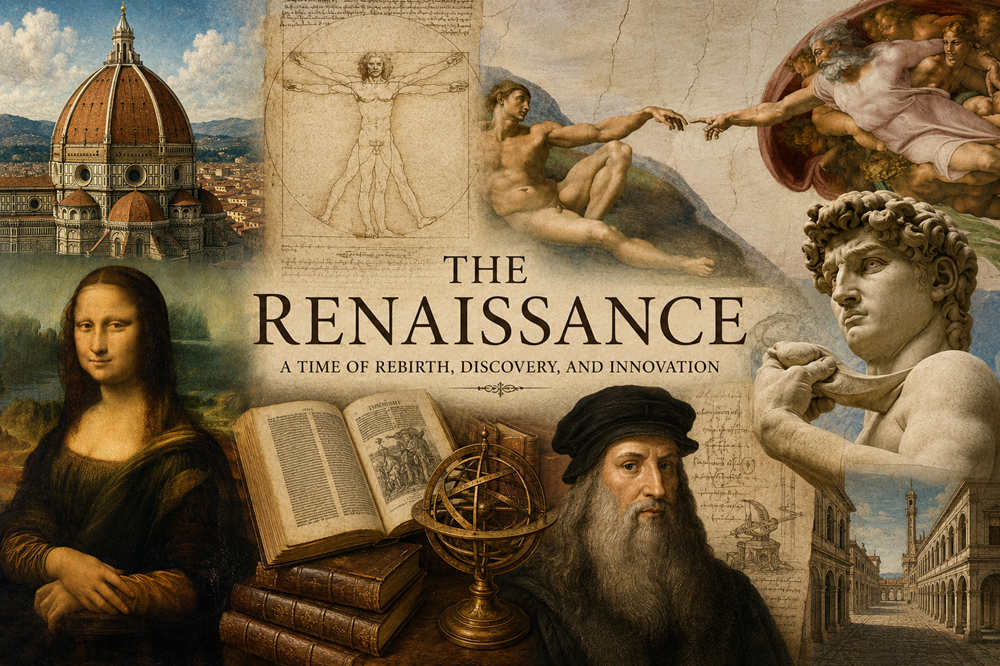
The Renaissance was a major period of change in European history. It began in Italy in the 1300s, reached a high point in the late 1400s and early 1500s, spread across northern Europe, and gradually blended into the early modern period by the late 1500s. This timeline explains the major events, people, artworks, inventions, and ideas that shaped the Renaissance.
What Was the Renaissance?
The word “Renaissance” means “rebirth.” In history, it refers to a period when Europeans renewed their interest in ancient Greek and Roman learning while also creating new forms of art, literature, science, education, and political thought.
The Renaissance did not happen all at once. It grew slowly out of late medieval Europe, especially in wealthy Italian city-states such as Florence, Venice, Milan, and Rome. From there, Renaissance ideas spread through trade, travel, education, diplomacy, war, and the printing press.
One of the most important Renaissance ideas was humanism. Humanists studied classical texts, grammar, rhetoric, poetry, history, and moral philosophy. They believed education could help people think clearly, speak persuasively, serve public life, and understand human experience more deeply.
Quick Renaissance Timeline
| Date or Period | Major Development | Why It Matters |
|---|---|---|
| 1300s | Early Renaissance literature and humanism develop in Italy | Writers and scholars begin looking closely at classical learning and human experience |
| Early 1400s | Florence becomes a leading Renaissance center | Art, architecture, banking, trade, and patronage support new cultural achievements |
| c. 1450s | Movable-type printing spreads in Europe | Books and ideas circulate faster than before |
| Late 1400s | Italian Renaissance art becomes more realistic and technically advanced | Artists study anatomy, perspective, light, movement, and classical models |
| c. 1490s–1527 | The High Renaissance reaches its peak | Leonardo, Michelangelo, and Raphael create some of the best-known works of Renaissance art |
| Early 1500s | The Northern Renaissance grows | Humanism, detailed realism, printmaking, and religious scholarship spread across northern Europe |
| 1517 onward | The Protestant Reformation begins | Religious debate changes European politics, education, art, and society |
| 1543 | Major works by Copernicus and Vesalius are published | Astronomy and anatomy move toward new models based on study, observation, and evidence |
| Late 1500s | Late Renaissance and Mannerism develop | Renaissance styles and ideas shift into the early modern world |
Before the Renaissance: Late Medieval Background
The Renaissance was not a sudden break from the Middle Ages. It developed from changes that were already happening in late medieval Europe.
Italian cities became especially important because they were wealthy, competitive, and connected to trade. Florence, in particular, was a center of banking, craftsmanship, and commerce. That wealth created demand for churches, homes, public buildings, paintings, sculptures, books, and monuments. The National Gallery of Art describes Florence as a center of trade and banking that helped generate broad demand for art.
Universities also helped prepare the ground for Renaissance learning. Medieval scholars had preserved and debated important works in law, medicine, theology, philosophy, and natural science. By the 1300s and 1400s, more scholars became interested in recovering ancient Greek and Roman texts and studying classical languages carefully.
The Black Death of the 1300s also changed European society. The plague caused enormous loss of life, but it also disrupted older social patterns. Labor shortages, shifting wealth, and new questions about death, faith, and human purpose shaped the world in which Renaissance culture grew.
1300s: Early Roots of Renaissance Thought
The early roots of the Renaissance can be seen in literature, scholarship, and art during the 1300s. This period is sometimes called the Trecento, the Italian word for the 1300s.
Dante Alighieri helped show that serious literature could be written in the language of ordinary educated readers, not only in Latin. His Divine Comedy combined Christian theology, classical references, political commentary, and personal reflection.
Francesco Petrarch helped shape Renaissance humanism. He searched for ancient manuscripts, admired Roman writers such as Cicero, and encouraged scholars to study classical literature as a guide to language, ethics, and public life.
Giovanni Boccaccio added another important voice. His Decameron explored human behavior during the plague, including fear, humor, love, greed, survival, and social change. Together, Dante, Petrarch, and Boccaccio helped make Italian literature central to early Renaissance culture.
Art also began to change. Painters such as Giotto gave figures more weight, emotion, and physical presence. Renaissance realism would develop much further later, but the movement toward more human-centered art had already begun.
1400s: The Early Renaissance in Italy
The 1400s were a major period of Renaissance growth, especially in Florence. Artists, architects, scholars, and patrons experimented with new ways to represent space, the body, nature, and classical ideas.
Filippo Brunelleschi transformed architecture by studying ancient Roman buildings and applying mathematical thinking to design. His dome for Florence Cathedral became one of the great engineering achievements of the period. He is also closely associated with the development of linear perspective, a technique that helped artists create the illusion of depth on a flat surface.
Donatello brought new realism and individuality to sculpture. His figures often looked more natural, emotional, and physically present than many earlier medieval works. Masaccio used light, shadow, and perspective to give painted figures a stronger sense of weight and space.
The Medici family helped make Florence a Renaissance center. As bankers and political leaders, they supported artists, architects, scholars, and religious institutions. Patronage mattered because large works of art and architecture usually required wealthy sponsors.
Humanism also became more influential in education. Students studied grammar, rhetoric, poetry, history, and moral philosophy. These subjects were meant to prepare people for public life, leadership, writing, and thoughtful judgment.
1450s: The Printing Press Spreads Renaissance Ideas
The printing press was one of the most important turning points in the Renaissance. Around the 1450s, Johannes Gutenberg helped develop movable-type printing in Europe. The Gutenberg Bible became one of the most famous early books printed in Western Europe with movable metal type.
Before printing, books had to be copied by hand. That made them expensive and limited their circulation. Printing made it easier to produce multiple copies of the same text, which helped spread classical works, religious writings, grammar books, maps, scientific arguments, and political ideas.
Printing did not create the Renaissance by itself, but it changed the speed and scale of communication. Scholars could compare texts more easily. Students could gain access to more books. Religious reformers could circulate arguments quickly. Scientific and historical knowledge could reach readers across borders.
Late 1400s: Renaissance Art Reaches New Levels
By the late 1400s, Renaissance art had become more technically advanced. Artists studied anatomy, light, movement, proportion, landscape, and emotion. They also looked to ancient sculpture and architecture for models of balance, beauty, and order.
Sandro Botticelli created graceful works that often blended classical mythology with Renaissance ideals of beauty and meaning. Leonardo da Vinci began developing his reputation as a painter, engineer, inventor, and close observer of nature.
Italian courts, churches, guilds, and wealthy families commissioned major works of art. Art served many purposes: it taught religious stories, honored rulers, decorated public spaces, expressed civic pride, and displayed wealth.
Florence remained important, but Renaissance culture spread through other Italian centers. Venice developed a rich painting tradition known for color and atmosphere. Rome became increasingly important as popes sponsored major artistic and architectural projects.
c. 1490s–1527: The High Renaissance and Its Peak
The High Renaissance is often seen as the peak of Renaissance art. It flourished from the early 1490s until 1527, when the sack of Rome marked a major turning point for the city and its artistic world.
Leonardo da Vinci created some of the most famous works of the period. The Last Supper, painted in Milan around 1495–1498, showed his interest in emotion, gesture, composition, and psychological drama. The Mona Lisa, usually dated to the early 1500s, became famous for its subtle expression, atmospheric background, and lifelike presence.
Michelangelo Buonarroti brought extraordinary force to sculpture and painting. His marble David, completed in 1504, became a symbol of human strength, civic pride, and artistic mastery. Between 1508 and 1512, he painted the Sistine Chapel ceiling, creating one of the most ambitious fresco projects of the Renaissance.
Raphael became known for harmony, clarity, and graceful composition. His School of Athens, painted in the Vatican from 1508 to 1511, placed ancient philosophers in a grand architectural setting. The work captured the Renaissance admiration for classical thought while also reflecting papal Rome’s cultural ambition.
The High Renaissance brought together religious themes, classical influence, mathematical space, human-centered realism, and technical mastery. Its most famous artists worked in different ways, but together they helped define the visual language of the age.
Early 1500s: The Northern Renaissance
The Renaissance developed differently in northern Europe. In regions such as Germany, the Netherlands, France, and England, Renaissance culture often placed strong emphasis on detailed realism, religious scholarship, moral reform, and printed texts.
Northern artists paid close attention to textures, landscapes, clothing, household objects, and symbolic details. Jan van Eyck helped raise the status of oil painting through precise detail and rich color. Albrecht Dürer combined Italian Renaissance ideas with northern printmaking and careful observation. Pieter Bruegel later became known for scenes of peasant life, landscapes, and moral commentary.
Northern humanists also shaped education and religion. Erasmus of Rotterdam became one of the best-known Christian humanists. He studied ancient languages, edited religious texts, criticized corruption, and argued for a more thoughtful Christian life.
Printing helped northern Renaissance ideas spread quickly. Books, pamphlets, engravings, and translations moved through cities and universities, connecting humanism with wider debates about religion, education, and reform.
1517 and After: Renaissance Ideas and the Reformation
The Renaissance and the Protestant Reformation were not the same movement, but they were connected. Renaissance humanism encouraged close reading of texts. Printing made arguments easier to circulate. Criticism of church practices also grew in many parts of Europe.
In 1517, Martin Luther wrote the Ninety-Five Theses, a set of arguments against the sale of indulgences and other church practices. The document became a central text of the Protestant Reformation.
Printed pamphlets, sermons, translations, and debates helped Reformation ideas move far beyond one university town. Religious disagreement soon affected rulers, cities, schools, laws, and political alliances.
The Reformation also changed art. In some Protestant regions, religious images were removed, limited, or treated with suspicion. In Catholic regions, art remained an important tool for teaching, devotion, and church authority. By the mid-1500s, Europe had become more religiously divided than it had been before.
Mid-1500s: Science, Exploration, and New Worldviews
Renaissance curiosity helped shape astronomy, medicine, geography, navigation, and the study of nature. Scholars increasingly compared sources, tested older authorities, and paid attention to observation, even when they still worked within inherited traditions.
European exploration changed maps, trade routes, and global contact. It connected Europe more directly with Africa, Asia, and the Americas. These voyages also led to conquest, colonization, forced labor, and devastating consequences for Indigenous peoples. A balanced Renaissance timeline should recognize both the expansion of knowledge and the violence that often accompanied European expansion.
In 1543, Nicolaus Copernicus published De revolutionibus orbium coelestium, which argued that Earth moves around the sun. His heliocentric model challenged the older Earth-centered view of the universe and influenced later astronomers.
That same year, Andreas Vesalius published De humani corporis fabrica, a major work on human anatomy. Vesalius emphasized direct study of the body and helped correct errors inherited from ancient medical authorities.
These developments did not complete the Scientific Revolution, but they helped prepare for it. Renaissance learning encouraged scholars to ask new questions, compare evidence, and share discoveries through print.
Late Renaissance and Mannerism
After the High Renaissance, European art did not simply repeat the balanced style of Leonardo, Michelangelo, and Raphael. Many artists moved toward Mannerism, a style that often used elongated figures, unusual poses, dramatic colors, crowded spaces, and emotional tension.
Mannerism reflected a changing world. Religious conflict, political instability, and war affected many parts of Europe. The sack of Rome in 1527 weakened the city as a stable artistic center and pushed artists and writers into new environments.
By the late 1500s, Renaissance ideas had spread widely through schools, courts, churches, workshops, and printed books. The Renaissance gradually blended into the early modern period, influencing art, science, politics, religion, and education for centuries.
Key People in the Renaissance Timeline
Petrarch
Petrarch helped shape humanism by searching for ancient texts and encouraging scholars to study classical literature for language, ethics, and historical understanding.
Brunelleschi
Brunelleschi changed Renaissance architecture through engineering, classical design, and mathematical space. His work helped connect art with geometry and practical construction.
Donatello
Donatello gave sculpture a stronger sense of realism, movement, and individual character. His work helped revive interest in classical form while keeping religious subjects emotionally powerful.
Gutenberg
Gutenberg’s printing technology changed how books were produced and shared. Printing became one of the main reasons Renaissance, Reformation, and scientific ideas spread so widely.
Leonardo da Vinci
Leonardo joined art with anatomy, engineering, optics, movement, and natural observation. His notebooks show the broad curiosity often associated with Renaissance learning.
Michelangelo
Michelangelo worked as a sculptor, painter, architect, and poet. His art gave the human body dramatic physical and spiritual force.
Raphael
Raphael became known for clarity, balance, and graceful design. His Vatican frescoes connected classical philosophy, Christian Rome, and Renaissance ideals of order.
Erasmus
Erasmus used humanist scholarship to study Christian texts and criticize moral corruption. His work shows how Renaissance learning could support religious reform without immediately breaking from the Catholic Church.
Machiavelli
Niccolò Machiavelli studied politics as it worked in real life, especially in the competitive world of Italian city-states. His writings helped shape later political thought.
Copernicus
Copernicus challenged the Earth-centered model of the universe. His heliocentric theory became a major step toward new scientific thinking in early modern Europe.
Major Ideas That Shaped the Renaissance
Humanism
Humanism encouraged people to study classical texts, history, language, ethics, and public life. It helped make education central to Renaissance culture.
Classical Learning
Renaissance scholars and artists looked to ancient Greece and Rome for models of beauty, argument, architecture, literature, and civic life. They used the ancient past to create new work, not simply to copy it.
Patronage
Patronage allowed artists and scholars to produce major works. Popes, rulers, merchants, guilds, and wealthy families paid for paintings, sculptures, buildings, books, and public monuments.
Perspective and Realism
Renaissance artists used perspective, anatomy, proportion, and careful observation to create more believable images. These methods changed European painting and sculpture.
Printing
Printing helped ideas move across Europe faster than before. It changed education, religion, science, politics, and public debate.
Observation and Evidence
Renaissance thinkers increasingly studied nature, the body, and the heavens through observation and comparison. This approach helped prepare the way for the Scientific Revolution.
Conclusion
The Renaissance timeline shows a long period of change, not one single event. It began with late medieval conditions, grew through Italian humanism and art, spread through printing and education, and helped reshape religion, politics, science, and culture.
By the late 1500s, Europe had not become fully modern, but it had changed in lasting ways. Renaissance artists, writers, scholars, printers, and scientists connected old knowledge with new questions. That combination helped shape the early modern world and left an influence that can still be seen in art, education, literature, and historical study today.