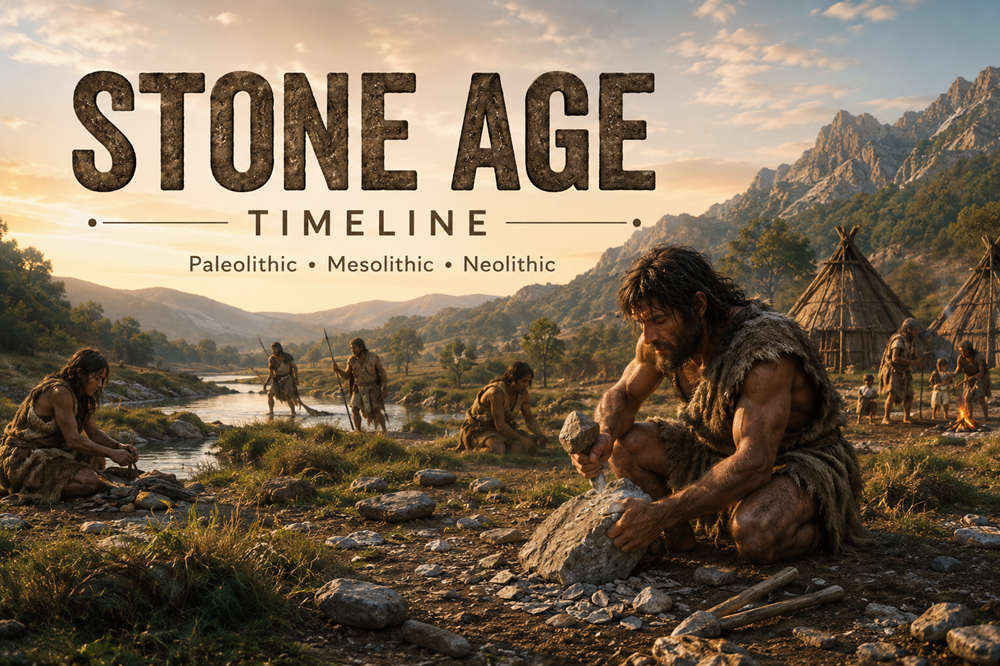
The Stone Age was the longest stage of human prehistory. It began millions of years before written records and lasted until people in different regions gradually adopted metal tools. During this long period, stone tools helped early humans hunt, cut, scrape, build, prepare food, and survive in changing environments.
The Stone Age is usually divided into three main periods: the Paleolithic, Mesolithic, and Neolithic. These divisions are helpful for studying prehistory, but they should not be treated as one exact worldwide schedule. Different regions changed at different times, especially when farming and metalworking began.
This timeline gives a broad overview of the major stages in early human life, from the first known stone tools to the rise of farming communities.
Stone Age Timeline at a Glance
BCE means “Before Common Era,” so larger BCE numbers are farther back in time. Because the Stone Age covers such a long span of prehistory, many dates are approximate.
| Period or Development | Approximate Date | Main Features | Why It Matters |
|---|---|---|---|
| Earliest known stone tools | About 3.3 million years ago | Simple stone flakes, cores, and pounding tools | Shows that early human relatives could shape materials for practical use |
| Oldowan tool tradition | About 2.6 million years ago | Hammerstones, sharp flakes, and stone cores | Marks one of the earliest widespread stone tool traditions |
| Acheulean tool tradition | About 1.76 million years ago | Hand axes and large cutting tools | Shows greater planning and skill in shaping tools |
| Middle Paleolithic / Middle Stone Age in some regional systems | Roughly 400,000 to 40,000 years ago, varying by region | More specialized flake tools, prepared cores, and varied hunting strategies | Shows gradual improvements in technology and adaptation |
| Upper Paleolithic | Roughly 50,000 to 12,000 years ago | More visible art, ornaments, bone tools, and symbolic culture | Reveals increasingly complex social and creative life |
| Mesolithic | After the last Ice Age, often beginning around 10,000 BCE in parts of the Eastern Hemisphere | Microliths, fishing tools, seasonal camps, and varied hunter-gatherer life | Acts as a bridge between Ice Age hunting and later farming societies |
| Neolithic | Beginning roughly between 10,000 and 9,000 BCE in parts of Southwest Asia, later elsewhere | Farming, domestication, polished stone tools, pottery, and villages | Transforms food production, settlement, and social organization |
| End of the Stone Age | Different dates by region | Gradual use of copper, bronze, and later iron | Marks the transition from stone-based technology to metalworking |
Early Stone Tools: Before the Main Stone Age Periods
The earliest part of the Stone Age reaches so far back in time that it came before modern humans. The oldest known stone tools date to about 3.3 million years ago. These early tools were simple compared with later hand axes or polished stone axes, but they were still a major step in human development.
Early toolmakers shaped stone by striking one rock against another. This could create sharp flakes for cutting, stone cores left after flakes were removed, or hammerstones used for pounding and breaking. These tools may have helped early hominins cut meat, crack bones, process plants, and work with other materials.
By at least 2.6 million years ago, Oldowan toolkits became one of the earliest widespread stone tool traditions. They included hammerstones, stone cores, and sharp flakes. These tools were not complicated, but they were useful and flexible. A single sharp flake could help with many everyday survival tasks.
This early technology matters because it shows that survival depended on more than physical strength. Toolmaking required observation, memory, and the ability to solve practical problems using materials from the surrounding environment.
Paleolithic Timeline: The Old Stone Age
The Paleolithic, or Old Stone Age, was the longest part of the Stone Age. It stretched from the earliest stone tools to the end of the last Ice Age. Most Paleolithic communities lived by hunting, gathering, fishing, and moving with seasonal resources.
Because the Paleolithic lasted for such a long time, archaeologists often divide it into early, middle, and upper stages. These stages help organize the timeline of toolmaking, migration, and cultural development.
Early Paleolithic: The First Major Tool Traditions
The Early Paleolithic includes some of the oldest stone tool traditions. At first, tools were often simple flakes, cores, and hammerstones. Over time, toolmaking became more controlled.
One major development was the Acheulean hand axe. By about 1.76 million years ago, early humans were making large cutting tools shaped on both sides. These tools were more symmetrical than earlier Oldowan tools and often required more planning to make.
A hand axe could be used for cutting, chopping, scraping, or butchering animals. Its importance is not only in what it did, but also in what it shows about early human behavior. Toolmakers had to choose the right stone, imagine a useful shape, and strike the material carefully enough to produce it.
Middle Paleolithic: Neanderthals, Early Humans, and Changing Tool Use
The Middle Paleolithic was marked by more specialized toolmaking. Instead of relying mainly on large core tools, many groups made sharper and more predictable flakes. These could be used for cutting meat, scraping hides, working wood, or preparing food.
This period also included different human groups, including Neanderthals in Europe and western Asia and early Homo sapiens in Africa. They lived in varied environments, from cold Ice Age landscapes to grasslands, forests, and coastal areas.
Tools from this period often show careful preparation. Some toolmakers shaped a stone core first so that flakes could be struck from it in planned forms. This made tool production more efficient and helped people adapt to different tasks.
Fire, shelter, clothing, cooperation, and knowledge of local landscapes were also important. People lived in small groups and relied on careful observation of animals, plants, weather, and seasonal change.
Upper Paleolithic: Art, Symbolism, and Wider Human Culture
The Upper Paleolithic is often remembered for art and symbolic culture. People still hunted and gathered, but the archaeological record from this period shows more visible signs of creativity, identity, and shared meaning.
Cave paintings, carved figures, beads, ornaments, decorated tools, and objects made from bone or antler appear in many regions. The Metropolitan Museum of Art’s overview of prehistoric art discusses works from about 20,000 to 8,000 BCE, a time before formal writing when people expressed ideas through images and objects.
Upper Paleolithic art does not always have a clear meaning today. Some images may have been connected to hunting, memory, ritual, teaching, storytelling, or group identity. What matters for a Stone Age timeline is that people were doing more than meeting basic needs. They were also creating symbols and passing meaning through objects and images.
This period also saw wider human movement. By the later Paleolithic, humans had spread across many parts of the world and adapted to deserts, forests, tundra, coastlines, and open plains.
Mesolithic Timeline: The Transitional Stone Age
The Mesolithic was a transitional period between the Paleolithic and Neolithic in many broad European-style timelines. It is sometimes called the Middle Stone Age in general summaries, but archaeologists use regional terms carefully. In African archaeology, for example, “Middle Stone Age” can refer to a different period than the European Mesolithic.
The Mesolithic is most often used to describe post-Ice Age hunter-gatherer societies in parts of Europe and the Eastern Hemisphere. It began after the last Ice Age, when climates warmed, forests expanded, sea levels rose, and people adjusted to new food sources.
Mesolithic communities still hunted and gathered, but their tools and habits often became more specialized. One important tool type was the microlith, a very small stone blade or point. Microliths could be fitted into wooden or bone handles to make arrows, spears, sickles, or cutting tools.
Fishing, shellfish gathering, river travel, and seasonal camps became important in many areas. Some groups moved between different places during the year, following fish runs, animal migrations, plant harvests, or weather patterns. Others became more settled in areas where food was abundant.
The Mesolithic shows that the shift toward farming was not immediate. Many communities created successful ways of life without agriculture, using detailed knowledge of their local environments.
Neolithic Timeline: The New Stone Age
The Neolithic, or New Stone Age, was the final major stage of the Stone Age. It is closely connected with farming, domesticated animals, polished stone tools, pottery, permanent settlements, and new forms of community life.
The Neolithic Period did not begin everywhere at once. In parts of Southwest Asia, farming developed roughly between 10,000 and 9,000 BCE. In other regions, agriculture appeared later, and many communities continued hunting and gathering for thousands of years.
Farming and Domestication
The biggest Neolithic change was the gradual move toward farming and domestication. Instead of relying only on wild plants and animals, some communities began planting crops, managing herds, and saving seeds for future harvests.
Important early crops varied by region. Wheat and barley were important in parts of Southwest Asia. Rice became central in parts of East Asia. Maize was later domesticated in the Americas. Animals such as goats, sheep, cattle, pigs, and dogs also became important in many farming societies.
This change is sometimes called the Neolithic Revolution, but the word “revolution” can make it sound too sudden. Farming developed over many generations. People experimented with plants and animals, combined farming with older food-gathering habits, and slowly changed how they lived.
Farming did not automatically make life easier. It could provide more dependable food in some places, but it also required hard labor, planning, storage, and protection of land and supplies. Even so, it changed human history by supporting larger and more permanent communities.
Permanent Settlements and Village Life
As farming spread, more people began living in permanent or semi-permanent settlements. A farming family could not always move as often as a hunter-gatherer group because crops needed planting, tending, harvesting, and storage.
Villages allowed people to build stronger homes, store grain, raise animals, and develop new skills. Some people could spend more time making pottery, weaving cloth, building tools, or organizing community projects. Over time, food storage and population growth helped create more complex social relationships.
Permanent settlement also created new challenges. People living close together had to manage waste, disease, conflict, property, and cooperation. They needed ways to share land, water, animals, harvests, and labor. These challenges helped shape later forms of organized society.
Polished Stone Tools, Pottery, and Megaliths
Neolithic technology was still based largely on stone, but tools became more varied. Polished stone axes could clear trees and shape wood more effectively than many earlier chipped tools. Grinding stones helped process grain into flour. Sickles helped cut crops. Pottery made it easier to store, cook, and transport food.
These tools show how daily life changed. A hunter’s toolkit was different from a farmer’s toolkit. Farming communities needed equipment for clearing land, planting, harvesting, grinding, cooking, and storage.
Some Neolithic communities also built large monuments, including tombs, stone circles, and other megalithic structures. These projects required planning, labor, and cooperation. They suggest that shared beliefs, ceremonies, or community identity played an important role in social life.
How the Stone Age Ended
The Stone Age ended gradually as people in different regions learned to use metals for tools, weapons, ornaments, and trade goods. There was no single worldwide end date.
In some places, copper was used before bronze. Copper could be hammered into shapes, but bronze, usually made from copper and tin, was stronger and more useful for many tools and weapons. As bronze technology spread, many regions entered what historians call the Bronze Age.
Stone tools did not disappear immediately. Many people continued to use stone alongside metal because stone was available, familiar, and effective for certain tasks. In some parts of the world, stone remained important long after metal tools became common elsewhere.
This gradual transition is one reason Stone Age timelines must be studied region by region. Metalworking spread unevenly, just as farming had done.
Stone Age Timeline Summary
The Stone Age was a vast period of human prehistory that began with the earliest known stone tools and ended gradually with the spread of metalworking. It included many different people, places, climates, and ways of life.
The Paleolithic, or Old Stone Age, was the longest stage. It was marked by early tools, hunting and gathering, migration, Ice Age environments, and the slow development of human technology and culture.
The Mesolithic was a transitional period in many regions after the last Ice Age. It included microlith tools, fishing, seasonal camps, and flexible hunter-gatherer lifeways.
The Neolithic brought farming, domesticated animals, permanent villages, polished stone tools, pottery, and larger communities. It changed food production and settlement patterns, though it did not happen everywhere at the same time.
In study terms, the Stone Age is important because it shows how human history began with tools, adaptation, cooperation, and culture long before written records.