The Crusades were a series of religiously framed military campaigns that shaped medieval history across western Europe, the Byzantine world, North Africa, and the eastern Mediterranean. The best-known Crusades focused on Jerusalem and the Holy Land, although the wider crusading movement also reached other regions and continued in different forms after 1291.
This Crusades timeline focuses mainly on the major Holy Land campaigns from 1095 to 1291. That period begins with Pope Urban II’s call for the First Crusade and ends with the fall of Acre, the last major Crusader stronghold on the mainland. Studying the timeline helps explain how religion, politics, warfare, diplomacy, and regional rivalries became connected over nearly two centuries.
Background Before the Crusades
Before the Crusades began, Jerusalem was already one of the most important religious cities in the world. It was sacred to Christians, Muslims, and Jews, and Christian pilgrims had traveled there for centuries. By the late 1000s, however, western Europeans increasingly viewed the Holy Land through the language of pilgrimage, military action, and religious duty.
The Byzantine Empire also played a key role in the background. Byzantine rulers faced pressure from Seljuk Turkish expansion in Anatolia, a region that had long been central to Byzantine power. When the Byzantine emperor asked western Europe for help, the request reached a papacy that was trying to strengthen its authority.
The result was not simply a military alliance. The Crusades mixed armed pilgrimage, religious devotion, papal leadership, noble ambition, land hunger, and political strategy. They involved Latin Christians, Byzantine Christians, Muslim rulers and communities, Jewish communities, merchants, nobles, peasants, and military orders. Because of that, the Crusades should not be reduced to a simple conflict between two sides.
1095: Pope Urban II Calls for the First Crusade
The traditional starting point of the Crusades is 1095, when Pope Urban II preached at the Council of Clermont in France. His message called on western Christians to travel east and take up arms. The campaign was presented as an armed pilgrimage meant to help eastern Christians and recover Jerusalem.
This call mattered because it gave papal approval to a military expedition and connected warfare with spiritual reward. For many participants, the journey was dangerous, expensive, and uncertain, but it was also presented as a sacred mission.
The response was larger than expected. Nobles, knights, clergy, and ordinary people joined different waves of the movement. Some groups were poorly organized and suffered heavily before reaching the eastern Mediterranean. Others became part of the main expedition later known as the First Crusade.
1096–1099: The First Crusade
The First Crusade lasted from 1096 to 1099 and became the only major Crusade to achieve its central goal in a direct military sense. Crusader armies traveled across Europe, through Byzantine territory, and into the eastern Mediterranean. The journey was difficult, and relations between the Crusaders and Byzantines were often tense.
One major victory came with the capture of Antioch in 1098. Antioch was a strategic city and a gateway into Syria and the Holy Land. Its capture gave the Crusaders a stronger position, but it also revealed divisions among their leaders. Different nobles wanted land, status, and influence, and those ambitions did not always match the stated religious goal of reaching Jerusalem.
In 1099, the Crusaders reached Jerusalem and captured the city after a siege. The conquest was violent and devastating for many of the city’s inhabitants. For the Crusaders, however, the capture of Jerusalem was seen as a major religious and military victory. It also changed the political map of the eastern Mediterranean.
1099–1144: Crusader States and Fragile Control
After Jerusalem fell, the Crusaders created several Latin Christian states in the region. These included the Kingdom of Jerusalem, the County of Edessa, the Principality of Antioch, and the County of Tripoli. Together, they are often called the Crusader states.
The Crusader states depended on fortified cities, castles, coastal ports, military orders, local alliances, and continued support from Europe. They were not simple copies of western European kingdoms. They existed in a region with many languages, religions, cultures, and political powers.
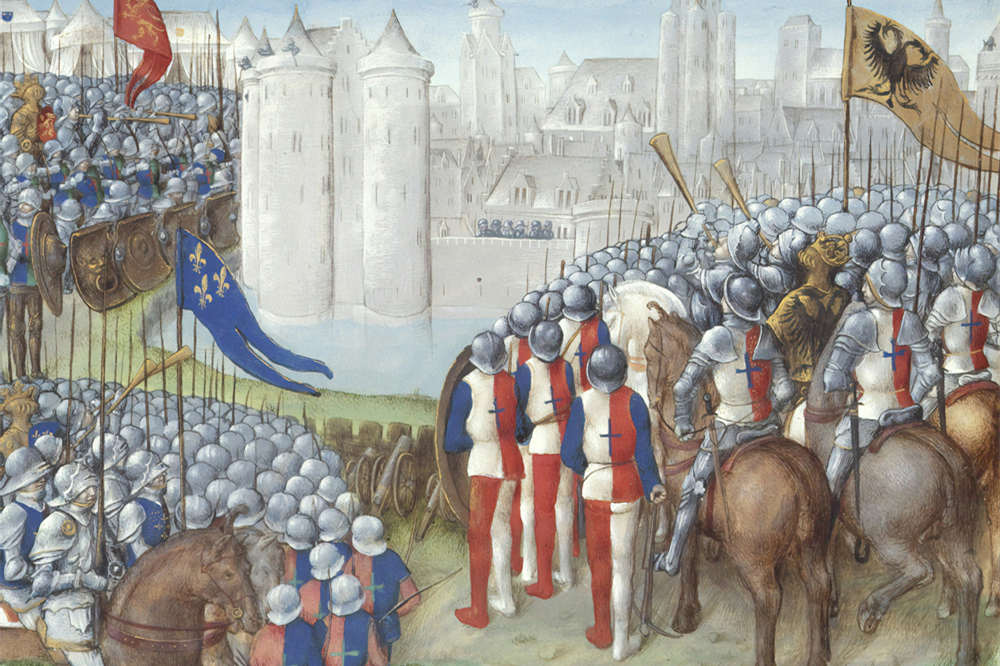
The Crusades from 1095 to 1291 left a visible mark on the landscape through castles, churches, ports, and fortified towns. These structures helped defend territory far from western Europe, but the Crusader states remained vulnerable because they were surrounded by larger and more established regional powers.
1144–1149: The Second Crusade
The Second Crusade began as a response to the fall of Edessa in 1144. Edessa was the first Crusader state established after the First Crusade, and its loss shocked Latin Christian leaders. The event showed that the gains of 1099 were not secure.
In Europe, the loss of Edessa inspired calls for another major expedition. Pope Eugenius III supported the new crusade, and rulers such as Louis VII of France and Conrad III of Germany joined the effort. Unlike the First Crusade, however, the Second Crusade failed to achieve its main goals in the eastern Mediterranean.
The failure damaged confidence in crusading leadership. It also showed that enthusiasm alone was not enough. Long-distance campaigns required planning, supplies, cooperation, and realistic strategy. The Second Crusade made clear that defending the Crusader states would be harder than capturing Jerusalem had been.
1187: Saladin Captures Jerusalem
One of the most important turning points in the Crusades came in 1187. Saladin, the Muslim ruler who had united Egypt and Syria under his leadership, defeated the Crusader army at the Battle of Hattin. This victory weakened the Crusader states and opened the way for Saladin to recapture Jerusalem.
The loss of Jerusalem had enormous symbolic power. The First Crusade had been remembered in western Europe as a holy victory, and Jerusalem was the emotional center of the movement. When Saladin captured the city, western Europe reacted with alarm and grief.
Saladin’s victory also changed the balance of power in the region. The Crusaders still held some coastal cities, but their position was much weaker. The recapture of Jerusalem directly led to the Third Crusade, one of the most famous campaigns in the Crusades timeline.
1189–1192: The Third Crusade
The Third Crusade took place from 1189 to 1192. It is sometimes called the Kings’ Crusade because several major European monarchs became involved. The best-known leaders were Richard I of England, Philip II of France, and Frederick I Barbarossa of the Holy Roman Empire. Saladin remained the central Muslim leader on the other side.
Frederick I joined the campaign but died on the journey east, weakening the German contribution before it could fully reach the Holy Land. Philip II later returned to France, leaving Richard I as the most famous European leader of the campaign.
The Crusaders captured Acre after a long siege and regained some important coastal territory. Richard won military victories and became famous in later European memory as Richard the Lionheart. However, the Crusaders did not retake Jerusalem.
The Third Crusade ended with an agreement that allowed Christian pilgrims access to Jerusalem while the city remained under Muslim control. The result was not a full Crusader victory, but it did preserve a reduced Latin Christian presence along parts of the coast.
1202–1204: The Fourth Crusade
The Fourth Crusade is one of the most controversial events in medieval history. It was originally intended to continue the struggle for the Holy Land, but it was diverted away from its original target. Instead of fighting Muslim powers in the eastern Mediterranean, the Crusaders became entangled in financial and political conflicts involving Venice and the Byzantine Empire.
In 1204, the Crusaders attacked and sacked Constantinople, the capital of the Byzantine Empire. The sack of Constantinople shocked the medieval world because Constantinople was a Christian city. The event deepened the division between Latin western Christians and Greek eastern Christians.
The Fourth Crusade weakened the Byzantine Empire and redirected crusading energy away from Jerusalem. It also showed how crusading ideals could be overtaken by debt, ambition, and rivalry. For students, this campaign is important because it challenges the idea that every Crusade followed one clear religious purpose.
1217–1221: The Fifth Crusade
The Fifth Crusade shifted attention toward Egypt. Crusade leaders believed that Egypt was a key center of Muslim political and economic power. If Egypt could be pressured or defeated, they hoped Jerusalem might become easier to recover.
The main focus became Damietta, an important city near the Nile Delta. Crusader forces captured Damietta, but they struggled to turn that victory into lasting success. The campaign became difficult because of poor coordination, uncertain leadership, and the challenge of fighting in unfamiliar terrain.
Eventually, the Crusaders were forced to surrender their gains and withdraw. The Fifth Crusade failed, but it shaped later strategy by encouraging another major attempt through Egypt.
1228–1229: The Sixth Crusade
The Sixth Crusade was unusual because it achieved its most famous result through diplomacy rather than major battlefield victory. It was led by Frederick II, the Holy Roman Emperor, who had long promised to go on crusade. His relationship with the papacy was tense, and he carried out the campaign while under excommunication.
In 1229, Frederick negotiated with al-Kamil, the Ayyubid ruler of Egypt. Through the Treaty of Jaffa, Jerusalem came under Christian control for a limited period, along with access to other important holy sites. The Sixth Crusade stands out because it recovered Jerusalem without a major siege of the city.
This success was fragile. The agreement depended on political circumstances, and Jerusalem’s status remained unstable. Still, the Sixth Crusade is an important reminder that diplomacy could sometimes achieve what armies could not.
1244: Jerusalem Is Lost Again
Frederick II’s diplomatic recovery of Jerusalem did not last. In 1244, Jerusalem was captured again, ending the brief period of Christian control that had followed the Sixth Crusade. This event is an important part of the Crusades timeline because it explains why later crusading efforts continued.
A medieval account preserved in the Medieval Sourcebook on the capture of Jerusalem in 1244 shows how deeply the event alarmed Latin Christian observers. For western Europeans who still hoped to recover the Holy Land, the loss reinforced the idea that another major expedition was needed.
The fall of Jerusalem in 1244 helped set the stage for Louis IX of France and the Seventh Crusade. It also showed that negotiated control of holy sites could disappear quickly when regional politics changed.
1248–1254: The Seventh Crusade
The Seventh Crusade was led by Louis IX of France, later remembered as Saint Louis. Louis followed an Egypt-first strategy, hoping that pressure on Egypt would open a path toward Jerusalem.
Louis and his forces captured Damietta in 1249, but the campaign soon ran into serious problems. The Crusaders struggled with disease, supply issues, local resistance, and difficult military conditions. In 1250, Louis was captured after defeat near Mansurah and later ransomed.
The Seventh Crusade ended in failure, but Louis remained committed to crusading. His campaign showed both the continuing power of crusading ideals and the growing difficulty of successful large-scale expeditions in the eastern Mediterranean.
1270: The Eighth Crusade
The Eighth Crusade was also led by Louis IX of France. Instead of going directly to the Holy Land or Egypt, the campaign went to Tunis in North Africa. The reasons behind this choice involved strategy, politics, and hopes of gaining influence in the wider Mediterranean.
The campaign quickly failed. Disease spread through the army, and Louis IX died in 1270. Without his leadership, the expedition lost momentum. The Eighth Crusade did not recover Jerusalem or strengthen the Crusader states in a lasting way.
By this point, large crusading expeditions were becoming harder to organize and sustain. European rulers had other priorities, and the remaining Crusader positions in the Holy Land were increasingly vulnerable.
1271–1272: Edward’s Expedition to Acre
Some timelines include Edward of England’s 1271–1272 expedition, often called the Ninth Crusade. Edward, who later became King Edward I, reached Acre and tried to support the remaining Crusader position in the region.
The campaign did not reverse the larger decline of Crusader power. It was smaller than earlier crusades and could not restore Jerusalem or rebuild the strength of the Crusader states. Still, it is useful to mention because many students encounter it in lists of numbered Crusades.
Edward’s expedition shows how the crusading movement continued after Louis IX’s death, but with less ability to change the military situation in the Holy Land.
1291: The Fall of Acre
The fall of Acre in 1291 is often treated as the end of the main Crusader presence on the mainland of the Holy Land. Acre was a major port and one of the most important remaining centers of Crusader power. After Jerusalem was lost, coastal strongholds like Acre became essential for trade, defense, and communication with Europe.
In 1291, Mamluk forces captured Acre after a major siege. The Siege of Acre forced surviving Crusaders to retreat from the mainland, many of them to Cyprus. Although crusading ideas did not disappear overnight, the fall of Acre ended the major Holy Land Crusades as a practical military project.
This final event closes the main Crusades timeline from 1095 to 1291. The movement had lasted nearly two centuries, but it ended without permanent western European control of Jerusalem or the Holy Land.
Crusades Timeline at a Glance
| Date | Event | Why It Matters |
|---|---|---|
| 1095 | Pope Urban II calls for the First Crusade | Marks the traditional beginning of the crusading movement. |
| 1096–1099 | The First Crusade | Crusader armies travel east and capture Jerusalem. |
| 1099 | Jerusalem captured by Crusaders | Leads to the creation of Crusader states in the eastern Mediterranean. |
| 1144 | Edessa falls | The first Crusader state is lost, triggering the Second Crusade. |
| 1147–1149 | The Second Crusade | Fails to recover Edessa and reveals Crusader weakness. |
| 1187 | Saladin captures Jerusalem | One of the greatest turning points in the Crusades timeline. |
| 1189–1192 | The Third Crusade | Regains some coastal territory but not Jerusalem. |
| 1202–1204 | The Fourth Crusade | Ends with the sack of Constantinople instead of a campaign for Jerusalem. |
| 1217–1221 | The Fifth Crusade | Targets Egypt but fails to secure a lasting victory. |
| 1228–1229 | The Sixth Crusade | Frederick II regains Jerusalem temporarily through diplomacy. |
| 1244 | Jerusalem is lost again | Ends the temporary recovery achieved after the Sixth Crusade. |
| 1248–1254 | The Seventh Crusade | Louis IX’s Egyptian campaign fails after early gains. |
| 1270 | The Eighth Crusade | Louis IX dies during the Tunis campaign. |
| 1271–1272 | Edward’s expedition to Acre | Shows continued crusading efforts, but without major recovery. |
| 1291 | Acre falls to the Mamluks | Ends the major Crusader presence on the mainland of the Holy Land. |
Conclusion
The Crusades timeline is important because it shows how medieval events were connected across many regions. A speech in France, a request from Byzantium, battles in Syria, campaigns in Egypt, politics in Venice, and sieges in Jerusalem and Acre all belonged to the same wider historical story.
From Pope Urban II’s call in 1095 to the fall of Acre in 1291, the Crusades affected rulers, soldiers, pilgrims, merchants, and local communities across the Mediterranean world. The story is not only about battles. It is also about shifting alliances, fragile victories, failed plans, and the limits of power. Studying the timeline helps readers understand why the Crusades remain one of the defining subjects of medieval world history.