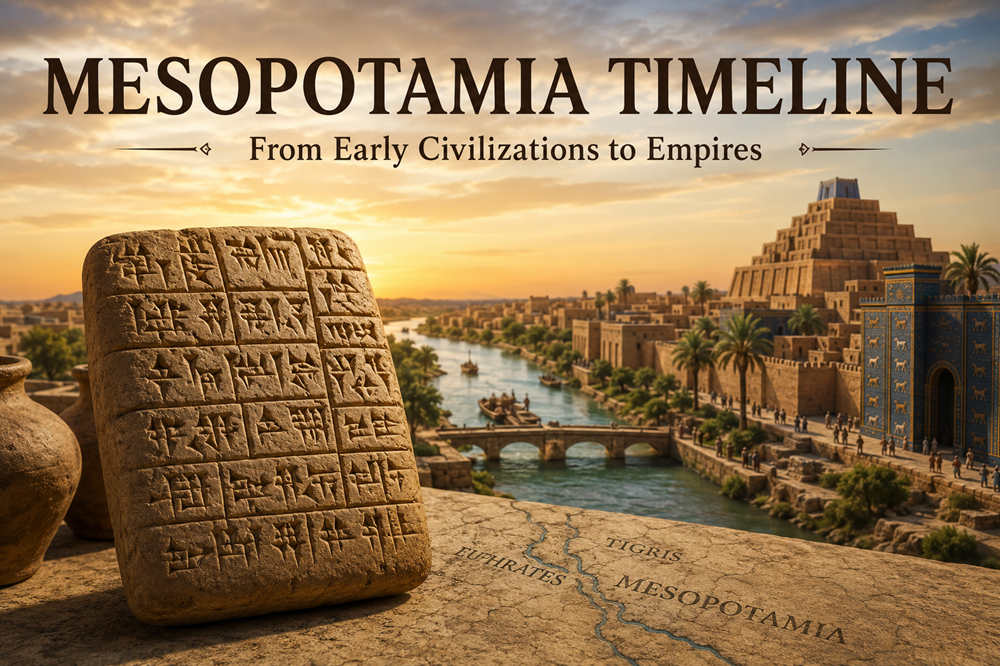
Mesopotamia was one of the earliest centers of civilization in world history. Located between the Tigris and Euphrates rivers, it became home to farming villages, city-states, writing, law codes, temple complexes, trade networks, and powerful empires. Use this Mesopotamia timeline as a study guide to the major periods, rulers, cities, and changes that shaped the land often called the “land between rivers.”
Mesopotamian history stretches from early farming communities before 4000 BCE to major civilizations such as Sumer, Akkad, Babylon, and Assyria, followed by Persian and later imperial rule after 539 BCE. Many early dates are approximate because ancient Near Eastern chronology is not always fixed, especially for the earlier periods. For that reason, this article uses terms such as “c.” and “around” where dates may vary by source.
Where Was Mesopotamia?
Mesopotamia was a historical region in Southwest Asia, mostly in the area of modern Iraq, with connections to parts of Syria, Turkey, Iran, and Kuwait. The name comes from Greek words meaning “between rivers,” referring to the Tigris and Euphrates. The University of Chicago’s Institute for the Study of Ancient Cultures describes Mesopotamia as the “land between the rivers,” a term often used for the area roughly equivalent to modern Iraq.
The rivers shaped life in the region. Their water made farming possible in a dry environment, but communities had to manage canals, fields, floods, and seasonal changes. In southern Mesopotamia especially, irrigation helped farmers produce food surpluses that supported larger settlements.
Geography also encouraged trade and conflict. Mesopotamia had fertile land, but it lacked some important resources such as large supplies of timber, stone, and metal. Cities often traded with neighboring regions, while rulers competed for land, water, labor, and trade routes.
Learn more: University of Chicago ISAC overview of Mesopotamia.
Mesopotamia Timeline Table
| Date / Period | Major Power or Culture | Key Developments | Why It Matters |
|---|---|---|---|
| c. 10,000–4000 BCE | Early farming communities | Settled villages, farming, animal domestication, pottery, and early irrigation | Created the foundation for later urban life |
| c. 4000–3100 BCE | Uruk period | Growth of large cities, temple administration, trade, and early writing | Marked one of the world’s earliest phases of urban civilization |
| c. 2900–2350 BCE | Sumerian city-states | City-states such as Ur, Uruk, Lagash, Kish, and Nippur developed | Established many political, religious, and cultural patterns of Mesopotamia |
| c. 2350–2150 BCE | Akkadian Empire | Sargon of Akkad united many cities under imperial rule | Often considered one of the first major empires in world history |
| c. 2112–2004 BCE | Third Dynasty of Ur | Ur reunified southern Mesopotamia and expanded centralized administration | Shows how earlier systems of government and recordkeeping had matured |
| c. 2000–1600 BCE | Old Babylonian period | Babylon rose under Hammurabi and became a major power | Produced one of the most famous law collections of the ancient world |
| c. 1600–1000 BCE | Kassites, Mitanni, and Middle Assyria | Regional kingdoms competed and interacted across the Near East | Connected Mesopotamia to wider diplomacy, trade, and warfare |
| c. 911–612 BCE | Neo-Assyrian Empire | Assyria built a vast military empire with capitals such as Nimrud and Nineveh | Created one of the ancient Near East’s most powerful imperial systems |
| 612–539 BCE | Neo-Babylonian Empire | Babylon rose again under kings such as Nebuchadnezzar II | Represents the last major independent Babylonian empire |
| 539 BCE onward | Persian and later empires | Persian, Greek, Seleucid, and Parthian powers ruled the region | Mesopotamia remained a major crossroads after native empires declined |
Key Terms to Know
| Term | Meaning |
|---|---|
| City-state | An independent city with its own government, land, ruler, temples, and local identity. |
| Cuneiform | A wedge-shaped writing system pressed into clay tablets. |
| Ziggurat | A large stepped temple platform built in some Mesopotamian cities. |
| Empire | A state that controls many peoples, cities, or regions under one ruling power. |
| Irrigation | The controlled movement of water to fields for farming. |
Before Cities: Early Settlement and Farming, c. 10,000–4000 BCE
Long before the famous kingdoms of Sumer, Babylon, and Assyria, people in and around Mesopotamia began moving toward settled life. Instead of relying only on hunting and gathering, communities gradually grew crops, raised animals, and built more permanent villages.
This shift happened over thousands of years. Early farmers learned to grow grains and legumes, make pottery, build houses, and organize village life. In northern Mesopotamia, rainfall could support some farming. In the drier south, irrigation became increasingly important.
As villages grew, society became more complex. People began to specialize in different kinds of work, including farming, pottery, weaving, building, and early metalworking. These changes did not create cities immediately, but they prepared the way for larger settlements and more organized communities.
The Uruk Period and the Rise of Cities, c. 4000–3100 BCE
The Uruk period was one of the great turning points in Mesopotamian history. During this era, large settlements expanded into true cities, especially in southern Mesopotamia. Uruk became one of the most important early urban centers in the world.
City life required more planning than village life. Temples managed land, workers, food, animals, and goods. Craftspeople made pottery, textiles, tools, and luxury items. Merchants and officials helped move goods across long distances. As society became more organized, people needed better ways to count, record, and remember transactions.
This is the background for the early development of writing. The earliest writing in Mesopotamia grew from practical needs such as recording grain, animals, labor, and temple goods. Over time, these early marks developed into cuneiform, a writing system made by pressing wedge-shaped signs into clay tablets.
Learn more: Smarthistory introduction to cuneiform.
Early Dynastic Sumer, c. 2900–2350 BCE
By the Early Dynastic period, southern Mesopotamia was dominated by Sumerian city-states. These were independent cities with their own rulers, temples, lands, workers, and protective gods. Important Sumerian cities included Ur, Uruk, Lagash, Kish, Nippur, and Eridu.
Sumerian city-states shared cultural features, but they also competed with one another. Disputes over land, water, trade routes, and political influence sometimes led to warfare. Kings gained authority as military leaders, temple builders, and organizers of public works.
Religion played a central role in Sumerian life. Each major city was associated with a patron deity, and temples were major social and economic institutions. Ziggurats later became one of the most recognizable forms of Mesopotamian architecture.
This period also helped shape Mesopotamian literature and learning. Stories connected to heroes, gods, kings, and the human search for meaning circulated in the region. The best-known example is the Epic of Gilgamesh, a later literary work based on older Mesopotamian traditions about Gilgamesh, the legendary king of Uruk.
The Akkadian Empire, c. 2350–2150 BCE
A major change came with the rise of Sargon of Akkad. Around the 24th century BCE, Sargon conquered many Sumerian city-states and created a large empire centered on Akkad, a city whose exact location is still unknown.
The Akkadian Empire is often described as one of the world’s first empires because it brought many cities and regions under one ruler. Unlike a single city-state, an empire had to govern different peoples, languages, and local traditions across a wider territory.
Akkadian, a Semitic language, became especially important in government and administration. Royal art from this era also presented new ideas about kingship, conquest, and imperial power.
After several generations, the Akkadian Empire weakened. Its decline may have involved internal rebellion, outside pressure, environmental stress, and the difficulty of controlling such a large territory. Its fall did not end Mesopotamian civilization, but it did mark the end of the region’s first major imperial experiment.
The Third Dynasty of Ur, c. 2112–2004 BCE
After Akkadian power declined and political disruption followed, the city of Ur rose to leadership in southern Mesopotamia. This period is known as the Third Dynasty of Ur, or Ur III.
The kings of Ur reunified much of southern Mesopotamia and built a highly organized state. Ur III shows how far earlier systems of writing, taxation, labor organization, and royal authority had developed by this point.
Sumerian culture experienced a strong revival under Ur III. Sumerian remained important as a language of administration, literature, and scholarship, even as Akkadian became more widely spoken in everyday life. The famous Great Ziggurat of Ur reflects the scale and ambition of royal building projects during this period.
Ur III eventually fell around 2004 BCE after attacks, internal problems, and pressure from neighboring peoples. Its collapse opened the way for new kingdoms in southern Mesopotamia, including Babylon.
The Old Babylonian Period and Hammurabi, c. 2000–1600 BCE
After the fall of Ur, Mesopotamia entered a period of competing kingdoms. Several Amorite dynasties ruled cities across the region. Babylon, at first only one power among many, became especially important under King Hammurabi.
Hammurabi ruled Babylon in the 18th century BCE, traditionally dated to 1792–1750 BCE. He expanded Babylonian control over much of southern Mesopotamia and became one of the best-known rulers of the ancient Near East.
Hammurabi is most famous for the Code of Hammurabi, a collection of legal judgments carved on a large stone stele. These judgments dealt with subjects such as family, property, trade, labor, debt, injury, and social status. It was not a modern constitution, but it shows how Babylonian rulers presented law, order, and royal justice.
Learn more: Louvre overview of the Code of Hammurabi.
The Code of Hammurabi was not the first law collection in Mesopotamia, but it is one of the most famous surviving examples. After Hammurabi’s death, Babylonian power weakened. The Old Babylonian kingdom eventually fell in the 16th century BCE, but Babylon remained an important cultural and religious center for centuries.
Kassites, Mitanni, and Middle Assyrian Power, c. 1600–1000 BCE
The centuries after the Old Babylonian period can be harder to follow because no single power controlled all of Mesopotamia for the entire era. Instead, several kingdoms and peoples shaped the region.
In southern Mesopotamia, the Kassites came to rule Babylonia for several centuries. They adopted many Babylonian traditions and helped preserve Babylon’s importance. In northern Mesopotamia and Syria, the kingdom of Mitanni became influential. Farther north, Assyria gradually grew stronger.
This period connected Mesopotamia more closely to the wider ancient Near East. Egypt, the Hittites, Mitanni, Assyria, and Babylonia interacted through war, diplomacy, trade, royal marriage, and written correspondence. Rulers exchanged gifts and messages, while armies fought for control of strategic cities and routes.
By the late second millennium BCE, Assyria was becoming one of the strongest powers in northern Mesopotamia. Its later expansion would transform the political map of the region.
The Neo-Assyrian Empire, c. 911–612 BCE
The Neo-Assyrian Empire was one of the largest and most powerful empires of the ancient Near East. From its homeland in northern Mesopotamia, Assyria expanded across a huge region, including parts of Syria, Anatolia, the Levant, Babylonia, and Egypt.
Assyrian kings built a highly organized military state. They used professional armies, siege warfare, cavalry, roads, governors, tribute systems, and deportations to control conquered territories. Cities that resisted Assyrian rule could face severe punishment, while loyal regions were expected to send taxes, goods, and soldiers.
Assyria was not only a military power. Its kings also built grand palaces decorated with carved stone reliefs showing battles, hunts, rituals, and royal ceremonies. Important Assyrian capitals included Ashur, Nimrud, Dur-Sharrukin, and Nineveh.
One of the most famous Assyrian rulers was Ashurbanipal, who ruled in the 7th century BCE. His library at Nineveh preserved many cuneiform tablets, including literary, religious, medical, astronomical, and scholarly texts. These tablets became a major source for modern knowledge of Mesopotamian learning.
The Neo-Assyrian Empire fell in 612 BCE when Babylonian and Median forces captured Nineveh. Its collapse ended Assyria’s position as the dominant empire in Mesopotamia, but many Assyrian methods of administration influenced later imperial systems.
The Neo-Babylonian Empire, 612–539 BCE
After Assyria fell, Babylon rose again. The Neo-Babylonian Empire controlled much of Mesopotamia and nearby regions during the late 7th and 6th centuries BCE.
The most famous Neo-Babylonian king was Nebuchadnezzar II, who ruled from 605 to 562 BCE. He expanded Babylonian power and carried out major building projects in the city of Babylon. The city became known for its walls, temples, processional way, and monumental architecture.
One of the best-known surviving symbols of this period is the Ishtar Gate, originally part of Babylon’s ceremonial entrance. Decorated with glazed bricks and animal figures connected to Mesopotamian gods, it shows the wealth and artistic skill of Neo-Babylonian royal culture.
This was Babylon’s final great period as an independent Mesopotamian empire. In 539 BCE, Cyrus the Great of Persia conquered Babylon, and Mesopotamia became part of the Achaemenid Persian Empire.
Persian, Hellenistic, and Parthian Rule, 539 BCE–1 CE
The Persian conquest did not make Mesopotamia unimportant. Instead, it became one of the valuable regions inside a much larger empire. Under Achaemenid Persian rule, Mesopotamia remained a center of agriculture, trade, administration, and urban life.
In 331 BCE, Alexander the Great defeated the Persians and took control of Babylon. After Alexander’s death, his empire broke apart, and Mesopotamia became part of the Seleucid Empire. Greek-style cities and new political structures changed the region, but older Mesopotamian traditions continued in many places.
Later, the Parthians gained control over much of Mesopotamia. By this time, the region had been shaped by thousands of years of Sumerian, Akkadian, Babylonian, Assyrian, Persian, and Greek influence. Cuneiform learning gradually declined, but Mesopotamia remained a crossroads between the Mediterranean world, Iran, Central Asia, and the Persian Gulf.
Key Inventions and Ideas from Mesopotamian History
The Mesopotamia timeline is not only a list of kings and empires. It also shows how people in the region developed ideas and systems that shaped later history.
Cuneiform Writing
Cuneiform began as a practical system for recording goods and labor. Over time, it became a flexible writing system used for laws, letters, literature, science, religion, and government. It was written on clay tablets and used for several languages across the ancient Near East.
Irrigation and City Life
Mesopotamian farming depended heavily on canals, ditches, fields, and water management. These systems supported larger populations and helped cities grow in areas where rainfall alone was not enough.
Law and Royal Justice
Mesopotamian rulers often presented themselves as protectors of justice and order. Hammurabi’s code is the most famous example, but it belonged to a longer tradition of written law, royal judgment, and public authority.
Mathematics and Astronomy
Mesopotamian scribes developed advanced systems of counting, measurement, and recordkeeping. Their base-60 number system influenced later ways of measuring time and angles. Babylonian scholars also made careful astronomical observations.
Empire and Administration
Akkadian, Assyrian, Babylonian, and Persian rulers all faced the challenge of governing large territories. They used officials, roads, tribute, military power, and written records to manage people and resources across distance.
For a broader museum-based chronology, see the Metropolitan Museum of Art’s Heilbrunn Timeline for Mesopotamia, 8000–2000 BCE.
Final Summary: Mesopotamia’s Place in World History
Mesopotamia was not one single civilization that stayed the same for thousands of years. It was a long sequence of villages, cities, kingdoms, and empires. Sumer, Akkad, Babylon, Assyria, and later imperial powers each added new layers to the region’s history.
The timeline begins with farming communities and ends with Mesopotamia as part of large Persian, Greek, and Parthian empires. In between, the region produced some of the earliest cities, one of the earliest writing systems, influential law collections, major temple complexes, powerful armies, and complex systems of government.
Studying the Mesopotamia timeline helps readers understand how early civilization developed step by step. Cities grew from farming, irrigation, trade, religion, labor organization, and recordkeeping. Over time, those same forces helped create kings, laws, empires, and written traditions that influenced history far beyond the land between the Tigris and Euphrates.