The Ottoman Empire was one of the longest-lasting empires in world history. It began as a small Turkish principality in Anatolia around the end of the 13th century and grew into a vast empire that ruled parts of southeastern Europe, western Asia, North Africa, and the eastern Mediterranean.
Its timeline covers more than 600 years. During that long history, the Ottomans captured Constantinople, made Istanbul an imperial capital, reached a high point under Süleyman the Magnificent, struggled with stronger rivals, attempted major reforms, and finally ended after World War I. This study guide explains the main stages of Ottoman history in chronological order.
Ottoman Empire Timeline at a Glance
| Date or Period | Event | Why It Matters |
|---|---|---|
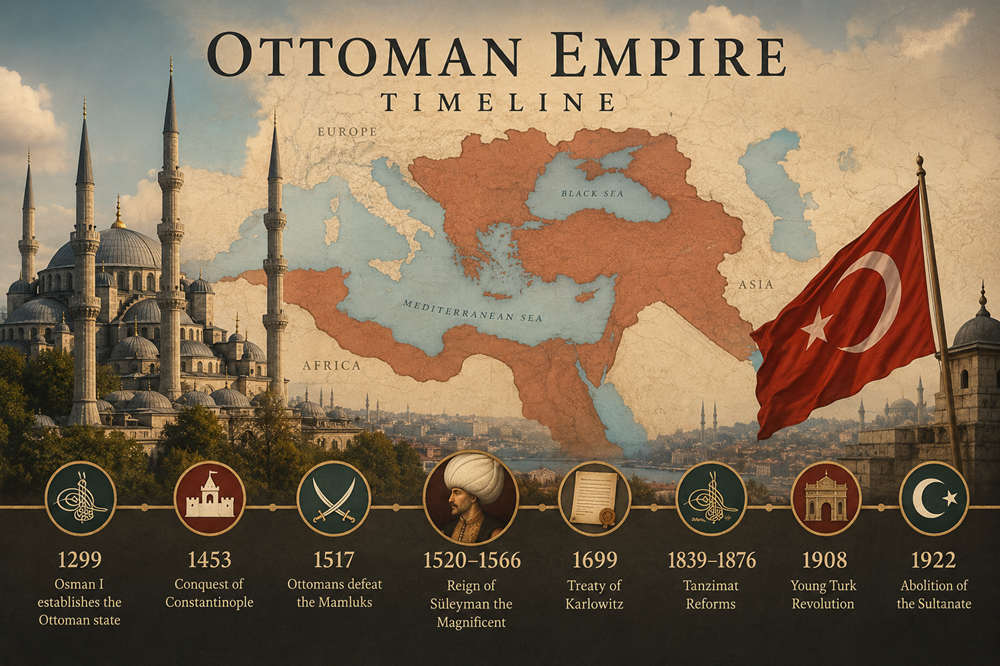
| c. 1299 | Osman I establishes the Ottoman state | This marks the beginning of the Ottoman dynasty. |
| 1326 | Bursa is captured | Bursa becomes an early Ottoman capital and political center. |
| 1350s–1400s | Ottoman expansion into the Balkans | The Ottomans become a major power in both Asia and Europe. |
| 1402 | Battle of Ankara | Timur defeats Sultan Bayezid I, nearly destroying Ottoman power. |
| 1402–1413 | Ottoman Interregnum | Bayezid’s sons fight for control before the empire is restored. |
| 1453 | Constantinople falls to Mehmed II | The Byzantine Empire ends, and Constantinople becomes the Ottoman capital. |
| 1517 | Ottomans defeat the Mamluk Sultanate | Ottoman authority expands across Egypt, Syria, and important Arab lands. |
| 1520–1566 | Reign of Süleyman the Magnificent | The empire reaches one of its strongest periods of military, political, and cultural power. |
| 1571 | Battle of Lepanto | Ottoman naval power faces a major challenge in the Mediterranean. |
| 1683 | Second Ottoman siege of Vienna fails | Ottoman expansion into central Europe reaches a clear limit. |
| 1699 | Treaty of Karlowitz | The empire formally loses major territory in east-central Europe. |
| 1839–1876 | Tanzimat reforms | The empire tries to modernize its laws, government, schools, and military. |
| 1876 | First Ottoman Constitution | The empire briefly enters a constitutional period. |
| 1908 | Young Turk Revolution | Constitutional government is restored. |
| 1912–1913 | Balkan Wars | The empire loses most of its remaining European territory. |
| 1914–1918 | World War I | Ottoman defeat helps bring the empire to an end. |
| 1922 | Sultanate is abolished | The Ottoman Empire formally ends. |
| 1923 | Republic of Turkey is recognized | A new post-Ottoman political order takes shape. |
Early Ottoman Beginnings in Anatolia
The Ottoman story began in northwestern Anatolia, in what is now Turkey. In the late 1200s, the region was divided among several powers. The Seljuk Sultanate of Rum had weakened, Byzantine control was shrinking, and Turkish frontier principalities competed for land, influence, and allies.
One of these principalities was led by Osman I, also called Osman Gazi. The Ottoman dynasty took its name from him. Osman’s territory was small at first, but its location near Byzantine lands gave the early Ottomans room to expand through warfare, diplomacy, and local agreements.
The first Ottoman rulers were not yet emperors of a vast state. They were frontier leaders building authority step by step. Their success came from flexible leadership, military organization, and the ability to absorb different groups into a growing political system.
Building Power: Bursa, Edirne, and Balkan Expansion
A major early turning point came in 1326, when the Ottomans captured Bursa. The city became an early capital and helped the dynasty develop a stronger administration. It also gave the Ottomans a symbolic center from which they could govern, collect resources, and plan further campaigns.
During the 14th century, Ottoman power moved into southeastern Europe. This expansion into the Balkans changed the direction of Ottoman history. The dynasty was no longer only an Anatolian power; it became deeply involved in European politics, warfare, and diplomacy.
Edirne, formerly Adrianople, became another key Ottoman base before the conquest of Constantinople. From Edirne, Ottoman rulers could direct campaigns in the Balkans while continuing to pressure the Byzantine capital. By the early 1400s, Constantinople was surrounded by Ottoman-controlled lands, although the city itself still remained Byzantine.
The Battle of Ankara and Ottoman Recovery
The early Ottoman rise was not smooth. In 1402, Sultan Bayezid I faced Timur, the powerful Central Asian conqueror, at the Battle of Ankara. Bayezid was defeated and captured, and the Ottoman state nearly collapsed.
The years after the battle are known as the Ottoman Interregnum. From 1402 to 1413, Bayezid’s sons fought one another for control. This civil conflict weakened the dynasty and showed that Ottoman power was still fragile.
The empire survived because Mehmed I eventually restored unity. This recovery was one of the most important moments in Ottoman history. Without it, the later conquest of Constantinople and the empire’s rise as a world power may never have happened.
1453: The Conquest of Constantinople
The conquest of Constantinople in 1453 was one of the most famous events in Ottoman history. Sultan Mehmed II, later known as Mehmed the Conqueror, led the siege against the Byzantine capital. After weeks of fighting, the city fell to the Ottomans.
This event ended the Byzantine Empire, which had continued the eastern Roman imperial tradition for centuries. It also gave the Ottomans one of the most valuable cities in the world. Constantinople controlled routes between Europe and Asia and between the Black Sea and the Mediterranean.
After the conquest, Constantinople became the Ottoman capital. Over time, it became widely known as Istanbul. The city grew into the political, religious, commercial, and cultural center of the empire. Its location helped Ottoman rulers connect their European, Asian, and Mediterranean territories.
The Ottoman Empire Becomes a World Power
After 1453, the empire expanded across several regions. It controlled more of southeastern Europe, strengthened its position in the eastern Mediterranean, and gained influence in the Middle East and North Africa.
One of the most important developments came under Selim I. In 1517, the Ottomans defeated the Mamluk Sultanate and gained control of Egypt, Syria, and the wider Mamluk lands. This victory also strengthened the Ottoman sultans’ role as protectors of the holy cities of Mecca and Medina.
The empire now ruled many peoples, languages, religions, and local traditions. Its subjects included Turks, Arabs, Greeks, Armenians, Kurds, Slavs, Jews, Christians, and Muslims from many backgrounds. Ottoman government depended on central authority, provincial administration, military service, legal institutions, and cooperation with local elites.
The Ottomans also became involved in long rivalries. They competed with the Safavid Empire in Persia, the Habsburgs in Europe, Venice in the Mediterranean, and later Russia around the Black Sea and the Balkans. These rivalries shaped Ottoman politics for centuries.
The Age of Süleyman the Magnificent
The reign of Süleyman I, from 1520 to 1566, is often seen as one of the high points of Ottoman history. In Europe, he became known as Süleyman the Magnificent. In the Ottoman world, he was also remembered as a lawgiver because of his role in strengthening imperial law.
Under Süleyman, Ottoman armies pushed into Hungary, and Ottoman naval forces became a major presence in the Mediterranean. The empire also played an active role in European diplomacy, especially in conflicts involving the Habsburgs.
This period was not only defined by conquest. The age of Süleyman the Magnificent was also a time of administrative order, architecture, literature, and court culture. Major works associated with the architect Mimar Sinan reflected the wealth and confidence of the empire.
Süleyman’s reign shows the Ottoman Empire at its classical height. It had a powerful army, an organized bureaucracy, a wealthy capital, and influence across Europe, Asia, and Africa.
Limits of Expansion and Mediterranean Rivalries
After the 1500s, the Ottoman Empire remained strong, but conquest became harder. Its rivals were better organized, wars became more expensive, and military technology continued to change. The empire was not simply collapsing after Süleyman, but it was entering a more difficult period.
In the Mediterranean, the Battle of Lepanto in 1571 showed that Ottoman naval power could be challenged by European coalitions. The Ottomans continued to be a major force at sea, but the battle became a warning sign that Mediterranean dominance would be contested.
On land, the empire faced the Habsburgs in central Europe, Safavid Persia in the east, Venice in maritime conflicts, and Russia in the Black Sea region. These rivalries stretched Ottoman resources and forced rulers to defend several frontiers at the same time.
Vienna, Karlowitz, and a Changing Balance of Power
A major symbolic turning point came in 1683, when the Ottomans failed to capture Vienna during their second siege of the city. The failure did not end the empire, but it showed that Ottoman expansion into central Europe had reached a serious limit.
The more formal turning point came in 1699 with the Treaty of Karlowitz. The treaty ended a long war between the Ottoman Empire and the Holy League and transferred major territories, including much of Hungary and Transylvania, away from Ottoman control.
Karlowitz mattered because it marked a shift in the balance of power. Austria became stronger in east-central Europe, while the Ottomans increasingly had to defend their remaining lands instead of expanding into new ones.
Reform, Crisis, and the Tanzimat Period
By the 1800s, Ottoman leaders understood that the empire faced serious problems. It had lost territory, suffered military defeats, and faced pressure from European powers. At the same time, nationalist movements were growing in several regions, especially in the Balkans.
Ottoman reform did not begin all at once, but the most famous reform era was the Tanzimat, which lasted from 1839 to 1876. The word Tanzimat means “reorganization.” These reforms aimed to strengthen the empire by changing government, law, taxation, education, and military structures.
The 1839 Gülhane Edict announced reform goals, including better protection of life, honor, and property. Later changes addressed legal equality among subjects, new courts, modern schools, and centralized administration. Ottoman leaders hoped these measures would help the empire compete with European states while keeping its diverse population together.
In 1876, the empire proclaimed its first constitution. This moment connected the Tanzimat reform tradition to the idea of constitutional government. Although the first constitutional period was brief, the idea returned in the early 20th century during the Young Turk Revolution.
Nationalism and Territorial Losses
Nationalism became one of the strongest forces affecting the Ottoman Empire in the 19th century. Many communities in the Balkans and other regions demanded autonomy or independence. These movements were shaped by local grievances, religious identity, European political ideas, and great-power rivalries.
Greek independence in the early 19th century was one of the clearest signs that Ottoman rule in Europe was under pressure. Later, Serbia, Romania, Bulgaria, and other Balkan areas moved toward greater separation from Ottoman control. European powers often became involved through diplomacy, war, or political pressure.
Russia played a major role in this process. Russian-Ottoman wars weakened the empire and changed the balance of power in southeastern Europe and around the Black Sea. Britain, France, Austria-Hungary, and other powers also tried to influence Ottoman affairs because the empire’s lands were strategically valuable.
By the late 1800s, the empire still existed, but its borders were smaller and its politics more unstable. Ottoman leaders had to respond to reform demands, independence movements, foreign pressure, and military threats at the same time.
The Young Turks and the Last Ottoman Decades
In 1908, the Young Turk Revolution restored constitutional government in the Ottoman Empire. The revolution challenged the autocratic rule of Sultan Abdulhamid II and revived the constitution that had first appeared in 1876.
The Young Turks were not one simple group. They included reformers, military officers, intellectuals, and political activists. Many were connected to the Committee of Union and Progress, often called the CUP. Their goal was to strengthen the empire during a time of crisis.
At first, constitutional politics raised hopes that the empire’s different communities might share a common Ottoman identity. Those hopes faded as political conflict, military pressure, and nationalism intensified.
The Balkan Wars of 1912–1913 were especially damaging. According to the history of the Balkan Wars, the conflicts stripped the Ottoman Empire of nearly all its remaining territory in Europe except part of Thrace and Edirne. These losses deeply shook Ottoman society before World War I.
World War I and the End of the Empire
World War I was the final major crisis of the Ottoman Empire. The empire entered the war on the side of Germany and the Central Powers. Ottoman forces fought on several fronts, including Gallipoli, the Caucasus, Mesopotamia, Palestine, and Arabia.
Gallipoli became one of the best-known fronts because Ottoman forces successfully resisted an Allied attempt to force passage through the Dardanelles. Other fronts were more damaging, especially as the war strained the empire’s economy, army, and civilian population.
Defeat in 1918 led to Allied occupation, postwar partition plans, and growing resistance in Anatolia. Mustafa Kemal, later known as Atatürk, became the leading figure in the Turkish War of Independence.
In 1922, the sultanate was abolished, formally ending the Ottoman Empire. The following year, the Treaty of Lausanne recognized the new political settlement, and the Republic of Turkey was proclaimed in 1923. The Ottoman dynasty’s political rule was over, and a modern nation-state replaced the old imperial system.
Ottoman Empire Timeline Summary
The Ottoman Empire timeline can be understood in several stages. First, the Ottomans began as a small frontier state in Anatolia. Then they expanded into the Balkans and built stronger centers of government at Bursa and Edirne.
The Battle of Ankara nearly destroyed the early Ottoman state, but the dynasty recovered after the Interregnum. The conquest of Constantinople in 1453 then transformed the Ottomans into a major imperial power.
In the 1500s, the empire expanded across the Middle East, North Africa, southeastern Europe, and the Mediterranean. Süleyman the Magnificent’s reign marked a high point of Ottoman law, military strength, and culture.
After the 1600s, Ottoman rulers faced stronger rivals and increasing territorial pressure. The Treaty of Karlowitz showed that the balance of power in Europe had shifted. In the 1800s, reformers tried to modernize the empire through the Tanzimat and constitutional change.
The final stage came in the early 20th century. The Young Turk Revolution restored constitutional government, but the Balkan Wars and World War I brought severe losses. After World War I, the Ottoman Empire ended and the Republic of Turkey emerged.
Conclusion
The Ottoman Empire connected many periods of history. It grew from the medieval frontier world of Anatolia, conquered the Byzantine capital, became a major Islamic and Mediterranean empire, struggled with European imperial rivalries, and faced the modern forces of nationalism and constitutional reform.
Its timeline matters because it links medieval, early modern, and modern history in one long story. Understanding the Ottoman Empire helps explain the history of Turkey, the Middle East, southeastern Europe, North Africa, and the wider Mediterranean world.