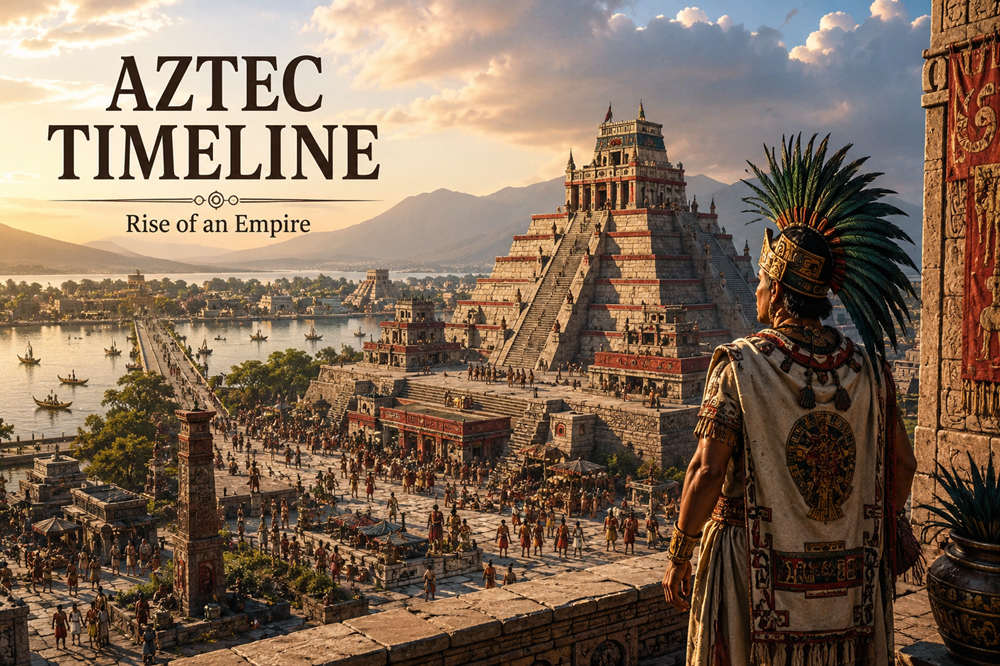
The Aztec Empire was one of the most powerful civilizations in Mesoamerica before the Spanish conquest. Centered on the island city of Tenochtitlan, it grew from a Mexica settlement into a major political, military, and economic power. This Aztec timeline follows the rise of Tenochtitlan, the formation of the Triple Alliance, the expansion of imperial rule, and the fall of the city in 1521.
Key Facts About the Aztec Timeline
| Main civilization | Aztec/Mexica |
|---|---|
| Region | Central Mexico |
| Capital | Tenochtitlan |
| Major political structure | The Triple Alliance of Tenochtitlan, Texcoco, and Tlacopan |
| Approximate imperial period | 1428–1521 |
| Major turning point | The Spanish-led conquest of Tenochtitlan in 1521 |
| Main language | Nahuatl |
Before the Aztec Empire: Migration and Settlement
The people commonly called the Aztecs are often described more specifically as the Mexica. They were Nahuatl-speaking people who became powerful in the Valley of Mexico, a highland basin filled with lakes, city-states, farmland, and trade routes. Before they built an empire, the Mexica were one group among many in a crowded political world.
Mexica migration traditions tell of a journey from a place called Aztlan. Historians treat this tradition carefully because it combines memory, identity, and sacred storytelling. For the timeline, the important point is that the Mexica eventually entered the Valley of Mexico and had to find a place among older, established powers.
The Valley of Mexico was not empty. City-states already controlled land, tribute, and military networks. The Mexica’s early history was shaped by dependence, conflict, and political survival. Their later empire did not appear suddenly; it grew through years of settlement, adaptation, military service, and local relationship-building.
Early 1300s: Founding of Tenochtitlan
Tenochtitlan was founded on an island in Lake Texcoco in the early 1300s. Many school timelines use 1325, while some references give 1345 as the traditional founding date. Because the exact date can vary by source, it is safest to understand the founding as an early 14th-century event.
According to Mexica tradition, the people were told to settle where they saw an eagle on a cactus. This image became closely tied to Tenochtitlan’s identity and later became an enduring symbol of Mexico. The story was more than a foundation legend; it helped explain why this island city was sacred, chosen, and central to Mexica history.
The island location mattered. Lake Texcoco gave Tenochtitlan natural defenses, access to water routes, and room for controlled growth. Over time, the Mexica built causeways that connected the city to the mainland, canals that moved people and goods, and agricultural systems that helped feed a growing population.
1300s–Early 1400s: Tenochtitlan Grows in Power
During the 1300s and early 1400s, Tenochtitlan changed from a modest settlement into a rising city-state. Its leaders built political connections with nearby powers, served in regional wars, and strengthened the city’s economy. The Mexica were not yet rulers of an empire, but they were becoming harder to ignore.
One reason for Tenochtitlan’s growth was its productive environment. Farmers used chinampas, often described as raised agricultural fields, to grow crops in the shallow lake region. These fields helped support the city’s population and connected food production to urban life.
Trade also became important. Markets linked Tenochtitlan to goods from nearby and distant regions. People could find food, textiles, tools, luxury items, and materials used in religious and political life. As the city grew wealthier, it also became more important as a military and ceremonial center.
Religion, warfare, and politics were closely connected. Temples and ceremonies helped define public life, while military success helped leaders gain prestige. By the early 1400s, Tenochtitlan was ready to become part of a much larger political transformation.
1428: The Triple Alliance Forms
The year 1428 is one of the most important dates in Aztec history. Under the ruler Itzcóatl, Tenochtitlan helped form the Triple Alliance with Texcoco and Tlacopan. Together, these city-states defeated the Tepanec power centered at Azcapotzalco and created the political structure usually known as the Aztec Empire.
At first, the Triple Alliance was a partnership among three city-states. Each member had its own rulers, interests, and responsibilities. Over time, however, Tenochtitlan became the dominant partner. Its leaders gained greater control over tribute, military campaigns, and imperial decision-making.
This moment marks the shift from Tenochtitlan as a strong city-state to Tenochtitlan as the center of an expanding empire. The Aztec Empire was not a modern nation-state with one uniform government over every place it controlled. It was a tribute-based empire that ruled through conquest, diplomacy, local rulers, and political pressure.
Mid-1400s: Expansion Through War, Tribute, and Political Control
After the Triple Alliance formed, the empire expanded across much of central Mexico and beyond. Military campaigns brought many communities under Aztec influence. Some were conquered directly, while others entered dependent relationships through negotiation, pressure, or practical submission.
Tribute was at the heart of the empire. Conquered or dependent communities often had to provide goods such as cotton cloth, maize, cacao, feathers, jade, military supplies, or other valuable materials. Some also provided labor or military support. Tribute helped make Tenochtitlan wealthy and allowed its rulers to support temples, markets, palaces, warriors, priests, and officials.
This system strengthened the empire, but it also created tension. Many subject peoples kept their local rulers and customs, but they still had to meet imperial demands. Heavy tribute could create resentment, especially among communities that saw Tenochtitlan as a powerful outside force. Those tensions later mattered when the Spanish arrived and found Indigenous groups willing to fight against Mexica power.
Expansion was not only about war. Marriage ties, religious ceremonies, trade relationships, and political gifts also helped hold the empire together. Still, military force remained a constant part of imperial rule. Communities that resisted could face punishment, while loyal partners might gain protection or status.
Late 1400s: Tenochtitlan Becomes a Major Imperial Capital
By the late 1400s, Tenochtitlan had become one of the most impressive cities in the Americas. Built on an island, it had causeways, canals, temples, marketplaces, neighborhoods, palaces, and administrative spaces. The city showed the wealth and organization of the empire it ruled.
At the time of the Spanish conquest, Tenochtitlan may have had around 200,000 inhabitants, making it one of the largest cities in the world. Its size and planning surprised Spanish observers, who compared its markets, buildings, and waterways to major cities they knew in Europe.
At the center of Tenochtitlan stood the sacred precinct, which included the Templo Mayor. This temple complex reflected the religious life of the city and the empire. Ritual, public ceremony, and political authority were deeply connected. Rulers did not simply govern from Tenochtitlan; they presented the city as a sacred and imperial center.
The city’s market life was also important. Tlatelolco, a neighboring city closely connected to Tenochtitlan, had a famous marketplace where thousands of people gathered. Goods from across the empire and beyond moved through these markets, showing how trade and tribute supported the capital’s daily life.
1486–1502: Ahuitzotl and the Empire Before Moctezuma II
Before Moctezuma II came to power, the ruler Ahuitzotl helped push the empire into one of its strongest periods. His reign, from 1486 to 1502, was marked by military expansion, major building projects, and increasing imperial wealth.
Ahuitzotl’s rule is useful to include in an Aztec timeline because it connects the empire’s earlier expansion to the world Moctezuma II inherited. By 1502, Tenochtitlan was not just a strong city-state. It was the center of a large tribute network, with influence reaching far beyond the Valley of Mexico.
1502–1520: Moctezuma II and the Empire at Its Height
Moctezuma II began ruling in 1502. Under his rule, the empire was powerful, wealthy, and feared, but it also faced serious pressures. Tenochtitlan stood at the center of a wide tribute system, and its rulers expected obedience from many different communities.
Moctezuma II inherited an empire that had grown through generations of conquest, trade, and political negotiation. His court was highly ceremonial, and his authority was supported by military strength, religious power, and imperial administration. At the same time, expansion had limits. Not every group in the region accepted Mexica power, and some neighboring peoples remained independent or hostile.
The empire’s strength and weakness came from the same system. Tribute brought wealth to the capital, but it also reminded subject peoples of their dependence. Military power helped maintain control, but it could not erase resentment. When foreign invaders entered the region in 1519, they arrived in a world already shaped by rivalry, fear, diplomacy, and resistance.
1519: Hernán Cortés Arrives in Mexico
In 1519, Hernán Cortés led a Spanish expedition to Mexico. The arrival of Cortés changed the timeline dramatically because the Spanish entered a region already shaped by conflict between powerful city-states and communities under Mexica pressure.
Cortés did not conquer the empire alone. His forces were small compared with the population of central Mexico. What changed the balance was his ability to make military partnerships with Indigenous groups that opposed Mexica rule or had their own political reasons for joining him. The Tlaxcalans became especially important allies.
The Spanish also brought horses, steel weapons, firearms, and military tactics unfamiliar to many people in the region. These advantages mattered, but they were only part of the story. The conquest depended on local politics, Indigenous allies, disease, siege warfare, and the instability created by first contact.
1519–1520: First Contact, Tensions, and Moctezuma’s Death
Cortés and his allies entered Tenochtitlan in 1519. The meeting between Cortés and Moctezuma II became one of the most famous moments in the history of the Americas. At first, the encounter involved diplomacy, ceremony, and uncertainty. Both sides were trying to understand the other while protecting their own interests.
Tensions soon increased. Cortés took Moctezuma into Spanish custody, which damaged the emperor’s authority and created anger in the city. Conflict grew between the Spanish and the Mexica, especially after violence broke out during a religious gathering. The situation became impossible to control.
Moctezuma died in 1520 while in Spanish custody. Historical accounts differ on the exact circumstances of his death, so the event should be described carefully. What is clear is that his death deepened the crisis and removed a ruler at the center of an already unstable political situation.
1520: La Noche Triste and the Spanish Retreat
In 1520, Spanish forces and their allies tried to escape Tenochtitlan under heavy attack. This retreat became known in Spanish memory as La Noche Triste, or “The Night of Sorrows.” It showed that the conquest was not quick or easy.
The Mexica fought fiercely to defend their city. Many Spanish soldiers and allies were killed as they fled across the causeways. The retreat was a major defeat for Cortés, and for a time it seemed possible that the Mexica might survive the invasion.
But the situation changed again. The Spanish regrouped with their Indigenous allies, while a devastating smallpox epidemic spread through Tenochtitlan. The disease weakened the city at a critical moment, killing many people and disrupting leadership. Cuitláhuac, who succeeded Moctezuma II, died after only a short time in power.
1521: Siege and Fall of Tenochtitlan
In 1521, Cortés returned with Spanish soldiers and large numbers of Indigenous allies. Instead of relying only on direct attack, they placed Tenochtitlan under siege. The campaign targeted the city’s food supplies, water routes, causeways, and ability to communicate with the outside world.
The siege lasted for months. Fighting took place on land and water as Spanish-built brigantines challenged Mexica canoes on the lake. Street-by-street combat destroyed parts of the city. Hunger, disease, and exhaustion weakened the defenders, but resistance continued until the final collapse.
The Battle of Tenochtitlan ended on August 13, 1521, when Cuauhtémoc, the last Mexica ruler of Tenochtitlan, was captured. The fall of the city ended the Aztec Empire as a political power.
That defeat did not mean Indigenous peoples disappeared. Nahuatl-speaking communities, religious memories, local identities, agricultural knowledge, art traditions, and cultural practices continued under difficult colonial conditions.
After 1521: What Changed After the Aztec Empire Fell?
After Tenochtitlan fell, the Spanish began building Mexico City on the ruins of the Mexica capital. The new colonial city became the center of Spanish power in New Spain. Temples were destroyed or buried, churches and government buildings were built, and Spanish institutions reshaped political life.
The conquest changed landholding, religion, labor systems, disease patterns, and trade. Indigenous communities faced forced conversion, tribute demands, violence, population loss, and new colonial rule. At the same time, they adapted, resisted, negotiated, and preserved important parts of their languages and traditions.
For students, the key point is that the fall of the empire was not caused by one factor alone. It came from war, Indigenous political divisions, Spanish military strategy, epidemic disease, and the pressure of a long siege.
Aztec Timeline Summary
| Date/Period | Event |
|---|---|
| Early 1300s | The Mexica settle in the Valley of Mexico after migration traditions connected to Aztlan. |
| 1325/early 1300s | Tenochtitlan is founded on an island in Lake Texcoco. |
| 1300s–early 1400s | Tenochtitlan grows through farming, trade, warfare, religion, and local political connections. |
| 1428 | Under Itzcóatl, Tenochtitlan joins Texcoco and Tlacopan to form the Triple Alliance. |
| Mid-1400s | The empire expands through conquest, tribute, diplomacy, and political control. |
| Late 1400s | Tenochtitlan becomes one of the most powerful cities in Mesoamerica. |
| 1486–1502 | Ahuitzotl rules during a major period of expansion before Moctezuma II. |
| 1502 | Moctezuma II begins ruling during the height of imperial power. |
| 1519 | Hernán Cortés arrives in Mexico and begins forming partnerships with Indigenous opponents of Mexica rule. |
| 1519–1520 | Cortés enters Tenochtitlan, tensions rise, and Moctezuma II dies in Spanish custody. |
| 1520 | Spanish forces and their allies retreat from Tenochtitlan during La Noche Triste. |
| 1520–1521 | Smallpox devastates Tenochtitlan and weakens the city during the wider conflict. |
| 1521 | Tenochtitlan falls after a long siege, ending the Aztec Empire as a political power. |
Final Summary
The Aztec timeline shows how the Mexica built Tenochtitlan from an island settlement into the center of a powerful empire. The major turning point came in 1428, when the Triple Alliance gave Tenochtitlan a new path toward regional dominance.
By the early 1500s, the empire was wealthy and powerful, but it also faced resentment from some subject peoples and rival communities. The arrival of Cortés in 1519 turned those tensions into a larger crisis. After disease, war, siege, and the involvement of many Indigenous allies, Tenochtitlan fell in 1521. The empire ended, but Mexica history and cultural legacy continued long after the conquest.