The Industrial Revolution was one of the most important turning points in world history. It changed how people worked, where they lived, how goods were made, and how quickly people and products could move from place to place. Instead of relying mostly on hand tools, home workshops, and animal power, many societies began using machines, factories, coal, steam engines, and railroads.
The Industrial Revolution began in Britain during the 18th century and later spread to Europe, the United States, and other parts of the world. It did not happen all at once. Dates are approximate because historians often distinguish between early foundations, factory growth, and later industrial expansion. Use this timeline to follow the Industrial Revolution from early textile inventions to steam power, railroads, factory reform, and the Second Industrial Revolution.
What Was the Industrial Revolution?
The Industrial Revolution was the shift from mostly handmade production to machine-powered production. Before this period, many goods were made in homes, small workshops, or local craft shops. During industrialization, more goods were produced in factories using machines powered by water, steam, and later electricity.
This change affected more than technology. It reshaped work schedules, family life, city growth, transportation, business, trade, and the environment. Factories needed workers, fuel, raw materials, machines, and transportation networks. As a result, industrial towns grew quickly, railroads expanded, and people became more connected to national and global markets.
Historians often describe the first Industrial Revolution as beginning in Britain in the mid-1700s and continuing into the early 1800s. A later wave of industrialization brought steel, electricity, oil, chemicals, and mass production into the center of modern industry.
Before the Industrial Revolution: Life Before Industrialization
Before the Industrial Revolution, most people lived in rural areas and worked in farming. Families often produced much of what they needed locally. Clothing, tools, furniture, and household items were usually made by hand or in small workshops.
One important system before factories was the cottage industry. Under this system, merchants supplied raw materials such as wool or cotton to workers, who spun thread or wove cloth in their homes. The finished goods were then collected and sold. This system allowed production beyond the household, but it was still slow compared with factory work.
Transportation also limited economic growth. Roads could be poor, travel was slow, and moving heavy goods over long distances was expensive. Rivers, canals, and coastal shipping helped, but many communities were still shaped by local markets. These limits made later improvements in steamships and railroads especially important.
By the early 1700s, however, conditions were changing. Population was growing, trade was expanding, and demand for cotton cloth and other goods was rising. Britain had coal and iron resources, overseas trade connections, and a growing class of investors and inventors. These conditions helped prepare the way for industrial change.
Early Foundations of Industrial Change: 1700–1750
The early 1700s were not yet the factory age, but important foundations were already forming. Britain had large coal deposits, which became essential for powering steam engines and producing iron. Coal mattered because wood supplies were limited and industries needed a stronger, more reliable energy source.
Iron was also important. Machines, tools, bridges, rails, and engines all depended on stronger metal production. Improvements in ironmaking helped support later industrial growth because factories and transportation systems required durable materials.
Agricultural change played a role as well. Improvements in farming helped support a growing population. As food supplies increased and farming methods changed, more people could move away from full-time farm work. Some became wage workers in mines, mills, workshops, and later factories.
Trade gave another push. Britain’s merchants were connected to wider markets, including overseas markets. Demand for cotton textiles grew sharply, and this encouraged inventors and business owners to search for faster ways to spin thread and weave cloth.
1750s–1770s: Textile Inventions and the Factory System Begin
The textile industry was one of the first major areas transformed by industrialization. Cloth production had many steps, including cleaning fibers, spinning thread, and weaving fabric. When one step became faster, the others had to catch up. This pressure encouraged a series of inventions.
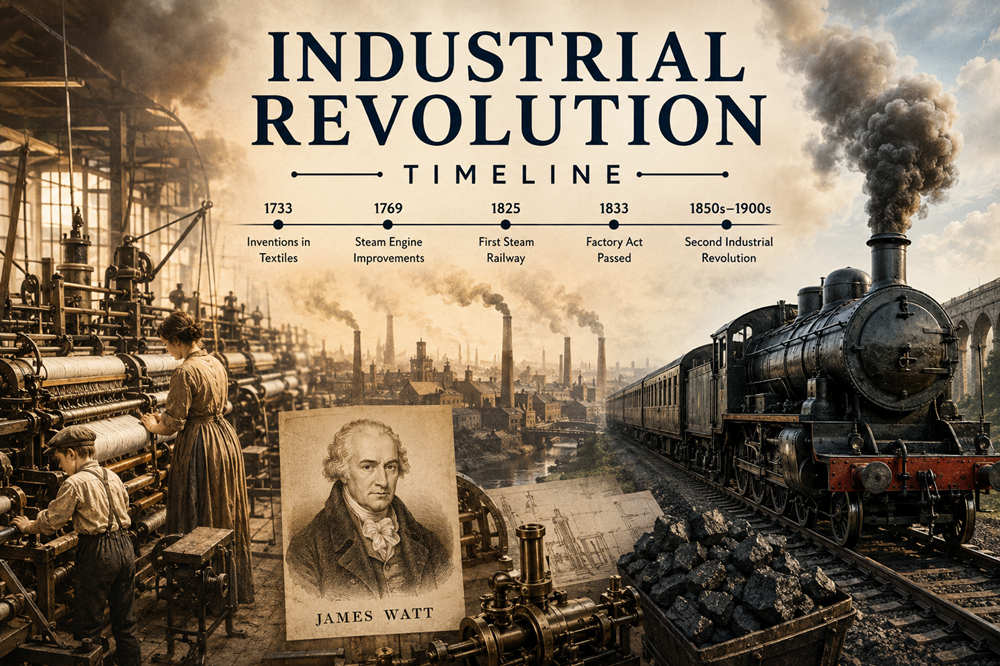
In 1733, John Kay invented the flying shuttle. This device made weaving faster by allowing one weaver to work more efficiently on a wider loom. Faster weaving created a greater need for thread, which encouraged inventors to improve spinning.
In the mid-1760s, James Hargreaves developed the spinning jenny, a machine that allowed one worker to spin several threads at once. It increased thread production, although the thread it produced was not always strong enough for every textile use.
In 1769, Richard Arkwright patented the water frame. Unlike the spinning jenny, the water frame used water power and produced stronger thread. Because it required a steady power source and larger equipment, it encouraged the growth of mills where workers and machines were brought together in one place.
In 1779, Samuel Crompton developed the spinning mule, which combined features of earlier spinning machines. It produced finer and stronger thread, making it especially important for cotton textiles. These inventions did not create the Industrial Revolution by themselves, but they helped move textile production from homes and small workshops into larger factory settings.
1760s–1780s: Steam Power Changes Industry
Steam power became one of the most important technologies of the Industrial Revolution. Early steam engines were used mainly to pump water out of mines. This was useful because deeper coal mines often filled with water, making it difficult to reach fuel supplies.
James Watt’s work on the separate condenser made steam engines more efficient and helped them become useful beyond mine pumping. Watt’s improvements reduced wasted heat and helped steam power move into factories, mills, and other industrial settings.
Steam power reduced dependence on rivers and waterwheels. Factories no longer had to be located only where water power was available. They could be built closer to coalfields, workers, ports, and growing towns.
Steam also connected industries to each other. Coal powered steam engines. Steam engines helped mines produce more coal. Iron was needed to build engines, machinery, and rails. Together, these links helped industrial production expand.
1780s–1820s: Iron, Coal, and Expanding Factories
By the late 1700s and early 1800s, production was becoming larger and more organized. Textile mills grew, coal mining expanded, and iron production became increasingly important.
Factories changed the rhythm of work. Instead of working at home according to seasonal or household routines, factory workers followed the schedule of machines and managers. Work became more disciplined, timed, and repetitive. Wages became central to survival for many industrial workers.
Factory towns grew quickly. Places with mills, mines, ports, or transportation links attracted workers from rural areas. Manchester became one of the best-known industrial cities because of its cotton mills and steam-powered machinery. The city’s industrial history is closely tied to engines, mills, railways, and manufacturing, a connection still explored by the Science and Industry Museum.
This growth created new opportunities, but it also created serious problems. Industrial towns often struggled with overcrowding, pollution, poor housing, and unsafe working conditions. Women and children worked in some factories and mines, often for lower wages than adult men. These conditions later encouraged reform movements and labor laws.
1820s–1850s: Railroads, Steamships, and Faster Transportation
Transportation was another major turning point in the Industrial Revolution timeline. Factories needed raw materials such as cotton, coal, and iron. They also needed ways to ship finished goods to markets. Steam-powered transportation made this easier.
Steamships appeared in the early 1800s and improved travel on rivers, canals, and oceans. They made transportation more predictable because they did not depend only on wind or animal power.
Railroads changed land transportation even more dramatically. In 1825, the Stockton and Darlington Railway opened in England. In 1830, the Liverpool and Manchester Railway opened, showing how railways could connect major industrial cities.
Railroads moved coal, iron, cotton, food, passengers, newspapers, and finished goods faster than roads and canals alone could manage. They also changed how people understood distance and time. Towns became more connected, goods reached markets more quickly, workers moved more easily, and industries could connect to wider supply networks.
Industrialization Spreads Beyond Britain
Britain industrialized first, but during the 1800s, industrial methods spread into parts of western Europe, the United States, and later other regions. Some countries borrowed or adapted British technology, while others built industries around railroads, mining, textiles, iron, steel, or manufacturing.
The spread of industrialization depended on many conditions, including natural resources, investment, transportation, government policy, skilled workers, and access to markets. Because these conditions varied, industrial growth did not happen at the same speed everywhere.
In the United States, industrial growth accelerated during the 19th century. The Library of Congress explains the Industrial Revolution in the United States as a long transformation in which production moved from handcraft and home businesses toward machine-aided factory production. After the Civil War, the United States entered a period often described as the Rise of Industrial America, with major growth in petroleum refining, steel manufacturing, electrical power, and railroads.
Industrialization also shaped global trade and empire. Some regions became major industrial centers, while others supplied raw materials, labor, or markets for manufactured goods. This uneven development influenced world history in the 19th and early 20th centuries.
1850s–1900s: The Second Industrial Revolution
Many historians separate the first Industrial Revolution from the Second Industrial Revolution. The first phase focused heavily on textiles, steam power, coal, iron, and early factories. The second phase grew from the mid-1800s into the early 1900s and took place across Britain, continental Europe, North America, Japan, and later other parts of the world.
Steel became especially important. Stronger and cheaper steel supported railroads, bridges, ships, machines, and large buildings. The growth of the steel industry helped industrial economies build bigger and more durable infrastructure.
Electricity also transformed industry and daily life. Electric power eventually allowed factories to use new kinds of machinery and lighting. It also helped reshape cities, homes, communication, and transportation.
Oil and chemicals became major industries as well. Petroleum refining, chemical manufacturing, fertilizers, dyes, and new industrial materials expanded what factories could produce. The telegraph and later communication technologies allowed information to travel faster across long distances.
Mass production became more important during this period. Factories increasingly used standardized parts, assembly methods, and larger production systems. These methods helped create the modern industrial economy.
Labor, Cities, and Social Change During the Industrial Revolution
The Industrial Revolution changed everyday life for millions of people. One of the most visible changes was urbanization. As factories, mines, and railroads grew, people moved from rural villages to industrial towns and cities in search of work.
Industrial cities could offer wages and new opportunities, but they were often crowded and unhealthy. Housing could be cramped. Sanitation systems were often poor. Smoke from coal fires and factories polluted the air. Rivers and streets could become dirty from waste and industrial activity.
Factory work was often difficult. Workers might spend long hours doing repetitive tasks near dangerous machines. Injuries were common in many workplaces. Children worked in factories and mines because they could be paid less and could fit into small spaces around machines or underground tunnels.
Reform came slowly. In Britain, the 1833 Factory Act was one important step toward improving conditions for children working in factories. The act did not solve every problem, but it showed that industrial society was beginning to respond to the human costs of factory labor.
Labor movements also grew as workers organized to demand better wages, shorter hours, safer conditions, and more political rights. Over time, industrialization created new debates about fairness, wealth, poverty, education, public health, and the role of government.
Industrial Revolution Timeline: Key Dates at a Glance
| Date / Period | Event | Why It Matters |
|---|---|---|
| 1733 | John Kay invents the flying shuttle | Weaving becomes faster, increasing demand for more thread. |
| Mid-1760s | James Hargreaves develops the spinning jenny | One worker can spin multiple threads at once, speeding textile production. |
| 1769 | Richard Arkwright patents the water frame | Water-powered spinning supports larger mills and stronger thread production. |
| 1769 | James Watt patents improvements to the steam engine | Steam power becomes more efficient and more useful for industry. |
| 1779 | Samuel Crompton develops the spinning mule | Textile production improves with finer and stronger thread. |
| 1780s | Steam power expands in industrial use | Factories become less dependent on river locations. |
| 1790s–1820s | Factory growth increases in Britain | Industrial towns, wage labor, and machine production expand. |
| 1825 | Stockton and Darlington Railway opens | Steam-powered rail transport begins reshaping freight and passenger movement. |
| 1830 | Liverpool and Manchester Railway opens | Railways begin connecting major industrial cities more effectively. |
| 1833 | Britain passes the Factory Act | Early reform efforts begin addressing child labor conditions in factories. |
| 1830s–1850s | Railways spread across Europe and North America | Goods, people, and raw materials move faster over long distances. |
| 1850s–1900s | Second Industrial Revolution expands | Steel, electricity, oil, chemicals, and mass production grow in importance. |
| Late 1800s–early 1900s | Labor reform movements continue | Workers and reformers push for safer conditions, shorter hours, and stronger protections. |
Conclusion
The Industrial Revolution timeline shows how a series of inventions and changes gradually built a new industrial world. Textile machines increased production. Steam power changed factories and mining. Coal and iron supported engines, railways, and machines. Railroads and steamships moved people and goods faster than ever before.
By the late 1800s, industrialization had expanded far beyond its early British roots. Steel, electricity, oil, chemicals, and mass production pushed industrial society into a new phase. At the same time, factory labor, crowded cities, child work, pollution, and reform movements showed that industrial progress came with serious challenges.
Studying the Industrial Revolution as a timeline makes the process easier to understand. It was not one invention, one year, or one country. It was a long chain of connected changes that reshaped work, transportation, cities, technology, and modern life.