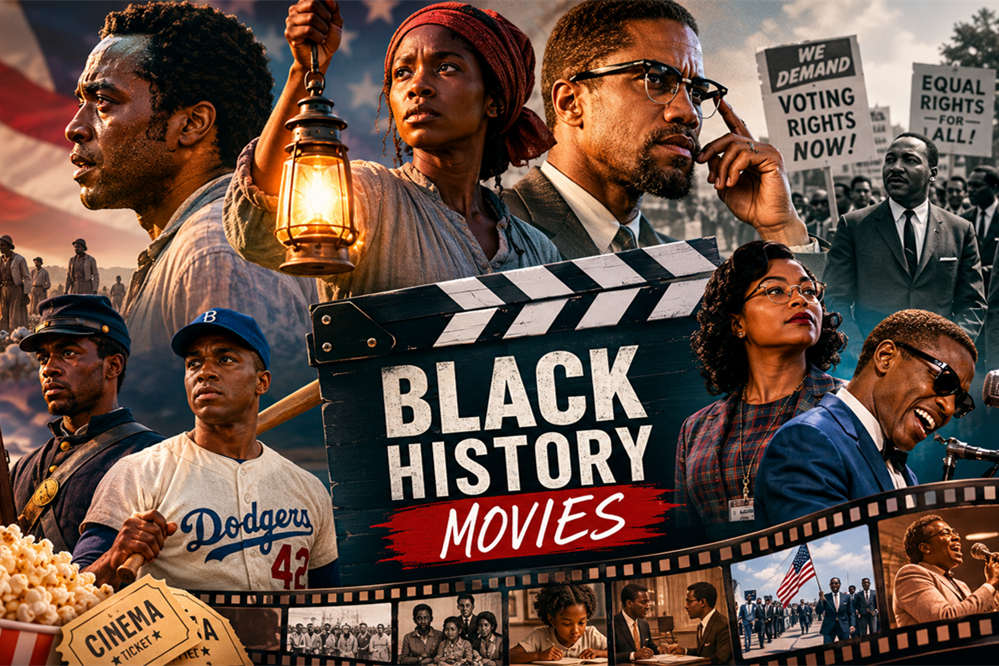
Black history movies can help viewers connect major events to real people, personal choices, and lived experiences. This guide highlights films about slavery, the Civil War, Reconstruction, segregation, civil rights, Black leaders, documentaries, music, sports, education, and everyday African American life.
Movies are not the same as textbooks, archives, or primary sources. Many films compress timelines, combine characters, or dramatize events for storytelling. Still, when watched with historical context, they can become powerful starting points for learning. They can help viewers ask deeper questions about freedom, citizenship, justice, culture, and the long struggle to make American democracy more equal.
Movies About Slavery and the Fight for Freedom
Films about slavery can be difficult to watch, but they are important because they show how deeply the system shaped American life. Slavery was not only forced labor. It was also a legal, economic, political, and violent system that affected families, courts, churches, businesses, land, and government power.
12 Years a Slave
12 Years a Slave tells the story of Solomon Northup, a free Black man from New York who was kidnapped and sold into slavery in the South. Based on Northup’s 1853 memoir, the film shows how fragile freedom could be for Black Americans even outside the slaveholding South.
Northup’s experience reveals the cruelty of slavery through one person’s life, but it also points to a larger system. Kidnapping, forged documents, corrupt networks, and racist courts all helped slavery survive. The story makes clear that freedom required more than personal status; it required legal protection, public recognition, and political power.
Harriet
Harriet focuses on Harriet Tubman, who escaped slavery and returned repeatedly to help others reach freedom. The film introduces Tubman as a freedom seeker, organizer, guide, and leader whose work went far beyond a single escape.
The movie also gives viewers a way to understand the Underground Railroad. It was not a literal railroad, but a loose network of people, safe houses, routes, churches, and communities that helped enslaved people move toward freedom. Tubman’s story shows how resistance required courage, planning, secrecy, and trust.
Amistad
Amistad is based on the 1839 revolt by enslaved Africans aboard the Spanish ship La Amistad. Their case eventually reached the United States Supreme Court, where questions of captivity, law, identity, and freedom became part of a national debate.
The film is valuable because it shows enslaved people acting as historical agents rather than passive victims. They resisted through rebellion, testimony, memory, and legal struggle. The story also connects American slavery to the wider Atlantic world, where ships, courts, governments, and trade networks all shaped the lives of captive Africans.
Glory
Glory follows the 54th Massachusetts Infantry Regiment, one of the first official Black regiments in the Union Army during the Civil War. The film helps explain why Black military service became such a powerful part of the fight against slavery.
Black soldiers fought for the Union, but they also fought for the destruction of slavery and the recognition of Black citizenship. Their service challenged racist ideas about courage, discipline, and patriotism. It also strengthened the argument that Black Americans deserved full rights in the nation they helped save.
Movies About Reconstruction, Segregation, and Racial Violence
The end of slavery did not bring full equality. After the Civil War, Black Americans built schools, churches, businesses, farms, political organizations, and family networks. At the same time, they faced white supremacist violence, voter suppression, segregation, and economic exploitation.
Movies about Reconstruction, Jim Crow, and racial terror help explain why freedom had to be defended again and again. They also show how communities remembered, resisted, and survived violence that was often ignored or hidden in official histories.
The Birth of a Nation (2016)
The Birth of a Nation from 2016 focuses on Nat Turner, an enslaved preacher who led a rebellion in Virginia in 1831. This film should not be confused with the racist 1915 silent film of the same name, which promoted white supremacist mythology and glorified the Ku Klux Klan.
The 2016 film raises difficult questions about slavery, religion, violence, and rebellion. Nat Turner has been interpreted in different ways by historians and writers, so the movie should be watched with context. Its central historical issue is still important: what choices were available to people trapped inside a system built on force?
Rosewood
Rosewood is based on the 1923 massacre in Rosewood, Florida, where a Black community was destroyed by white mob violence. The film shows that racial terror often targeted entire towns, not only individuals.
The story broadens the meaning of Jim Crow history. Segregation was not limited to separate schools, train cars, or public facilities. It also involved intimidation, land loss, false accusations, mob action, and silence. Rosewood reminds viewers why oral history, local memory, and historical records matter when communities have been pushed out of public view.
Till
Till tells the story of Mamie Till-Mobley’s fight for justice after the 1955 lynching of her son, Emmett Till. The film centers a mother’s grief, courage, and decision to make the truth visible to the nation.
Emmett Till’s murder became one of the events that helped energize the modern Civil Rights Movement. The movie shows how testimony, public mourning, photographs, journalism, and organized pressure could turn a local act of racial violence into a national demand for justice.
Mudbound
Mudbound explores race, poverty, land, and military service in Mississippi after World War II. The film is fictional, but its setting reflects real tensions faced by Black veterans who returned from fighting abroad to a segregated country at home.
That postwar setting matters. Many Black veterans had risked their lives in the name of democracy, then came back to discrimination, threats, and limited rights. Their experiences helped shape later civil rights activism by exposing the gap between American ideals and American reality.
Movies About the Civil Rights Movement
The Civil Rights Movement was not one event, one speech, or one leader. It included local campaigns, court cases, marches, boycotts, church networks, student sit-ins, voter registration drives, labor activism, and community organizing. The National Archives preserves records connected to many civil rights struggles, including federal laws, court documents, photographs, and records of major figures and events.
Selma
Selma focuses on the 1965 voting rights campaign in Alabama, especially the marches from Selma to Montgomery. Martin Luther King Jr. is central to the story, but the film also shows local activists, clergy, students, organizers, and ordinary citizens who risked violence to demand voting rights.
The film’s strongest historical value is its focus on voting as a hard-fought right. Long after the Civil War, Black citizens in many Southern states still faced literacy tests, intimidation, job loss, violence, and other barriers. Selma shows why federal voting rights protection became a major goal of the movement.
Malcolm X
Spike Lee’s Malcolm X follows Malcolm X from his early life through his work as a minister, speaker, critic of racism, and international human rights advocate. The film introduces viewers to a major voice whose ideas challenged both white supremacy and narrow views of civil rights leadership.
Malcolm X pushed Americans to see racism as a national and global problem, not only a Southern one. The film also traces how his thinking changed over time as he reflected on religion, self-defense, colonialism, Black identity, and political power.
The Rosa Parks Story
The Rosa Parks Story helps move Rosa Parks beyond the simplified image of a tired woman on a bus. Parks had a long history of activism before the Montgomery Bus Boycott, including work with the NAACP.
The film shows that the boycott grew from years of organizing, planning, frustration, and community discipline. It also highlights the importance of women, churches, drivers, lawyers, and working people who kept the protest going for more than a year.
The Best of Enemies
The Best of Enemies is based on the relationship between civil rights activist Ann Atwater and Ku Klux Klan leader C. P. Ellis during a school desegregation conflict in Durham, North Carolina. Instead of focusing on a nationally famous march, it turns attention to a local struggle.
That local setting is the point. Civil rights history happened in school board meetings, neighborhoods, churches, workplaces, and city halls across the country. The film shows how desegregation was not only a legal issue; it also forced communities to confront fear, prejudice, power, and public responsibility.
The Long Walk Home
The Long Walk Home is set during the Montgomery Bus Boycott and follows two women whose lives are changed by the protest. Through transportation, work, household relationships, and moral pressure, the film shows how a mass movement entered daily life.
Its quieter approach helps explain why boycotts required endurance. People had to walk, organize rides, risk jobs, face criticism, and keep going when change came slowly. The movie turns a famous civil rights campaign into a story of repeated choices made over time.
Judas and the Black Messiah
Judas and the Black Messiah tells the story of Fred Hampton, chairman of the Illinois chapter of the Black Panther Party, and William O’Neal, the FBI informant who betrayed him. The film brings viewers into late-1960s Chicago, where questions of policing, poverty, surveillance, coalition-building, and radical politics shaped Black freedom struggles.
This addition gives the article a wider view of civil rights history. The Black freedom movement did not end with the most familiar marches and speeches. By the late 1960s, activists were also debating economic justice, police violence, community programs, self-defense, and government surveillance. The film helps introduce that more complex political landscape.
Movies About Black Leaders, Thinkers, and Change-Makers
Biographical films can be useful when they show both the individual and the world around that person. A leader’s achievement becomes clearer when viewers understand the barriers, institutions, communities, and historical pressures that shaped the story.
Marshall
Marshall focuses on an early case in the legal career of Thurgood Marshall, who later became the first Black justice on the United States Supreme Court. The film shows Marshall before his most famous national achievements, when he was traveling across the country as an NAACP lawyer.
The courtroom setting highlights a major side of civil rights history: legal strategy. Lawyers challenged racism through evidence, jury selection, constitutional arguments, appeals, and public pressure. Marshall’s career shows how legal battles helped weaken segregation long before and after Brown v. Board of Education.
The Great Debaters
The Great Debaters is inspired by the debate team at Wiley College, a historically Black college in Texas. The film follows students who use research, public speaking, and intellectual discipline to challenge the racist assumptions of their time.
Its deeper historical theme is Black education. Historically Black colleges and universities created spaces where students could study, debate, organize, and prepare for public life despite segregation and unequal resources. The film celebrates education as both opportunity and resistance.
Hidden Figures
Hidden Figures tells the story of Katherine Johnson, Dorothy Vaughan, and Mary Jackson, Black women whose work at NASA contributed to the United States space program. The film connects African American history to mathematics, engineering, technology, and the Cold War.
NASA’s history of the “Hidden Figures” women shows how Black women worked as computers, mathematicians, and engineers at the National Advisory Committee for Aeronautics and NASA. The film broadens the way viewers think about modern American achievement by showing that Black history is also part of science and space history. Readers can learn more through NASA’s Hidden Figures materials.
King Richard
King Richard tells the story of Richard Williams and his role in guiding the early tennis careers of Venus and Serena Williams. It is more recent than many films in this guide, but it connects to important themes: family strategy, race, class, sports access, media pressure, and Black excellence.
The film works best as a modern achievement story rather than a traditional historical drama. It shows how athletic success is shaped by coaching, resources, public expectations, and unequal access to elite spaces. Venus and Serena Williams became champions, but they also changed how many people saw power and representation in tennis.
Respect
Respect follows the life and career of Aretha Franklin, whose music became deeply connected to gospel traditions, soul music, women’s voices, and the Civil Rights era. The film shows how an artist’s work can carry emotional and political meaning.
Aretha Franklin’s career reminds viewers that Black history includes cultural leadership as well as formal activism. Songs, churches, recording studios, concert stages, and public performances can all become part of historical change when they give voice to a community’s struggle, dignity, and hope.
Documentaries That Teach Black History Clearly
Documentaries often provide the clearest historical framing because they can include interviews, archival footage, photographs, speeches, news clips, and expert commentary. The PBS African American Experience collection is a useful starting point for viewers who want films, articles, and features about race, democracy, justice, and Black contributions to American history.
13th
13th examines the relationship between the Thirteenth Amendment, racial inequality, criminal justice, and mass incarceration. It connects slavery, Reconstruction, Jim Crow, prison labor, political language, policing, and modern incarceration debates.
The documentary asks viewers to think about systems across time. It does not focus only on one person or one moment. Instead, it traces how laws, punishment, race, and citizenship have been linked in American history.
I Am Not Your Negro
I Am Not Your Negro is built around the words and ideas of writer James Baldwin. The documentary reflects on race in America through Baldwin’s unfinished work about Medgar Evers, Malcolm X, and Martin Luther King Jr.
Baldwin’s voice gives the film its force. He pushes viewers to think about racism not only as a set of laws, but also as a problem of memory, fear, imagination, culture, and national identity. The documentary feels less like a simple biography and more like an argument with American history.
Eyes on the Prize
Eyes on the Prize remains one of the most important documentary series about the Civil Rights Movement. It covers major campaigns, local organizers, national leaders, court battles, protests, and ordinary people who helped change the country.
The series avoids reducing the movement to one person or one speech. It shows strategy, disagreement, courage, planning, and sacrifice. For many viewers, it is one of the clearest introductions to the modern Black freedom struggle.
The African Americans: Many Rivers to Cross
The African Americans: Many Rivers to Cross, hosted by Henry Louis Gates Jr., traces African American history across several centuries. It covers slavery, emancipation, Reconstruction, migration, politics, culture, identity, and achievement.
The series is especially helpful because it gives viewers a broad timeline. Rather than isolating one event, it connects different eras into a longer story. That makes it a strong companion for anyone trying to understand how African American history fits into the larger history of the United States.
PBS American Experience Documentaries
PBS has produced many documentaries connected to African American history, including films about civil rights, public figures, race, democracy, and justice. These documentaries often combine storytelling with historical evidence, making them useful companions to dramatized films.
The Library of Congress also provides film and video materials connected to African American history, while its broader digital collections include pamphlets, photographs, manuscripts, and other materials that help place films in context.
Movies About Black Culture, Music, Sports, and Everyday Life
Black history is not only a history of oppression. It is also a history of creativity, family, faith, language, education, sports, business, music, literature, food, style, humor, and community life. The National Museum of African American History and Culture presents African American history through stories, scholarship, art, and artifacts, which is a helpful reminder that culture is central to historical understanding.
Ray
Ray tells the story of Ray Charles, one of the most influential musicians of the twentieth century. The film explores music, disability, segregation, fame, addiction, and artistic independence.
Ray Charles’s career shows how Black musicians shaped the sound of modern America. His work crossed gospel, blues, jazz, country, soul, and pop. Through his story, viewers can see how African American musical traditions influenced national culture far beyond one genre.
Ma Rainey’s Black Bottom
Ma Rainey’s Black Bottom, based on the play by August Wilson, centers on blues singer Ma Rainey and a recording session in 1920s Chicago. Although the story is dramatized, it captures real historical tensions around race, business, performance, and control.
The film shows Black artistry inside an industry that often profited from Black talent while limiting Black power. It also presents the blues as more than entertainment. The music carries memory, pain, wit, survival, and self-expression.
One Night in Miami
One Night in Miami imagines a meeting among Malcolm X, Muhammad Ali, Sam Cooke, and Jim Brown. It is not a literal transcript of history, but it uses four real figures to explore fame, politics, religion, art, sports, and public responsibility.
The film stands out because it shows disagreement within Black public life. These men do not represent one single view of freedom or leadership. Their imagined conversation helps viewers understand the pressure placed on prominent Black figures during the 1960s and the different ways they used influence.
Akeelah and the Bee
Akeelah and the Bee is not a historical drama, but it belongs in a broader guide because it highlights education, language, mentorship, family, and community support. The story follows a young girl from South Los Angeles as she prepares for a national spelling bee.
The film adds a needed everyday-life angle. It shows Black childhood, academic ambition, neighborhood encouragement, and the importance of adults who recognize a student’s potential. Not every meaningful Black history movie has to center on a famous leader, court case, or national crisis.
Remember the Titans
Remember the Titans is based on a high school football team in Virginia during school integration. The movie uses sports to explore race, leadership, teamwork, and community conflict.
Although the film simplifies some events, it can introduce viewers to the social tensions surrounding desegregation. Schools were not only places of learning. They were public battlegrounds over citizenship, resources, neighborhood identity, and equality.
Summer of Soul
Summer of Soul documents the 1969 Harlem Cultural Festival, a major celebration of Black music, culture, fashion, pride, and politics. The festival took place during the same summer as Woodstock, but its footage was largely forgotten for decades before the documentary brought it to wider attention.
This film is a stronger cultural-history choice than a general inspirational movie because it is built from real performance footage and community memory. It shows Black joy, political awareness, musical brilliance, and Harlem’s cultural power at the end of the 1960s. It also reminds viewers that history can be lost, overlooked, and later recovered.
Final Thoughts
The best Black history movies do more than show the past. They help viewers understand how freedom, citizenship, culture, resistance, creativity, and community have shaped American life.
Some films in this guide focus on slavery and racial violence. Others explore law, protest, education, science, sports, music, and everyday experience. Together, they show that Black history is not one story. It is a long, complex, and central part of American history.
Movies can open the door, but deeper learning continues through museums, archives, books, documentaries, oral histories, and primary sources. When watched with curiosity and context, Black history movies can help viewers see not only what happened, but why it mattered and why it still matters today.