
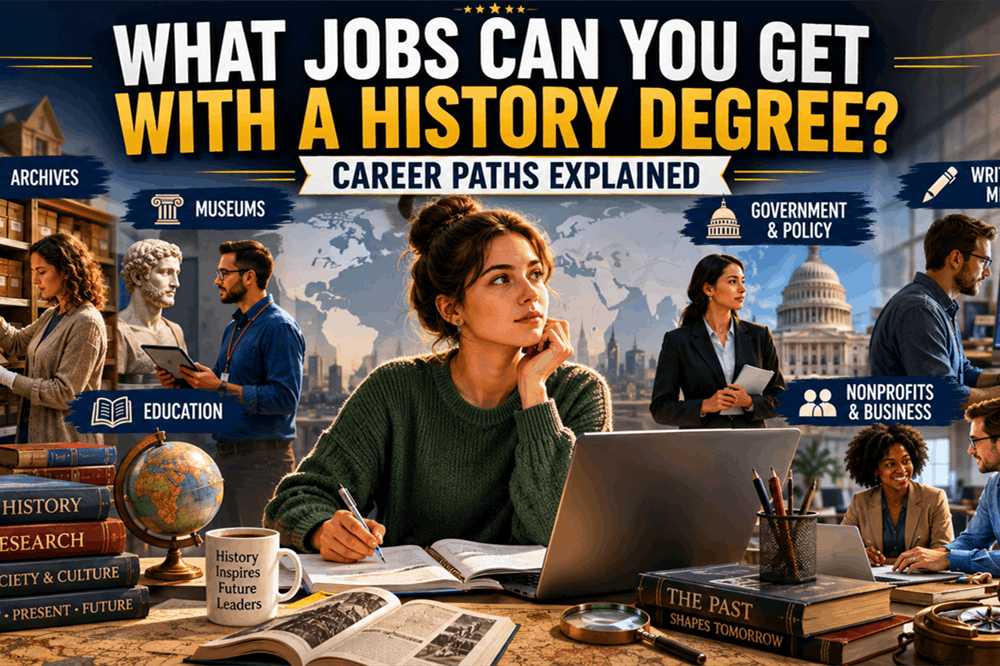
A history degree can lead to jobs in education, museums, archives, government, law, writing, research, nonprofit work, business, and communications. The degree is most useful when students connect their research and writing skills to internships, practical experience, and a clear career direction. History is not a narrow major, but it does require planning.
The Short Answer: A History Degree Can Lead to More Than Teaching
Many people assume a history degree only leads to teaching. Teaching is one good path, but it is not the only one. History majors can work in schools, museums, libraries, archives, law offices, government agencies, nonprofit organizations, media companies, research firms, publishing, marketing, and business operations.
The key is learning how to explain the degree in employer-friendly language. Employers may not always ask for “history majors,” but they often need people who can research carefully, read complex material, write clearly, organize information, understand context, and explain ideas to different audiences.
That is where history training can help. A history student learns to work with evidence. They read primary and secondary sources, compare different viewpoints, check claims, build arguments, and explain why events happened. Those skills can transfer into many jobs, especially when paired with internships, digital tools, writing samples, data basics, or career-specific training.
The honest answer is this: a history degree gives you a strong foundation, but it does not automatically hand you one fixed career. Students who do best usually choose a direction early, build experience outside the classroom, and learn how to describe their skills in practical terms.
What Skills Do History Majors Actually Build?
A history degree is not only about memorizing dates. Good history programs train students to ask better questions, evaluate evidence, and explain complicated subjects in a clear way. Those skills matter in many workplaces.
History majors often build these skills:
- Research: finding reliable sources, comparing evidence, and checking facts.
- Writing: turning complex information into clear reports, papers, summaries, or presentations.
- Critical thinking: asking what evidence supports a claim and what might be missing.
- Context: understanding how decisions, laws, cultures, and institutions develop over time.
- Communication: explaining ideas to readers, classmates, professors, clients, visitors, or coworkers.
- Organization: managing notes, timelines, records, documents, and long-term projects.
- Interpretation: making meaning from documents, images, speeches, maps, laws, letters, and data.
The American Historical Association explains that history study can prepare students for a wide range of careers by helping them understand the value of the degree in workplaces and communities. That matters because many history graduates do not end up with “historian” as their job title. They use historical thinking in practical roles that involve people, records, writing, policy, education, or research.
Career readiness also depends on broader workplace skills. The National Association of Colleges and Employers explains that career readiness includes core competencies that help college-educated workers succeed in the workplace and manage their careers over time. History students should learn to connect their coursework to skills such as communication, critical thinking, professionalism, teamwork, technology, and career development.
History Degree Career Paths at a Glance
| Career Area | Example Jobs | What Helps You Get Hired |
|---|---|---|
| Museums and archives | Museum technician, collections assistant, archivist assistant, curator, records assistant | Internships, volunteer work, archival skills, museum studies, public history experience |
| Education | History teacher, social studies teacher, tutor, curriculum writer, education program coordinator | Teaching certification, classroom experience, lesson planning, graduate school for some roles |
| Government and law | Legislative assistant, policy aide, paralegal, court clerk, records analyst, public affairs assistant | Legal or policy internships, strong writing, document analysis, research experience |
| Writing and media | Writer, editor, journalist, documentary researcher, podcast researcher, content specialist | Writing samples, editing practice, research portfolio, multimedia skills |
| Business and nonprofits | Program coordinator, development assistant, project coordinator, HR assistant, customer success specialist | Communication, organization, data basics, project experience, internships |
The wage numbers in this guide are national medians from the U.S. Bureau of Labor Statistics, so actual pay can vary by location, employer, experience, education, and job title.
Jobs Closely Connected to History
Some jobs are directly connected to historical research, historical interpretation, public history, or heritage work. Not every role requires a history degree, but the degree can help when the job involves research, context, documents, or public explanation.
Possible jobs include:
- Historian
- Historical researcher
- Public historian
- Historical consultant
- Historic preservation assistant
- Cultural resource specialist
- Genealogist
- Heritage interpreter
- Tour guide at a historic site
- Research assistant for a museum, archive, author, or documentary project
These jobs can be rewarding, but they can also be competitive. A job with the title “historian” often requires more than a bachelor’s degree. Some positions require a master’s degree or doctorate, especially in academic, government, museum, or specialized research settings.
The U.S. Bureau of Labor Statistics reports that historians had a median annual wage of $74,050 in May 2024, with employment projected to grow 2 percent from 2024 to 2034. The same BLS page notes that about 300 openings for historians are projected each year on average over the decade. That is a useful reminder: historian jobs exist, but they are limited compared with broader career paths.
Students who want this path should look for opportunities at museums, historic sites, archives, preservation offices, libraries, state humanities councils, local history organizations, or cultural resource firms. A strong research paper, digital exhibit, oral history project, or public history portfolio can also help.
Museum, Archive, and Library Careers
Museums, archives, and libraries are natural career areas for history majors because they involve collections, documents, public learning, and careful record-keeping. These jobs can connect history with education, preservation, technology, and community outreach.
Possible jobs include:
- Archivist assistant
- Archives technician
- Museum technician
- Collections assistant
- Curatorial assistant
- Museum educator
- Exhibit assistant
- Records manager
- Library assistant
- Digital archives assistant
The BLS page for archivists, curators, and museum workers reports a median annual wage of $57,100 in May 2024 and projects 6 percent employment growth from 2024 to 2034. It also notes that internship or volunteer experience in archives or museums is helpful, and that museum technicians typically need a bachelor’s degree.
That last point is important. Museum and archive jobs often value experience as much as coursework. A student who volunteers at a local museum, helps catalog materials, learns basic preservation methods, or builds a digital exhibit may be more competitive than someone who only completes classes.
Some higher-level jobs require graduate training. Archivists often benefit from a master’s degree in library and information science, archival studies, history, public history, or museum studies. Curator roles may require advanced subject knowledge. Entry-level assistant and technician roles can be useful starting points for students who build relevant experience early.
Education and Teaching Careers
Teaching is still one of the best-known career paths for history majors. A history degree can prepare students to teach history, social studies, civics, geography, or related subjects, depending on the school system and certification rules.
Possible jobs include:
- Middle school social studies teacher
- High school history teacher
- Elementary teacher
- Tutor
- Curriculum writer
- Education program coordinator
- Test-prep instructor
- College instructor or professor
Public school teaching usually requires certification or licensure, and the exact rules vary by state. Students who want to teach should check their state education department requirements early, because a history degree alone usually is not enough for public school teaching.
The BLS reports that high school teachers had a median annual wage of $64,580 in May 2024. It also projects employment of high school teachers to decline 2 percent from 2024 to 2034, while still estimating about 66,200 openings each year on average because many workers leave the occupation or retire.
College teaching is different. Full-time professor roles usually require graduate school, often a Ph.D. Community college roles may require at least a master’s degree. These paths can be meaningful, but they are competitive and take more years of study.
Students interested in education should build classroom experience early. Tutoring, substitute teaching, camp counseling, museum education, youth programs, and curriculum writing can all help show that a student can explain ideas clearly and work with learners.
Law, Government, and Public Policy Jobs
History majors often do well in law, government, and policy-related work because these fields rely on reading, writing, evidence, context, and argument. A history student who can analyze documents and explain complicated issues may be well prepared for public-facing or research-heavy roles.
Possible jobs include:
- Paralegal
- Legal assistant
- Court clerk
- Legislative assistant
- Policy research assistant
- Public affairs assistant
- Government program assistant
- Records analyst
- Campaign researcher
- Foreign service-related support roles
A history degree can also be a strong foundation for law school. History students learn to read closely, interpret evidence, understand institutions, and write persuasive arguments. Those habits are useful in legal study, though law school is a separate professional path with its own costs, requirements, and risks.
The BLS page for paralegals and legal assistants reports a median annual wage of $61,010 in May 2024. Employment is projected to show little or no change from 2024 to 2034, but BLS still projects about 39,300 openings each year on average over the decade.
For students interested in government or policy, real-world exposure is especially important. Look for opportunities with city offices, state agencies, courts, legislative offices, public policy organizations, historical commissions, nonprofits, or advocacy groups. These experiences help turn classroom skills into practical work experience.
Writing, Research, Media, and Communications Jobs
History majors write a lot. That can lead to jobs where clear communication and strong research are valuable. This path is a good fit for students who enjoy explaining complicated topics, editing language, building stories from evidence, or helping organizations communicate with the public.
Possible jobs include:
- Writer
- Editor
- Journalist
- Research assistant
- Documentary researcher
- Podcast researcher
- Content writer
- Communications specialist
- Grant writer
- Publishing assistant
The BLS reports that writers and authors had a median annual wage of $72,270 in May 2024, with employment projected to grow 4 percent from 2024 to 2034. Pay can vary widely, and entry-level writing jobs often depend heavily on samples, internships, clips, editing skills, and subject knowledge.
History students who want this path should not wait until after graduation to build a portfolio. Write articles, create research summaries, edit student publications, help with newsletters, make short videos, write exhibit labels, create a blog, or contribute to a campus magazine. Employers want proof that you can write clearly for real readers.
Media work can also connect directly to history. Documentaries, podcasts, educational YouTube channels, museum exhibits, historical fiction research, public radio, and publishing projects often need people who can check facts and organize background material.
Business, Nonprofit, and Tech Roles for History Majors
Many history majors work in jobs that do not have “history” in the title. That does not mean the degree is wasted. It means the graduate is using transferable skills in a practical setting.
Possible jobs include:
- Program coordinator
- Project coordinator
- Development assistant
- Human resources assistant
- Customer success specialist
- Operations coordinator
- Market research assistant
- User research assistant
- Content marketing assistant
- Administrative analyst
These jobs often value communication, organization, problem-solving, and the ability to understand people. History students can be strong candidates if they also build practical skills such as spreadsheets, data basics, project management tools, presentation skills, customer communication, and workplace writing.
Market research is one example of a business path where history skills can connect with data and human behavior. The BLS reports that market research analysts had a median annual wage of $76,950 in May 2024, with employment projected to grow 7 percent from 2024 to 2034. A history major would usually need to add data, survey, statistics, or business experience to compete well for these roles.
Nonprofit work is another strong fit. History majors may work in fundraising, program support, community outreach, volunteer coordination, grant writing, education, or communications. These jobs reward people who can write well, understand communities, track details, and explain a mission clearly.
Jobs That Usually Need More Than a Bachelor’s Degree
Some career paths are possible with a history degree, but they usually require extra education, certification, or specialized training. Students should know this early so they can plan realistically.
| Career Goal | Extra Step Usually Needed | Why It Matters |
|---|---|---|
| Public school history teacher | State teaching certification or licensure | Most public schools require licensed teachers. |
| Archivist | Often a master’s degree in library science, archives, history, or public history | Archives work requires specialized training in records, preservation, and access. |
| Museum curator | Often graduate study and museum experience | Curators usually need deep subject knowledge and collections experience. |
| College professor | Usually a Ph.D.; sometimes a master’s for community college roles | Higher education jobs are competitive and research-focused. |
| Lawyer | Law school and bar admission | A history degree can prepare students for law school, but it does not qualify them to practice law. |
| Policy analyst | Sometimes a graduate degree in public policy, political science, economics, or a related field | Policy roles often require research methods, data, and subject specialization. |
This does not mean a history degree is weak. It means students should match the degree with the career they want. A student who wants to teach should plan for certification. A student who wants museum work should seek collections or public history experience. A student who wants business or research work should build data and workplace technology skills.
How to Make a History Degree More Job-Friendly
A history degree becomes much more useful when students build evidence of their skills. Employers need to see what you can do, not just what you studied.
Here are practical ways to make the degree stronger:
- Get work experience: museums, archives, law offices, nonprofits, schools, government offices, and media organizations are good places to start.
- Create a writing portfolio: include research papers, articles, exhibit text, policy memos, blog posts, newsletters, or edited work.
- Learn digital tools: spreadsheets, databases, presentation tools, basic data visualization, citation tools, content management systems, and project management platforms can help.
- Build public-facing experience: tutoring, tours, presentations, museum education, podcasts, videos, or community projects show communication skill.
- Add a minor or certificate: education, business, data analytics, public policy, museum studies, journalism, political science, or computer science can widen options.
- Network early: talk to alumni, professors, career center staff, museum workers, teachers, librarians, lawyers, and nonprofit professionals.
- Translate skills clearly: say “research,” “writing,” “document analysis,” “project coordination,” and “public communication,” not only “I studied history.”
Students should also learn to read job descriptions carefully. If a job asks for research, communication, writing, records, analysis, outreach, or project support, a history major may have relevant experience. The goal is to show that connection clearly in a resume, cover letter, interview, and portfolio.
Final Career Takeaway for History Majors
A history degree can lead to many careers, but the best path depends on how the student uses the degree. Teaching, museums, archives, law, government, writing, nonprofit work, business, and research are all possible directions. Some are directly connected to history, while others use the skills history students develop.
The safest approach is to combine history with visible proof of ability. Coursework matters, but employers also want signs that a graduate can work with people, meet deadlines, communicate clearly, and handle real tasks. Projects, portfolios, references, and early career experience can make the degree easier to sell.
History majors should not undersell themselves. They learn how to ask questions, study evidence, understand people, explain change over time, and write with purpose. Those skills matter. The challenge is to connect them to real jobs and prove them through practical work.