Black History Month quotes are more than memorable lines. Many come from speeches, letters, poems, books, interviews, and movements that shaped history. When we read them carefully, they can help us understand freedom struggles, education, protest, identity, leadership, and hope.
This guide gathers famous Black History Month quotes from Black leaders, writers, activists, and thinkers. Each quote includes simple historical context so readers can understand not only what the words say, but why they matter.
Background of Black History Month
Black History Month began as a response to what was missing from many classrooms, textbooks, museums, and public conversations. For much of American history, the achievements, ideas, struggles, and leadership of Black people were ignored, minimized, or told through incomplete and biased accounts.
Historian Carter G. Woodson worked to change that. In 1915, he helped found the organization now known as the Association for the Study of African American Life and History. Its purpose was to research, preserve, and share Black history at a time when many schools and institutions treated that history as unimportant.
In 1926, Woodson launched Negro History Week. He chose February because the month already held meaning for many Black communities, especially through the birthdays of Frederick Douglass and Abraham Lincoln. Over time, the observance grew. In 1976, during the nation’s bicentennial year, Negro History Week expanded into Black History Month.
That background helps explain why quotes are such a meaningful part of Black History Month. The words of Black leaders, writers, teachers, activists, poets, and thinkers are not just short sayings to repeat in February. They are pieces of a larger historical record. They help readers hear how people described freedom, injustice, education, identity, courage, and hope in their own voices.
When we read these quotes with context, they become more than inspiration. They become entry points into the history Black History Month was created to preserve and teach.
Quotes About Freedom and Justice
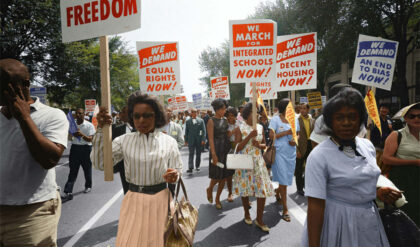
Many of the most famous Black History Month quotes come from the long struggle for freedom and equal rights. These words connect slavery, abolition, Reconstruction, segregation, civil rights, and the continuing work of justice.
1. Frederick Douglass: “If there is no struggle, there is no progress.”
Frederick Douglass escaped slavery and became one of the most powerful abolitionist speakers and writers of the nineteenth century. This quote, preserved in public memory and highlighted by the Library of Congress, reminds readers that progress is rarely handed down by those in power. It is often won through pressure, organizing, courage, and persistence.
Douglass’s words challenge a simple version of history. Freedom was not a single event. It was a long fight involving enslaved people, abolitionists, Black soldiers, writers, speakers, families, churches, and communities.
2. Sojourner Truth: “I am a woman’s rights.”
Sojourner Truth, who was born into slavery in New York and later became an abolitionist and women’s rights speaker, delivered a famous speech at the 1851 Women’s Rights Convention in Akron, Ohio. Many people remember that speech through the later title “Ain’t I a Woman?” but historians note that later versions changed some wording and added dialect that likely did not match Truth’s own speech.
The line “I am a woman’s rights,” included in early accounts of the speech and discussed by Dickinson College’s House Divided project, places Truth herself at the center of the argument. She was not asking to be included as an afterthought. She was showing that Black women’s labor, strength, intelligence, and dignity belonged in the conversation from the beginning.
3. Martin Luther King Jr.: “Injustice anywhere is a threat to justice everywhere.”
Martin Luther King Jr. wrote these words in his 1963 “Letter from Birmingham Jail” while responding to critics who called civil rights protests “unwise and untimely.” The quote explains one of King’s central ideas: injustice is never isolated. What happens to one community affects the moral health of the whole society.
For Black History Month, this line turns history into a question of responsibility. It asks readers to think about how laws, customs, silence, and public action can either protect justice or weaken it.
Quotes About Courage and Resistance
Courage in Black history did not always look dramatic from the outside. Sometimes it meant publishing the truth, refusing an unjust order, trying to register to vote, organizing neighbors, or speaking in public when doing so carried real danger.
4. Ida B. Wells: “The way to right wrongs is to turn the light of truth upon them.”
Ida B. Wells was a journalist, educator, and anti-lynching activist. In the late nineteenth and early twentieth centuries, she investigated racial violence and used facts, reporting, and public speaking to challenge lies used to justify lynching. The New York Public Library’s Schomburg Center connects this quote to Wells’s anti-lynching writings and legacy.
Her words show why history and journalism matter. Wells understood that injustice often survives through silence, fear, and misinformation. By documenting violence and exposing false stories, she made truth a form of resistance.
5. Rosa Parks: “I would like to be remembered as a person who wanted to be free and wanted other people to be also free.”
Rosa Parks is often remembered for refusing to give up her bus seat in Montgomery, Alabama, on December 1, 1955. That act helped spark the Montgomery Bus Boycott, one of the major campaigns of the modern civil rights movement.
This quote, preserved in a Library of Congress print, expands the familiar story. Parks was not simply tired on a bus. She was a longtime activist whose vision of freedom reached beyond herself. Her words connect personal courage with collective liberation.
6. Fannie Lou Hamer: “I’m sick and tired of being sick and tired.”
Fannie Lou Hamer was a Mississippi voting rights activist who helped challenge racial exclusion in American politics. She delivered a speech using this famous phrase in 1964 at a Harlem rally supporting the Mississippi Freedom Democratic Party’s Congressional Challenge, according to the Archives of Women’s Political Communication.
Hamer’s words carried exhaustion and determination at the same time. Her life shows that voting rights history was not abstract. Black citizens who tried to register to vote in the Jim Crow South often faced threats, job loss, violence, and humiliation. Her quote helps readers understand the human cost of systems that denied people basic political rights.
7. John Lewis: “Get in good trouble, necessary trouble.”
John Lewis was a civil rights organizer, student activist, and later a longtime member of Congress. His phrase “good trouble” became a short way to describe nonviolent action against injustice.
Lewis used the phrase while speaking about civil rights memory and public responsibility, including during commemorations at the Edmund Pettus Bridge in Selma, Alabama. As Brookings explains, “good trouble” was not chaos for its own sake. It meant disciplined, moral action when ordinary rules protected an unjust system.
Quotes About Education, Knowledge, and History
Education has always been central to Black freedom movements. During slavery, many states restricted or punished Black literacy. After emancipation, freedpeople built schools, supported teachers, and made education a foundation for citizenship and self-determination.
8. Carter G. Woodson: “Real education means to inspire people to live more abundantly.”
Carter G. Woodson is often called the “Father of Black History.” His 1933 book The Mis-Education of the Negro argued that education should help people understand their own lives, history, and possibilities rather than train them to accept inequality.
This quote fits Black History Month especially well because it explains why history education matters. Woodson did not want students to memorize facts without meaning. He wanted education to help people think clearly, act responsibly, and build fuller lives.
9. Mary McLeod Bethune: “I leave you a thirst for education.”
Mary McLeod Bethune was an educator, civil rights leader, and government adviser. She founded a school for Black girls in Florida that later became Bethune-Cookman University. In her 1955 “Last Will and Testament,” shared by Bethune-Cookman University, she described the values she wanted to leave future generations, including love, hope, faith, dignity, and education.
The phrase “I leave you a thirst for education” captures a major theme in Black educational history. Education was not only about reading, writing, or job training. It was also about dignity, confidence, opportunity, and belief in human possibility.
10. James Baldwin: “Nothing can be changed until it is faced.”
James Baldwin was a novelist, essayist, and public intellectual whose work examined race, identity, power, love, and American society. His words explain why honest history matters.
Black History Month is not only a celebration of heroes. It is also a time to face hard truths: slavery, segregation, racial violence, exclusion, and inequality. Baldwin’s line reminds readers that avoiding the past does not heal it. Understanding it is part of the work of change.
Quotes About Identity, Pride, and Self-Worth
Black writers and artists have often used language to defend dignity and expand how people understand identity. Their words remind us that history is not only made in courtrooms, legislatures, and protest marches. It is also made in novels, poems, songs, classrooms, kitchens, churches, newspapers, and family stories.
11. Maya Angelou: “Still I rise.”
Maya Angelou’s poem “Still I Rise” has become one of the most recognized expressions of resilience in modern American literature. The phrase is short, but it carries a large message: oppression, insult, and false history do not have the final word.
For Black History Month, Angelou’s words connect personal strength with collective memory. The line speaks to generations who survived, created, resisted, and continued forward.
12. Audre Lorde: “The master’s tools will never dismantle the master’s house.”
Audre Lorde was a poet, essayist, Black feminist thinker, and activist. Her essay “The Master’s Tools Will Never Dismantle the Master’s House” challenges readers to think carefully about power, difference, and exclusion.
Lorde’s words ask a deeper question about reform. Are people only trying to be included in old structures, or are they trying to build something more just? That question remains important in discussions of race, gender, education, and activism.
13. Toni Morrison: “We do language.”
Toni Morrison won the Nobel Prize in Literature in 1993. In her Nobel Lecture, she explored language as something alive, powerful, and morally serious.
This quote matters because Black history has often been shaped by who gets to speak, who gets recorded, and whose stories are treated as worthy of study. Morrison’s work reminds readers that language can harm, but it can also preserve truth and create freedom.
Quotes About Leadership and Community
Black history is often taught through famous individuals, but no major movement was built by one person alone. Behind well-known leaders were organizers, families, students, teachers, churches, unions, artists, local groups, and ordinary people doing difficult work.
14. Shirley Chisholm: “If they don’t give you a seat at the table, bring a folding chair.”
This quote is widely associated with Shirley Chisholm, though its exact origin is debated. Quote Investigator traces the phrase through later public recollections connected to Chisholm’s legacy rather than a single confirmed original speech.
Even with that caution, the line fits Chisholm’s public life. She became the first Black woman elected to the United States Congress in 1968 and later ran for the Democratic presidential nomination in 1972. Her career showed that democracy is incomplete when whole groups are excluded from decision-making. The quote has endured because it captures the demand for representation in plain, memorable language.
15. Coretta Scott King: “Freedom is never really won. You earn it and win it in every generation.”
Coretta Scott King was an activist, author, and organizer who worked to preserve Martin Luther King Jr.’s legacy while continuing her own advocacy for civil rights, peace, and justice. This quote is commonly cited in discussions of her work and legacy.
The historical lesson is clear: rights can be expanded, challenged, protected, or weakened over time. Black History Month should not be treated as a closed chapter. It is part of an ongoing conversation about citizenship, memory, and responsibility.
Quotes About Hope, Creativity, and the Future
Black history includes protest and survival, but it also includes imagination. Black poets, scientists, musicians, artists, athletes, inventors, teachers, and writers have helped people imagine futures beyond the limits placed on them.
16. Langston Hughes: “Hold fast to dreams.”
Langston Hughes was one of the major writers of the Harlem Renaissance. His poem “Dreams” is brief, but its message is lasting. Hughes understood dreams not as empty wishes, but as necessary sources of strength.
This line fits Black History Month because hope has often been practical. Enslaved people dreamed of freedom. Students dreamed of schools. Activists dreamed of voting rights. Writers dreamed of telling the truth. Hope helped people build, organize, and endure.
17. Octavia E. Butler: “All good things must begin.”
Octavia E. Butler was a groundbreaking science fiction writer whose work explored power, survival, race, gender, environment, and human behavior. This line is commonly connected to Butler’s notebook and journal writings, which are part of the wider public interest in her creative process and archive.
For students, Butler is a reminder that Black history is not only about the past. It also includes future-making: art, science, technology, literature, and new ways of thinking about society. Her words encourage readers to see beginnings as part of historical change.
How Students Can Study These Quotes
Quotes are useful study tools when readers do more than memorize them. A good historical quote can help students identify a person, a period, a problem, and a larger idea.
When studying a Black History Month quote, ask four questions:
- Who said it? Learn the speaker’s basic biography and role in history.
- Where did it come from? Check whether the quote came from a speech, poem, book, letter, interview, or later recollection.
- What problem was the speaker addressing? Connect the words to slavery, segregation, voting rights, education, literature, labor, culture, or another historical issue.
- Why does it still matter? Explain the lesson in your own words instead of only repeating the quote.
This approach turns a quote list into a history lesson. It helps readers move from inspiration to understanding.
Final Thoughts
Famous Black History Month quotes matter because they carry memory. They help readers hear the voices of people who fought for freedom, exposed injustice, built schools, wrote literature, led movements, protected communities, and imagined better futures.
But the quote is only the beginning. The deeper lesson comes from studying the person behind the words and the history around them. When read with care, these quotes can become more than inspirational lines. They can become doorways into the larger story of Black history, American history, and the continuing work of justice.