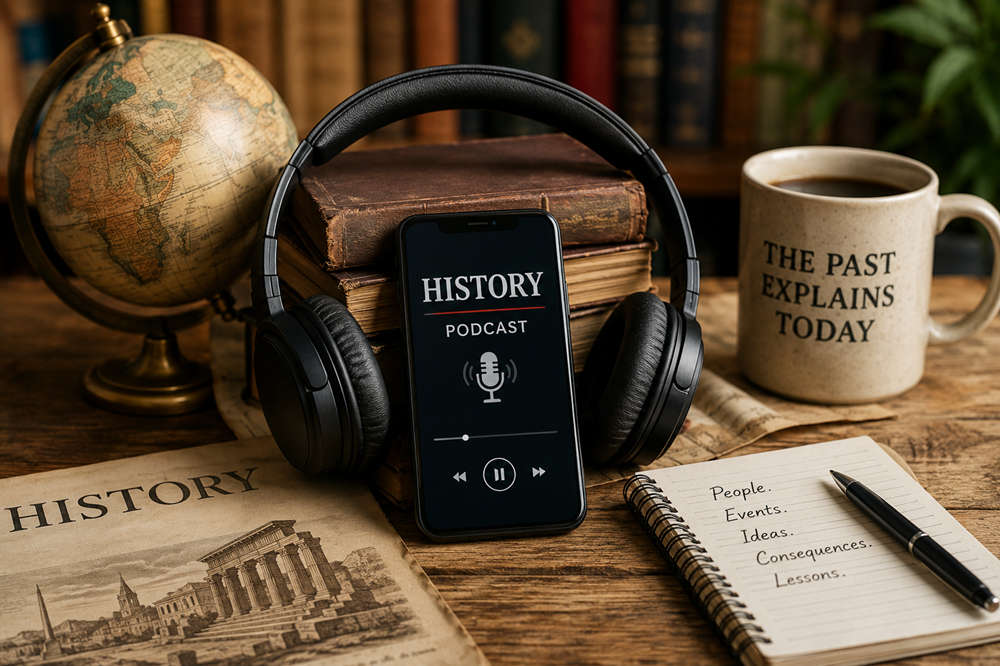
History podcasts make it easier to learn about the past without sitting at a desk. You can listen while walking, commuting, cleaning, exercising, or taking a study break. The best history podcasts do more than repeat dates and names. They explain people, choices, causes, conflicts, and consequences in a way that helps history feel connected and understandable.
The right podcast depends on how you like to learn. For broad history, The Rest Is History is a strong place to start. For expert interviews, HistoryExtra works well. For comedy, You’re Dead to Me is especially beginner-friendly. For U.S. history, American History Tellers gives major events a clear story shape. For deep historical change, Revolutions is one of the most useful long-form options.
What Makes a Good History Podcast?
A good history podcast should help listeners understand more than what happened. It should also explain why events mattered, how people made decisions, and what changed afterward. Strong history podcasts usually have clear storytelling, careful context, and a host who can guide listeners through complicated topics without making them feel lost.
For students and beginners, pacing matters. A podcast that jumps too quickly between names, dates, and places can be hard to follow. The most helpful shows explain background information as they go. They define unfamiliar terms, introduce important figures clearly, and avoid assuming that every listener already knows the subject.
For deeper learners, expert guests and source-based discussion become more important. Some podcasts bring in historians, authors, archaeologists, journalists, or museum professionals who have studied a topic closely. Others use narrative storytelling to make historical events feel vivid and memorable. Both styles can be useful, depending on the listener’s goal.
Availability matters too. A podcast is easier to recommend when it has a large archive, steady updates, and access through major platforms such as Apple Podcasts, Spotify, YouTube, Audible, or the show’s own website.
Best Overall History Podcast: The Rest Is History
The Rest Is History works well for listeners who want one podcast that can cover many parts of the past. Hosted by historians Tom Holland and Dominic Sandbrook, the show moves across ancient history, modern politics, famous rulers, cultural stories, wars, scandals, books, and unexpected historical questions.
Its biggest advantage is range. A student might listen to an episode about the Roman world one day and a discussion of twentieth-century politics the next. A casual listener can enjoy the conversational style, while a more serious history fan can use the show as a doorway into deeper reading.
The podcast succeeds because it treats history as a set of connected stories rather than a list of facts. The hosts often explain why a person, event, or idea mattered, and their discussions can make unfamiliar subjects easier to approach.
Start here if you want one flexible history podcast that can introduce you to many periods, places, and historical personalities.
Best History Podcast for Expert Interviews: HistoryExtra
HistoryExtra is more interview-driven than many narrative history podcasts. Connected to BBC History Magazine, it features conversations with historians and authors on topics from ancient history to recent British, American, and world history.
This format is helpful for readers who want to hear from specialists. Instead of following only one host’s interpretation, listeners can hear from people who have written books, studied archives, researched specific periods, or worked closely with a particular historical question.
The topic range is broad. Episodes cover monarchs, wars, archaeology, politics, daily life, empires, revolutions, women’s history, social change, and historical debates. Because many episodes are standalone interviews, listeners can choose topics that match a class assignment, personal interest, or reading project.
Start here if you prefer expert discussion over dramatic narration, or if you want a podcast that can support serious history learning without feeling too academic.
Best Funny History Podcast: You’re Dead to Me
You’re Dead to Me takes a lighter route into the past. Created and hosted by historian Greg Jenner, the show pairs historians with comedians to explore surprising, important, and sometimes overlooked subjects from global history.
The comedy makes the podcast easier to enter, but the history still has substance. A historian provides the main knowledge, while the comedian reacts, asks questions, and keeps the conversation lively. This setup is especially helpful for listeners who find traditional history lessons too dry.
The show is also useful because it often introduces people, places, and stories that do not always receive much attention in basic survey courses. That makes it a good choice for students who want variety, beginners who need a friendly tone, and casual listeners who remember information better when it comes with humor.
Start here if you usually find history intimidating, or if you want a show that makes learning feel relaxed without turning the subject into trivia.
Best Podcast for History Behind Current Events: Throughline
Throughline stands out because it connects past events to present-day questions. Produced by NPR, the show often begins with a modern issue and then looks backward to explain how that issue developed over time.
This approach is valuable for students studying government, politics, social movements, international relations, or modern world history. Instead of treating history as something sealed off from the present, Throughline shows how older decisions, conflicts, laws, ideas, and institutions can shape the world people live in now.
The show also uses narrative structure and sound design to make episodes feel immersive. It does not simply list events in order. It builds each episode around a question, which helps listeners follow cause and effect more clearly.
Start here if you often ask, “How did we get here?” and want history that explains the roots of current debates and modern life.
Best U.S. History Podcast: American History Tellers
American History Tellers is a strong pick for listeners who want U.S. history in a narrative style. Hosted by Lindsay Graham and produced by Wondery, the show focuses on events, people, and turning points that shaped the United States.
The podcast often places listeners inside a historical moment. Rather than giving only a summary, it follows choices, conflicts, and consequences as they unfold. This can make major topics easier to remember, especially for students who struggle with textbook chapters that move quickly from one event to another.
American History Tellers can help listeners understand political movements, wars, legal changes, cultural shifts, national crises, and public figures. It is not a substitute for a full U.S. history course, but it can make the main themes of American history feel more concrete.
Start here if you want American history told through clear scenes, turning points, and human decisions.
Best Podcast for Revolutions and Political Change: Revolutions
Revolutions, created by Mike Duncan, is one of the best history podcasts for understanding political upheaval. The show is organized around major revolutionary movements and uses long-form narrative to explain how revolutions begin, develop, succeed, fail, and reshape societies.
This podcast is especially useful for students of modern world history. Revolutions are often difficult to understand because they involve economic pressure, political ideas, class conflict, leadership struggles, violence, reform, reaction, and unintended consequences. Duncan’s structured approach helps listeners follow those moving parts over time.
The show is also helpful because it makes comparison easier. After listening to more than one season, readers can begin to notice patterns: rising frustration, weak institutions, divided elites, popular mobilization, radicalization, and struggles over what should come next.
Start here if you want to understand how large-scale political change happens, especially in modern world history.
Best History Podcast Network for Variety: History Hit
History Hit is useful for listeners who want many history options in one place. The network includes shows such as Dan Snow’s History Hit, The Ancients, Gone Medieval, Not Just the Tudors, American History Hit, and other history-focused programs.
This range makes History Hit a good choice for people who already know the periods they enjoy. Someone interested in the ancient world can try The Ancients. A listener drawn to the Middle Ages can choose Gone Medieval. Readers interested in Tudor history can explore Not Just the Tudors. General listeners can begin with Dan Snow’s History Hit.
The network format also makes it easier to build a listening habit. Instead of searching for a completely new show every time, listeners can move between related podcasts within the same history-focused space.
Start here if you want topic variety and like the idea of choosing podcasts by period, region, or theme.
Best Royal History Podcast: Noble Blood
Noble Blood focuses on monarchs, royal families, power, tragedy, and personal stories that affected political history. Hosted by author Dana Schwartz, the podcast explores royals who were powerful, misunderstood, doomed, dangerous, or caught in events larger than themselves.
Royal history can easily become gossip, but this podcast is most useful when it shows how personal decisions could affect entire countries. A marriage, betrayal, succession crisis, execution, family conflict, or court rivalry could change the future of a kingdom.
The show is especially appealing for listeners who enjoy biography and dramatic storytelling. It often focuses on people whose lives included ambition, danger, scandal, or tragedy. For students, that can make historical figures easier to remember as human beings rather than names on a family tree.
Start here if you like monarchy, political drama, dynastic conflict, and the human side of power.
Best Long-Form History Podcast: Hardcore History
Hardcore History, hosted by Dan Carlin, is one of the best-known long-form history podcasts. It is best for listeners who enjoy dramatic, detailed, and immersive historical storytelling. Episodes can be much longer than standard podcast episodes, so the show works better for deep listening than quick review.
Hardcore History is not a traditional classroom lecture, and it should not be treated as the only source for serious study. Its strength is scale, atmosphere, and narrative force. Carlin often explores war, empire, crisis, violence, leadership, and major turning points with a style that feels closer to an intense audio documentary than a short lesson.
This podcast fits listeners who want to spend several hours with one major topic. It is especially effective for big historical questions: How do societies break down? Why do wars become so destructive? What makes leaders dangerous? How do ordinary people experience extreme historical moments?
Start here if you have the patience for long episodes and want history that feels immersive and dramatic.
Best History Podcasts by Type of Listener
For Students
Students often need podcasts that explain context clearly and avoid moving too quickly. HistoryExtra, You’re Dead to Me, American History Tellers, and Revolutions are especially helpful because they make large topics easier to follow. These shows can be used before reading a textbook chapter, after class for review, or while preparing for a project.
For Casual Listeners
Casual listeners may prefer shows that are easy to enter without much background knowledge. The Rest Is History, You’re Dead to Me, and Noble Blood are good choices because they focus on memorable stories, interesting personalities, and clear explanations. They make history feel enjoyable rather than like homework.
For Deep-Dive Learners
Deep-dive learners should try Hardcore History, Revolutions, HistoryExtra, and selected History Hit shows. These options give listeners more time with a topic or more access to expert discussion. They are useful for people who want to understand not only what happened, but also why historians care about causes, evidence, and interpretation.
For U.S. History Readers
American History Tellers is the clearest pick for U.S. history storytelling. Throughline is also useful when episodes connect American history to modern laws, institutions, politics, or social questions. Together, these shows can help readers understand both national stories and the long roots of present-day issues.
For World History Readers
World history readers should start with The Rest Is History, HistoryExtra, Revolutions, and History Hit’s network of podcasts. These shows cover many regions and time periods, making them useful for readers who want to move beyond one country or one era.
For People Who Like Funny Learning
You’re Dead to Me is the best choice for listeners who want humor with real historical substance. Its format makes history less intimidating while still giving space to expert explanation. It is a good reminder that learning history does not have to feel dry.
Comparison Table: Which History Podcast Should You Try First?
| Podcast | Best For | Main Style | Time Commitment | Best Starting Listener |
|---|---|---|---|---|
| The Rest Is History | Broad history learning | Conversational storytelling | Medium | Someone who wants a wide range of topics |
| HistoryExtra | Expert interviews | Historian and author conversations | Low to medium | Someone who likes specialist insight |
| You’re Dead to Me | Funny, beginner-friendly learning | Comedy with expert history | Low to medium | Someone who wants history to feel lighter |
| Throughline | History behind current events | Narrative journalism | Medium | Someone who wants context for modern issues |
| American History Tellers | U.S. history | Narrative storytelling | Medium | Someone studying American events and turning points |
| Revolutions | Political change and modern world history | Long-form chronological narrative | High | Someone who wants structured deep learning |
| History Hit | Podcast variety | Network of topic-focused shows | Flexible | Someone who wants to choose by period or theme |
| Noble Blood | Royal history | Dramatic biography | Low to medium | Someone interested in monarchy and power |
| Hardcore History | Long-form deep dives | Dramatic extended narration | Very high | Someone ready for immersive historical storytelling |
How to Use History Podcasts for Learning
History podcasts are most useful when listeners treat them as a starting point. A good episode can introduce a topic, explain a confusing event, or make a historical figure easier to remember. For serious study, though, it helps to pair listening with books, timelines, maps, museum pages, primary sources, or class notes.
One simple method is to listen with a question in mind. Instead of starting an episode on the French Revolution with no goal, ask: What caused the revolution? Who gained power? Who lost power? What changed afterward? A guiding question makes it easier to remember the main points.
It also helps to pause and look up unfamiliar names, places, and dates. History often becomes confusing when too many new terms appear at once. A quick map, timeline, or short biography can make the rest of an episode easier to follow.
Students can take short notes after listening. These do not need to be long. A useful note might include the main topic, three important facts, one cause, one effect, and one question to research later. This turns a podcast from background noise into a learning tool.
Finally, try more than one podcast style. Some topics are easier to understand through expert interviews. Others are easier to remember through dramatic storytelling. Comedy can help with first exposure, while long-form episodes can support deeper interest. A strong learning routine often includes a mix.