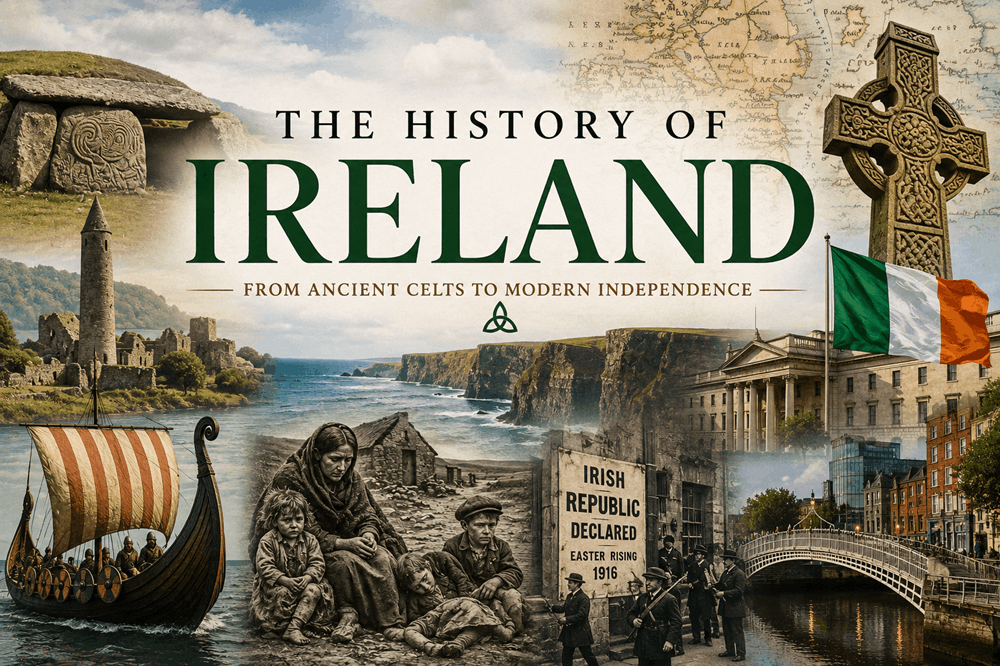
Ireland’s history stretches from ancient monuments and Gaelic kingdoms to British rule, famine, revolution, partition, and modern independence. The island’s story includes rich culture, deep conflict, mass migration, and a strong sense of national identity that spread far beyond Ireland itself.
Ireland’s History at a Glance
| Period | What Happened | Why It Mattered |
|---|---|---|
| Prehistoric Ireland | Early farming communities built monuments such as passage tombs at Brú na Bóinne. | These sites show that Ireland had complex societies long before written records. |
| Iron Age and Gaelic Ireland | Gaelic language, law, kingship, poetry, and oral tradition became central to Irish society. | Gaelic culture shaped Irish identity for centuries. |
| 5th century onward | Christianity spread across Ireland. | Monasteries, manuscripts, and learning made Ireland important in early medieval Europe. |
| Late 700s–1000s | Vikings raided, traded, and founded towns such as Dublin. | Viking settlement connected Ireland more strongly to sea trade and urban life. |
| 1169 onward | Norman forces arrived in Ireland. | This began a deeper phase of English involvement in Irish politics and landholding. |
| 1500s–1600s | Tudor conquest, plantations, and religious conflict reshaped Ireland. | Land, religion, and political power became deeply connected. |
| 1801 | The Act of Union joined Ireland to Great Britain in the United Kingdom. | Ireland lost its own parliament, strengthening calls for reform and self-government. |
| 1845–1849 | The Great Famine devastated Ireland. | About one million people died, and roughly two million emigrated in the following years. |
| 1916 | The Easter Rising took place in Dublin. | It helped shift Irish nationalism toward independence. |
| 1919–1923 | War of Independence, Anglo-Irish Treaty, Irish Free State, partition, and Civil War. | Ireland was divided, and a new self-governing state was created. |
| Late 1960s–1998 | The Troubles brought violence and political conflict in Northern Ireland. | The conflict shaped relations between communities, governments, and identities. |
| 1998 | The Good Friday Agreement was signed. | It created a peace framework for Northern Ireland and changed politics across the island. |
| Modern Ireland | The Republic of Ireland became a modern European state with a global diaspora. | Irish culture, politics, and identity continue to have worldwide influence. |
Ancient Ireland Before Written Records
Ireland’s story begins long before written history. Early people arrived on the island after the last Ice Age. Over time, communities hunted, farmed, built homes, made tools, raised animals, and created monuments that still shape the Irish landscape today.
One of the most famous prehistoric areas is Brú na Bóinne in County Meath, which includes Newgrange, Knowth, and Dowth. The National Museum of Ireland describes these passage tombs as part of Ireland’s prehistoric story, along with tools, pottery, personal objects, and early metalworking. These sites remind us that ancient Ireland was not simple or empty. It had skilled builders, farmers, artists, and communities with strong beliefs about death, time, and the natural world.
Newgrange is especially important because it was built more than 5,000 years ago. Its passage and chamber align with the winter solstice sunrise, showing that prehistoric communities carefully observed the sky. Even without writing, they left behind evidence of planning, belief, labor, and social organization.
Gaelic Ireland and Early Society
When people talk about ancient Ireland, they often use the word “Celtic.” That word can be useful, but it should be used carefully. Ireland’s early culture developed over a long time, and historians still debate exactly how Celtic languages and cultural patterns spread. What is clear is that Gaelic language, law, poetry, kingship, and oral tradition became deeply important in Irish society.
Early Ireland was not one united kingdom. It was made up of many smaller kingdoms and local power centers. Kings ruled over territories, but their power depended on alliances, warfare, tribute, family connections, and reputation. Society included farmers, warriors, craftspeople, poets, judges, religious figures, and enslaved or dependent people.
Irish law and custom were shaped by kinship and status. Poets and learned classes preserved stories, genealogies, praise poems, and legal knowledge. Oral tradition mattered because many histories, laws, and legends were remembered and passed down by trained speakers before they were written in manuscript form.
This Gaelic world helped shape Ireland’s later identity. Even after foreign invasions, colonization, and political change, the Irish language, music, storytelling, place names, and memory of Gaelic society remained powerful symbols.
Christianity, Monasteries, and Ireland’s Golden Age
Christianity spread in Ireland during the early medieval period, especially from the fifth century onward. Saint Patrick is the most famous missionary linked to Ireland, but he was not the only one. Christianity reached the island through contact with Roman Britain, missionaries, trade, and local rulers who accepted the new religion.
Christianity did not erase Irish culture overnight. Instead, it blended with parts of the existing society. Monasteries became major centers of religion, learning, art, and manuscript production. Monks copied texts, studied Latin, preserved religious writings, and helped connect Ireland to Britain and continental Europe.
This period is sometimes called Ireland’s “golden age” of monastic learning. Irish monasteries produced beautiful manuscripts and trained scholars who traveled abroad. Irish missionaries and teachers helped spread Christianity and learning in other parts of Europe.
Still, this was not a peaceful age without conflict. Monasteries were also landholders, political players, and targets of raids. Irish society remained divided among kingdoms and powerful families. The Christian period brought learning and art, but it also existed within a world of rivalry and warfare.
Vikings, Towns, and Trade
Vikings began raiding Ireland in the late eighth century. At first, they attacked monasteries and coastal sites because those places held wealth, food, people, and portable goods. These raids were frightening and destructive, especially for religious communities.
But Vikings were more than raiders. Over time, they also became traders, settlers, and town builders. They established important coastal settlements, including Dublin, Waterford, Wexford, Cork, and Limerick. These towns became centers of trade, craft production, and political power.
Dublin became especially important. It connected Ireland to a wider Viking world that stretched across the Irish Sea, Britain, Scandinavia, and beyond. Trade brought goods, people, ideas, and conflict. Viking settlement changed Ireland by strengthening urban life and linking the island more closely to sea networks.
Irish kings fought Vikings, allied with them, married into their families, and competed for control of towns. By the time the Viking age faded, Ireland had changed. It remained Gaelic, but it was now more connected to international trade and urban politics.
Norman Arrival and English Influence
The Norman arrival in 1169 began another major turning point. Norman forces first came to Ireland as part of a local Irish power struggle, but their arrival opened the door to deeper English involvement. King Henry II of England soon asserted authority over parts of Ireland.
The Normans built castles, founded towns, introduced new forms of landholding, and controlled areas especially in eastern and southern Ireland. The region around Dublin became known as the Pale, where English law and influence were strongest.
For centuries, English control was strongest in some eastern areas, while many Gaelic Irish lordships continued to rule large parts of the island.
Norman power did not spread evenly across the island. In many areas, Gaelic Irish rulers remained strong. Over time, some Norman families adopted Irish language, customs, and alliances. This led to the famous phrase that some became “more Irish than the Irish themselves.”
Still, the Norman arrival mattered because it began a long and complicated relationship between Ireland and England. Over the next several centuries, English influence expanded, weakened, and expanded again, depending on war, marriage, politics, rebellion, and royal power.
Plantations, Religion, and Conflict
The 1500s and 1600s brought deeper English and later British control. The Tudor conquest aimed to bring all of Ireland under English authority. In 1541, Henry VIII was declared King of Ireland, marking a new royal claim over the island.
Religion became increasingly important after the Protestant Reformation. England became Protestant, while most Irish people remained Catholic. This difference became tied to land ownership, political rights, law, education, and power. But Irish conflict was never only about religion. It was also about land, empire, class, identity, language, and government.
The plantation system reshaped parts of Ireland, especially Ulster. Land was taken from many Irish Catholic owners and granted to Protestant settlers from England and Scotland. These plantations changed the population, economy, and politics of the island.
The 1600s brought rebellion, war, and brutal violence. Cromwell’s campaign in Ireland in the 1640s and 1650s left deep scars. Later, the Williamite War and the Battle of the Boyne in 1690 became important symbols, especially in Protestant unionist memory.
After these conflicts, the Protestant Ascendancy held major political and economic power. Penal laws restricted Catholics and, at times, Protestant dissenters. The result was a society where the Catholic majority often had limited rights while a Protestant elite controlled much of the land and government.
The Act of Union and the Great Famine
In 1801, the Act of Union joined the Kingdom of Ireland with Great Britain to form the United Kingdom of Great Britain and Ireland. Ireland’s parliament in Dublin was abolished, and Irish representatives sat in the British Parliament at Westminster.
Many Irish people wanted reform, Catholic rights, land reform, or self-government. Catholic Emancipation in 1829 allowed Catholics to sit in Parliament, but many deeper problems remained. Poverty, unequal land ownership, and dependence on tenant farming shaped much of rural Ireland.
The Great Famine was one of the most devastating events in Irish history. From 1845 to 1849, potato blight destroyed the crop that many poor tenant farmers depended on for survival. Britannica describes the Great Famine as the worst famine in Europe in the 19th century, with about one million deaths and an estimated two million more people emigrating.
The famine was not only a natural disaster. Potato blight caused the crop failure, but poverty, landholding patterns, eviction, economic policy, and the British government’s response made the suffering worse. Many Irish people believed the government failed to act with enough urgency or compassion.
The famine changed Ireland permanently. The population fell sharply. Irish-speaking communities were badly affected. Families were broken by death and emigration. Millions of Irish people and their descendants built new lives in the United States, Britain, Canada, Australia, and elsewhere. The famine also deepened anger toward British rule and strengthened Irish nationalism.
Nationalism, Home Rule, and the Easter Rising
In the late 1800s and early 1900s, Irish nationalism grew in many forms. Some people wanted Home Rule, which meant Ireland would have its own parliament while remaining within the United Kingdom. Others wanted full independence.
The Gaelic Revival also shaped Irish identity. Writers, teachers, athletes, and activists promoted Irish language, literature, sports, music, and culture. Organizations such as the Gaelic League and the Gaelic Athletic Association helped connect culture to national identity.
Home Rule became one of the biggest political questions of the era. Many Irish nationalists supported it, while many unionists, especially in Ulster, opposed it because they wanted to remain fully part of the United Kingdom. Tensions rose as both sides organized politically and militarily.
In 1916, the Easter Rising took place in Dublin. Members of the Irish Volunteers and the Irish Citizen Army occupied key buildings and proclaimed an Irish Republic. The rising was defeated, but the British execution of its leaders changed public opinion. The National Archives’ guide to Ireland’s Easter Rising notes that on Easter Monday, April 24, 1916, rebels occupied buildings in Dublin and proclaimed an Irish Republic.
At first, many Irish people did not support the rising. But after the executions and military response, sympathy grew. The Easter Rising became a turning point on the road to independence.
Independence, Partition, and Civil War
After the Easter Rising, Irish politics changed quickly. Sinn Féin gained support, and in 1919 Irish nationalists created a separate parliament called Dáil Éireann. The War of Independence followed, fought between Irish republican forces and British forces.
The conflict ended with the Anglo-Irish Treaty in 1921. The treaty created the Irish Free State as a self-governing dominion within the British Empire. It also confirmed partition. Northern Ireland, made up of six counties in the northeast, remained part of the United Kingdom.
The treaty split Irish nationalists. Supporters argued that it gave Ireland real self-government and a path toward greater independence. Opponents argued that it fell short of a full republic and accepted partition and loyalty to the British Crown.
This disagreement led to the Irish Civil War from 1922 to 1923. The Civil War was bitter because it divided people who had fought on the same side during the independence struggle. It shaped Irish politics for decades.
The National Archives of Ireland’s Decade of Centenaries collection covers key events from 1912 to 1923, including the 1916 Rising, the War of Independence, and the Civil War. This period created the foundations of modern Irish politics.
Northern Ireland and the Troubles
Partition created two different political paths on the island. The Irish Free State later became the Republic of Ireland. Northern Ireland remained within the United Kingdom. In Northern Ireland, politics were shaped by a unionist majority, largely Protestant, and a nationalist minority, largely Catholic.
The Troubles began in the late 1960s after civil rights protests, political tension, discrimination, policing conflict, and community division escalated into violence. It is too simple to describe the Troubles as only a religious conflict. Religion mattered because it was tied to identity and community, but the conflict was also about civil rights, national identity, policing, constitutional status, land, memory, and political power.
Unionists and loyalists generally wanted Northern Ireland to remain part of the United Kingdom. Nationalists and republicans generally wanted Irish unity. Paramilitary groups, the British Army, police forces, political parties, and civilians were all part of the conflict’s history.
The CAIN Archive at Ulster University contains information and source material on the Troubles and politics in Northern Ireland, covering the conflict and its wider social setting. This is useful because the Troubles cannot be understood through one event or one viewpoint.
The Good Friday Agreement, also called the Belfast Agreement, was signed on April 10, 1998. The Irish government describes the Good Friday Agreement as laying the foundations to build peace in Northern Ireland. It created new political institutions, supported power-sharing, and recognized that Northern Ireland’s constitutional future should depend on consent.
The agreement did not erase every problem. Northern Ireland has continued to face political tension, identity debates, and questions about the past. But the agreement greatly reduced violence and remains one of the most important peace frameworks in modern European history.
Modern Ireland and the Irish Diaspora
The Republic of Ireland changed greatly in the 20th and 21st centuries. It moved from a poor, mainly rural country to a modern European state with cities, technology industries, universities, tourism, and global cultural influence. Ireland joined the European Economic Community, now the European Union, in 1973, which helped shape its economy and international role.
Membership connected Ireland more closely to European markets, funding, diplomacy, and political cooperation.
The Irish state also developed its own foreign policy. The Documents on Irish Foreign Policy project makes Irish diplomatic history more accessible and shows how Ireland’s international relations developed from 1919 onward.
Modern Ireland is known for literature, music, film, sport, technology, education, and tourism. Irish writers, musicians, actors, and artists have had worldwide influence. Irish culture travels easily because the Irish diaspora is so large.
The Irish diaspora grew from many waves of migration, especially after the Great Famine. Irish communities formed across the United States, Britain, Canada, Australia, New Zealand, and many other places. For many descendants of Irish emigrants, Irish history is also family history.
At the same time, Ireland continues to debate language, memory, religion, migration, housing, economy, and identity. Irish history did not end with independence. It continues in questions about the Republic of Ireland, Northern Ireland, Europe, and the global Irish community.
Key Takeaways From Irish History
- Ireland’s history began long before written records, with prehistoric communities that built major monuments and developed rich material cultures.
- Gaelic language, law, storytelling, and kingship shaped Ireland’s identity for centuries.
- Christian monasteries made Ireland an important center of learning in early medieval Europe.
- Viking and Norman arrivals changed Ireland through trade, towns, warfare, landholding, and outside rule.
- English and British power reshaped Ireland through conquest, plantations, religion, land policy, and law.
- The Great Famine transformed Ireland through death, emigration, population loss, and political anger.
- The struggle for independence led to the Irish Free State, partition, and Civil War.
- Northern Ireland’s history must be understood through politics, identity, civil rights, community division, and the peace process.
- Modern Ireland is both a European country and the center of a worldwide Irish diaspora.
The history of Ireland is not a simple story of one people moving in one direction. It is a story of ancient culture, outside influence, survival, conflict, migration, creativity, and political change. To understand Ireland, readers need to see both the island itself and the millions of Irish people and descendants whose history spread around the world.