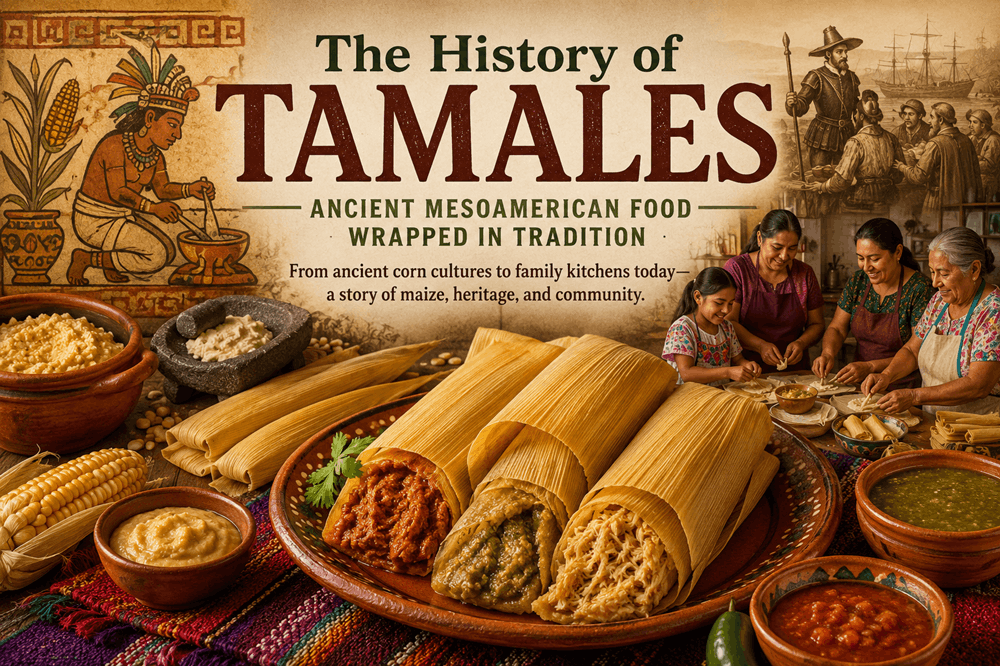
Tamales have roots in ancient Mesoamerica, where Indigenous peoples shaped corn dough around fillings, wrapped it in leaves, and cooked it as a portable, meaningful food. Over time, tamales became more than a meal. They became part of ceremonies, holidays, family gatherings, regional identity, and Mexican and Latin American food culture.
The Short Answer: Where Did Tamales Come From?
Tamales come from Indigenous Mesoamerican food traditions. They developed long before Spanish colonization and were built around maize, one of the most important crops in the region. Different Indigenous communities made versions of wrapped corn dough using local leaves, fillings, and cooking methods.
It is better to describe tamales as a Mesoamerican food with deep pre-Hispanic roots rather than saying one single group invented them. The Aztec, Maya, and other Indigenous peoples all lived in a wider world where corn-based foods were central to daily life, religion, trade, and community.
Mexico’s Secretaría de Cultura explains that the pre-Hispanic origin of tamales is clearly documented by major 16th-century writers, especially Bernardino de Sahagún. That matters because it connects tamales not only to modern kitchens, but also to early written records about Indigenous life after Spanish contact.
What Is a Tamale?
A tamale is usually made from masa, a corn-based dough, spread onto a wrapper such as a corn husk or banana leaf. A filling may be added, the dough is folded inside the wrapper, and the tamale is steamed or cooked until firm. The wrapper gives the tamale shape and flavor, but it is usually not eaten.
Britannica defines a tamale as a small steamed cake of corn dough, often placed on a corn husk or banana leaf, filled with ingredients such as meat, cheese, chiles, herbs, fish, or vegetables. Some tamales are savory, some are sweet, and some may have no filling at all.
The word tamal comes from the Nahuatl word tamalli, often translated as “wrapped.” That simple meaning tells us a lot. A tamale is not only defined by corn dough or filling. It is also defined by the act of wrapping food carefully inside leaves and cooking it as a package.
Why Corn Made Tamales Possible
To understand tamales, we have to understand maize. Corn was not just another ingredient in Mesoamerica. It was a foundation of food, agriculture, trade, belief, and identity. People grew it, processed it, cooked it, honored it, and built entire food traditions around it.
Traditional Mexican cuisine is closely tied to corn, beans, and chile. UNESCO describes traditional Mexican cuisine as a cultural model that includes farming, ritual practices, culinary techniques, community customs, and shared knowledge. Tamales fit naturally into that larger food system.
Masa is central to tamales. It is made from corn that has been processed, ground, and turned into dough. In many Mexican food traditions, corn is treated through nixtamalization, a process that uses an alkaline solution to improve texture, flavor, and nutrition. This process helped make corn more useful for foods such as tortillas, tamales, and other masa-based dishes.
Because tamales could be wrapped, carried, shared, and cooked in batches, they became useful in many settings. They could feed families, travelers, workers, guests, and communities gathered for special occasions.
Tamales in Ancient Mesoamerica
Tamales were part of a larger Indigenous food world long before the arrival of Europeans. They were made with local plants, local corn, and local cooking knowledge. Different regions used different leaves, fillings, shapes, and flavors.
Smarthistory describes tamales as both food and foodway: something people eat, but also a cultural practice shaped by labor, memory, family, place, and community. This is an important point. Tamales are old not only because the food is old, but also because the knowledge of making, wrapping, steaming, sharing, and teaching them has been passed down over time.
Early tamales may have been simple compared with many versions served today. Some likely used corn dough, water, local leaves, chiles, beans, seeds, turkey, fish, insects, or other regional ingredients. After colonization, new meats, fats, and seasonings entered the food system, but the core idea remained Indigenous: corn dough wrapped and cooked inside a protective covering.
We should be careful with exact age claims. Tamales are often described as thousands of years old, but the strongest historical wording is that they have deep pre-Hispanic roots and appear in early colonial descriptions of Indigenous food and ceremony.
Tamales as Everyday Food, Travel Food, and Ceremony Food
Tamales were useful because they could serve many purposes. They could be everyday food, but they could also appear in ceremonies, offerings, festivals, and social gatherings. Their wrapped form made them practical. Their corn base made them culturally powerful.
A wrapped tamale could be carried more easily than loose food. This made tamales useful for travel, work, markets, and movement across long distances. In a world without modern containers, a leaf wrapper was practical technology. It protected the food, helped cook it, and made it easier to transport.
Tamales also had ceremonial meaning. In many Indigenous traditions, food was connected to agriculture, seasons, ancestors, deities, and community obligations. Corn-based foods were especially important because maize was central to life. Tamales could be made for feasts, rituals, offerings, and important moments in the agricultural cycle.
That is why tamales should not be treated as just a snack or holiday dish. Their history reaches into farming, family work, religion, public celebration, and the social life of communities.
How Spanish Colonization Changed Tamales
Spanish colonization changed the food systems of Mexico and Central America, but it did not erase tamales. Instead, tamales continued while new ingredients and social conditions reshaped them.
Before colonization, tamales were made with Indigenous ingredients. After Spanish contact, foods such as pork, lard, dairy products, and some Old World spices became more common in many areas. These ingredients influenced many later tamale fillings and dough preparations, though Indigenous corn-based methods remained at the center.
The basic structure of the tamale stayed connected to Indigenous food knowledge. Corn dough, wrapping, steaming, and community preparation continued. The history of tamales is not a story of replacement. It is a story of survival, adaptation, and regional creativity.
Colonization also changed the social world around food. Mission towns, colonial markets, Catholic feast days, Indigenous communities, and mixed cultural traditions all shaped how tamales were made and eaten. Over time, tamales became part of both Indigenous continuity and new colonial-era foodways.
Regional Tamales Across Mexico and Latin America
One reason tamales have lasted so long is that they are flexible. There is no single “one true tamale.” Tamales vary by region, wrapper, masa, filling, size, shape, sauce, and occasion.
Mexico’s Secretaría de Agricultura notes that tamales can be wrapped in many kinds of leaves, including corn, banana, milpa, carrizo, chilaca, papatla, and others. That variety shows how closely tamales are tied to local plants and local environments.
In many parts of Mexico and the United States, people know corn-husk tamales filled with pork, chicken, beef, beans, cheese, chiles, or vegetables. In southern Mexico and parts of Central America, banana-leaf tamales are common. These can be larger, softer, and shaped differently from the corn-husk versions familiar in northern Mexico or Mexican American communities.
Michoacán has special tamales such as corundas and uchepos. Oaxaca is known for tamales often wrapped in banana leaves and sometimes filled with rich sauces such as mole. Sweet tamales may include sugar, fruit, raisins, cinnamon, or other flavorings. Some tamales are small and simple; others are large enough to feed several people.
Central America also has many tamale traditions. Guatemala, El Salvador, Honduras, Nicaragua, and other countries have their own versions, often shaped by local ingredients and holiday customs. Similar wrapped masa or corn-based foods appear in different parts of Latin America and the Caribbean, showing how adaptable the basic idea became.
This variety is important. Tamales are not only Mexican, even though Mexico has one of the richest and most visible tamale traditions. They belong to a wider Latin American history of maize, Indigenous foodways, migration, and regional identity.
The Tamalada: Tamales as Family and Community Tradition
A tamalada is a gathering where people make tamales together. This tradition shows why tamales are not only about eating. They are also about labor, memory, teaching, conversation, and family roles.
Making tamales takes time. Someone prepares the masa. Someone cooks or seasons the fillings. Someone soaks or cleans the wrappers. Someone spreads the dough. Someone folds. Someone stacks the tamales in the pot. Someone watches the steaming. In many families, everyone has a job.
The Smithsonian Center for Folklife and Cultural Heritage describes the tamalada as a tamale-making party connected to family tradition, especially around Christmas for many Mexican and Mexican American families. The work can be long, but the gathering turns labor into a social event.
The Library of Congress record for Carmen Lomas Garza’s Tamalada describes the artwork as showing a family preparing tamales in a large kitchen. That image captures something many people recognize: tamales are often made through shared knowledge passed from elders to younger family members.
In this way, the tamalada preserves more than a recipe. It preserves stories, jokes, techniques, family habits, regional preferences, and memories of people who made tamales before. A child may learn how much masa to spread, how to fold the husk, or how to tell when the tamales are ready by watching older relatives work.
Tamales in the United States
Tamales came into what is now the United States through Mexican, Indigenous, Mexican American, and Latin American communities. In the Southwest, tamales became part of local food culture in places shaped by long histories of Spanish colonization, Mexican settlement, Indigenous presence, and later U.S. expansion.
In Mexican American communities, tamales became especially visible around holidays, family gatherings, church events, fundraisers, and neighborhood food businesses. Christmas tamales are a strong tradition for many families, but tamales are not only holiday food. They are also sold by restaurants, street vendors, home cooks, markets, and small family businesses.
Tamales also tell a migration story. Families carried recipes, techniques, and preferences across borders and generations. Some people kept regional styles from Mexico or Central America. Others adapted to the ingredients available in the United States. Over time, tamales became part of Mexican American identity and a familiar food in many American cities.
The U.S. history of tamales is not separate from the older Mesoamerican story. It is one more chapter in the long movement of maize-based food traditions across regions, languages, families, and communities.
What the History of Tamales Teaches Us
The history of tamales teaches us that food can carry memory across centuries. A tamale may look simple from the outside, but inside that wrapper is a long story of maize, Indigenous knowledge, regional creativity, colonization, family labor, migration, and celebration.
Tamales survived because they were useful, meaningful, and adaptable. They could feed people at home, travel with workers, appear in ceremonies, mark holidays, and bring families together in the kitchen. They changed over time, but they did not lose their connection to corn, wrapping, and shared preparation.
That is why tamales remain powerful today. They are not only eaten. They are made, taught, remembered, gifted, sold, and shared. Their history is wrapped in leaves, masa, family stories, and the living traditions of the people who continue to make them.