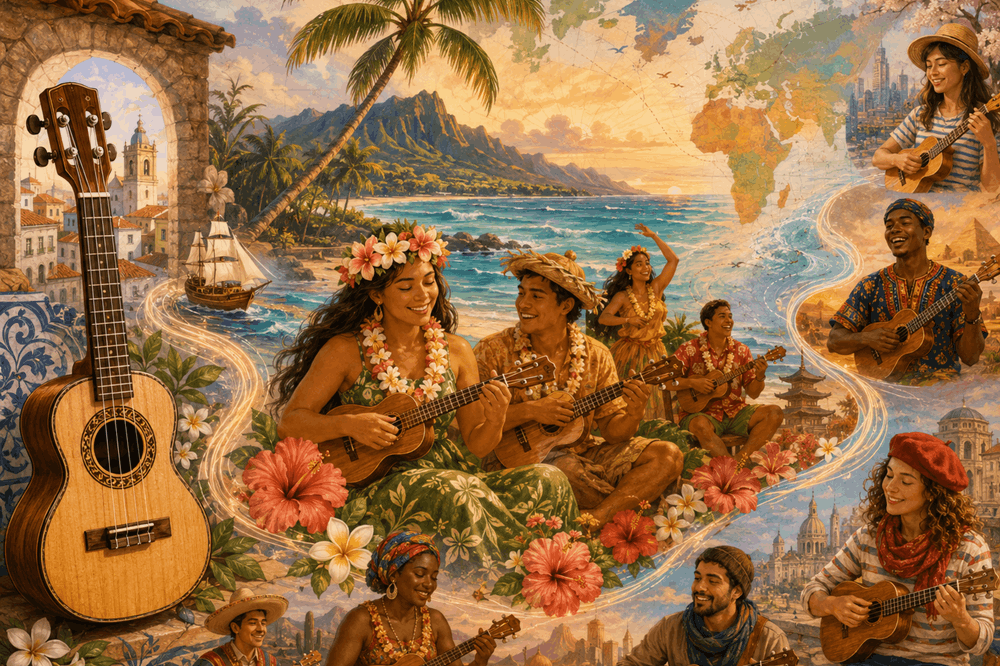
The ukulele is one of the most recognizable instruments in Hawaiian music, but its story reaches across oceans. Its history connects Portuguese immigration, Hawaiian craftsmanship, royal support, world’s fairs, American popular entertainment, and modern global music. The ukulele began as a small string instrument shaped by travel and cultural exchange, then became a lasting symbol of Hawaiian sound.
Quick Overview of Ukulele History
The ukulele developed in Hawaiʻi during the late 1800s after Portuguese immigrants brought small four-string instruments to the islands. These instruments were related to the machete, braguinha, and cavaquinho, which were already known in Portugal and Madeira. Hawaiian musicians and makers adapted the instrument, changed its place in local music, and helped turn it into something distinct.
By the late 19th century, the ukulele had become popular in Hawaiʻi. Hawaiian royalty, especially King David Kalākaua, helped raise its cultural status by supporting music, hula, and public performance. In the early 20th century, the ukulele spread to the mainland United States through expositions, sheet music, stage entertainment, and growing interest in Hawaiian music.
Today, the ukulele is played around the world. It appears in Hawaiian music, folk, pop, jazz, classrooms, online lessons, and casual home playing. Its history is shorter than the history of many older instruments, but it is a strong example of how migration and cultural blending can create something lasting.
What Is a Ukulele?
A ukulele is a small, four-stringed instrument usually played by strumming or plucking the strings with the fingers. It belongs to the larger family of lute-like string instruments, meaning it has a body, neck, strings, and fingerboard. It is often compared to a small guitar, but it has its own sound, tuning, and history.
The common English spelling is “ukulele,” but in Hawaiian it is often written as ʻukulele, with an ʻokina at the beginning. The ʻokina is a real letter in the Hawaiian language, not a decorative mark. Many English-language articles leave it out, but using ʻukulele helps show the word’s Hawaiian origin.
The word is most often translated as “jumping flea” or “leaping flea.” The Hawaiian dictionary resource Wehewehe Wikiwiki explains the word as literally meaning “leaping flea” and connects it to Edward Purvis, a small and quick musician who helped popularize the instrument in Hawaiʻi. Another common explanation is that the name described the fast movement of a player’s fingers across the strings.
Some later accounts connect Queen Liliʻuokalani with a more poetic interpretation of the word as “the gift that came here” or “a gift from afar.” That meaning is worth mentioning because it shows how the instrument gained cultural meaning in Hawaiʻi. Still, the standard dictionary explanation remains “leaping flea,” so both ideas should be understood in the right context.
Portuguese Roots: The Machete, Braguinha, and Cavaquinho
The ukulele did not appear from nowhere. Its roots are usually traced to small Portuguese string instruments brought to Hawaiʻi by immigrants in the 19th century. The machete, sometimes called the machete de braga, the braguinha, or linked with the cavaquinho, was a small four-stringed instrument played in Portugal and Madeira.
The Encyclopaedia Britannica describes the ukulele as a small guitar derived from the Portuguese machada or machete. The Library of Congress also describes the ukulele as a distinctively Hawaiian instrument adapted from small four-string guitars brought by Portuguese immigrant workers.
This background matters because it keeps the history balanced. The ukulele is not only Portuguese, and it is not only Hawaiian in a simple way. Portuguese instruments provided the starting point, but the ukulele developed in Hawaiʻi through local makers, Hawaiian musicians, and Hawaiian cultural life.
How the Ukulele Came to Hawaiʻi
The major turning point came in 1879, when Portuguese immigrants from Madeira arrived in Hawaiʻi. Many came as contract workers for the sugar industry, which was expanding in the Hawaiian Kingdom during the 19th century. Among these immigrants were people who knew how to play and build small string instruments.
The Metropolitan Museum of Art explains that the ukulele was probably introduced to Hawaiʻi in 1879 by Portuguese settlers from Madeira who brought a small guitar called the braguinha. That date is one of the most important markers in ukulele history.
Migration often changes culture in both directions. Immigrants bring language, food, tools, music, and customs with them. Once those traditions enter a new place, they may stay the same, blend with local traditions, or develop into something new. The ukulele is a clear example of that process. A small European island instrument crossed the ocean and became part of the musical life of another island society.
Early Ukulele Makers in Hawaiʻi
Three names are especially important in early ukulele history: Manuel Nunes, Augusto Dias, and José do Espírito Santo. These men were Portuguese immigrants and instrument makers who helped produce early ukuleles in Hawaiʻi. They are often credited with shaping the instrument during its first years of development.
The Met connects these early makers to the instrument’s development, and the Smithsonian Institution has an early ukulele connected to José do Espírito Santo, identified as a guitar maker in Honolulu.
These makers did more than copy a Portuguese instrument. They helped create an instrument that fit Hawaiian musical taste. Materials, body shape, tuning, sound, and playing style could all change when an instrument moved into a new cultural setting. Hawaiian koa wood, local demand, and Hawaiian performance traditions helped give the ukulele its own identity.
That is why it is better to say the ukulele developed in Hawaiʻi from Portuguese roots. This wording gives credit to the immigrant instruments that influenced it while also recognizing the Hawaiian culture that made it famous.
Why Hawaiʻi Adopted the Ukulele
The ukulele became popular in Hawaiʻi partly because it was portable, bright-sounding, and easy to use with singing. Its small size made it easy to carry, while its lively tone worked well for social gatherings and public performances.
Hawaiʻi in the late 1800s was also a place of major cultural change. The Hawaiian Kingdom was connected to global trade, missionary influence, plantation labor, immigration, and political pressure from foreign powers. In that setting, music became one way people expressed identity, community, and cultural pride.
The ukulele entered Hawaiian life at a time when musical traditions were already blending. Hawaiian chants, hula, Western hymns, guitars, and other instruments all existed in the islands. The ukulele found a place because it could support both older and newer performance styles.
King Kalākaua and the Ukulele’s Rise
King David Kalākaua played an important role in the ukulele’s rise. He ruled the Hawaiian Kingdom from 1874 to 1891 and is often remembered as the “Merrie Monarch” because of his support for music, dance, and Hawaiian cultural expression.
Kalākaua did not invent the ukulele. His role was different. He helped make the instrument more visible and respected by supporting music and hula in royal and public life. Under his reign, Hawaiian performance traditions gained renewed attention at a time when outside missionary influence had often discouraged hula and other Native Hawaiian practices.
The ukulele’s connection to Kalākaua helped it move beyond immigrant workshops and local entertainment. It became part of a wider Hawaiian cultural identity. When an instrument is welcomed into royal spaces, public celebrations, and cultural performances, it gains meaning beyond its shape and sound.
What Was Happening in Hawaiian History?
To understand the ukulele’s rise, readers also need some background on Hawaiian history. The instrument became popular during the final decades of the Hawaiian Kingdom, a period marked by immigration, plantation growth, foreign business influence, and political tension.
In 1893, the Hawaiian monarchy was overthrown. In 1898, the United States formally annexed Hawaiʻi through a joint resolution. Readers who want to study that political history more closely can view the National Archives page on the 1898 annexation document.
This political context matters because Hawaiian music was later promoted to American audiences during a time when Hawaiʻi was also being marketed through tourism, world’s fairs, postcards, sheet music, and stage entertainment. The ukulele’s popularity outside Hawaiʻi cannot be separated from the way mainland audiences imagined the islands.
The Ukulele Reaches the United States
The ukulele reached mainland American audiences in stages. The Smithsonian National Museum of American History notes that Americans first experienced the ukulele at the 1893 World’s Columbian Exposition in Chicago. World’s fairs were major public events where countries, territories, companies, and performers displayed culture, technology, and entertainment to large crowds.
These fairs helped introduce many Americans to Hawaiian music, but they also placed Hawaiian culture inside staged exhibits designed for outside viewers. That meant the ukulele reached new listeners through performances that were exciting, but also shaped by the expectations of tourism and entertainment.
The bigger ukulele explosion came in 1915 at the Panama-Pacific International Exposition in San Francisco. The fair celebrated the opening of the Panama Canal and San Francisco’s recovery after the 1906 earthquake. It also became a major moment for Hawaiian music. Hawaiian performers and ukulele players attracted large crowds, and the instrument quickly became fashionable.
The 1915 Ukulele Craze
The year 1915 is one of the most important dates in ukulele history. At the Panama-Pacific International Exposition, mainland audiences heard Hawaiian music and saw the ukulele as part of a lively performance culture. The instrument’s small size, cheerful sound, and connection to Hawaiʻi made it easy to market.
After the fair, the ukulele became popular in American homes, music stores, schools, and entertainment venues. Sheet music publishers produced Hawaiian-themed songs, and Tin Pan Alley helped turn popular songs into mass-market entertainment. Readers who want more background on that industry can explore Britannica’s overview of Tin Pan Alley.
The ukulele fit well into this world. It was easier to carry than a piano and less intimidating than many larger instruments. People could buy one, learn basic chords, and sing popular songs at home. In this way, the ukulele became part of early 20th-century leisure culture.
The Ukulele in Jazz, Vaudeville, and Popular Entertainment
During the 1910s and 1920s, the ukulele became common in vaudeville, jazz-influenced music, and popular stage acts. Vaudeville shows brought together comedy, music, dance, novelty acts, and short performances. The ukulele worked well in this setting because it was visually charming and easy to use in comic or musical routines.
At the same time, Hawaiian-themed songs became popular in the mainland United States. Many used romantic or tropical images of Hawaiʻi. Some helped spread interest in Hawaiian music. Others leaned on stereotypes. That mix is important for students of history. A tradition can gain fame and still be misunderstood.
The ukulele’s mainland popularity brought attention to Hawaiian music, but it also sometimes separated the instrument from its deeper cultural roots. That pattern appears often in cultural history, especially when local traditions become part of commercial entertainment.
The Ukulele in the Mid-20th Century
After its early boom, the ukulele remained part of American and Hawaiian music, though its popularity rose and fell over time. In the mid-20th century, it often appeared in radio, television, classrooms, novelty acts, and amateur music-making.
One major mid-century figure was Arthur Godfrey, a radio and television entertainer who helped popularize the baritone ukulele in the 1950s. The Smithsonian National Museum of American History describes Godfrey as a broadcaster and entertainer who popularized the baritone ukulele through his shows. His broadcasts helped bring the instrument into American homes after the first ukulele craze had faded.
This period affected how many people viewed the instrument. Some treated it as light entertainment or a beginner-friendly tool. Others continued to use it as a serious musical instrument. In Hawaiian music, it kept cultural meaning. In mainland entertainment, it was sometimes treated as a novelty. Both histories shaped its reputation.
Modern Ukulele Revival
The ukulele experienced a major revival in the late 20th and early 21st centuries. One important figure was Israel Kamakawiwoʻole, often known as “IZ.” His medley of “Over the Rainbow” and “What a Wonderful World” introduced many listeners to the gentle sound of the ukulele in a modern Hawaiian context.
The recording later became part of the Library of Congress National Recording Registry. Readers can learn more through the Library’s essay on “Over the Rainbow/What a Wonderful World.” Its preservation by the Library of Congress shows how a modern ukulele recording became part of the wider recorded sound heritage of the United States.
Another major figure is Jake Shimabukuro, whose performances helped show that the ukulele could handle complex, fast, and expressive instrumental music. His work challenged the idea that the ukulele was only a simple beginner instrument.
The internet also changed the ukulele’s history. Online videos, tutorials, chord charts, and social media made it easier for people around the world to learn. The instrument became popular with students, hobby players, songwriters, and professional musicians. Its low cost, small size, and friendly sound helped it spread quickly.
Timeline of Ukulele History
- Before the 1800s: Small four-string instruments such as the machete, braguinha, and cavaquinho develop in Portuguese musical traditions.
- 1879: Portuguese immigrants from Madeira arrive in Hawaiʻi, bringing small string instruments that influence the development of the ukulele.
- 1880s: Makers such as Manuel Nunes, Augusto Dias, and José do Espírito Santo produce early ukuleles in Honolulu.
- 1874–1891: King David Kalākaua supports Hawaiian music and performance culture during his reign.
- 1893: Mainland Americans encounter Hawaiian music and the ukulele at the World’s Columbian Exposition in Chicago.
- 1898: Hawaiʻi is annexed by the United States, changing the political setting in which Hawaiian music is marketed to mainland audiences.
- 1915: The Panama-Pacific International Exposition in San Francisco helps launch a major ukulele craze in the United States.
- 1910s–1920s: Ukuleles become popular in Tin Pan Alley songs, vaudeville, jazz-influenced entertainment, and home music-making.
- 1950s: Arthur Godfrey helps popularize the baritone ukulele through radio and television.
- 1990s–2000s: Artists such as Israel Kamakawiwoʻole and Jake Shimabukuro help renew global interest in the instrument.
- Today: The ukulele is played worldwide in Hawaiian music, pop, folk, jazz, classrooms, and online learning communities.
Why the Ukulele Matters
The ukulele matters because it shows how history can live inside music. It is not just an object made of wood and strings. It carries a story of migration, adaptation, cultural identity, politics, entertainment, and memory.
Its Portuguese roots remind us that immigrants often bring traditions that reshape their new homes. Its Hawaiian development shows how local communities can transform outside influences into something meaningful and distinct. Its royal support shows how culture can gain power when leaders choose to honor it. Its mainland popularity shows how music can travel quickly through fairs, publishing, performance, and media.
The ukulele also teaches an important lesson about cultural popularity. When the instrument became famous outside Hawaiʻi, it brought Hawaiian music to wider audiences. At the same time, mainland entertainment sometimes reduced Hawaiian culture to simple images of beaches, romance, and exotic escape. A careful history of the ukulele should include both sides.
Key Takeaways
- The ukulele developed in Hawaiʻi in the late 1800s from Portuguese small string instruments.
- Portuguese immigrants from Madeira brought instruments such as the braguinha or machete to Hawaiʻi.
- Early makers such as Manuel Nunes, Augusto Dias, and José do Espírito Santo helped shape the instrument.
- Hawaiian musicians and audiences made the ukulele part of Hawaiian culture and sound.
- King David Kalākaua helped raise the ukulele’s cultural status through royal support for music and performance.
- The 1915 Panama-Pacific International Exposition helped spark a major ukulele craze in the mainland United States.
- Arthur Godfrey helped keep the ukulele visible in mid-20th-century radio and television culture.
- Modern artists and online learning helped make the ukulele popular around the world again.
Helpful External Resources
- The Metropolitan Museum of Art: Ukulele, Hawaiʻi
- Library of Congress: The Ukulele, Portuguese Gift to Hawaii
- Smithsonian: The Great 1915 Ukulele Craze
- Smithsonian: Vega Baritone Ukulele and Arthur Godfrey
- Britannica: Ukulele Overview
- Wehewehe Hawaiian Dictionaries: Ukulele
- National Archives: Annexing the Hawaiian Islands
Final Thoughts
The history of the ukulele is more than the story of a small, cheerful instrument. It began with Portuguese migration, developed in Hawaiʻi, gained cultural meaning through Hawaiian musicians and royal support, and spread through American entertainment and global media.
That journey makes the ukulele an important cultural object. Its sound may be light and bright, but its history carries larger lessons about immigration, identity, creativity, and the way music travels across cultures.