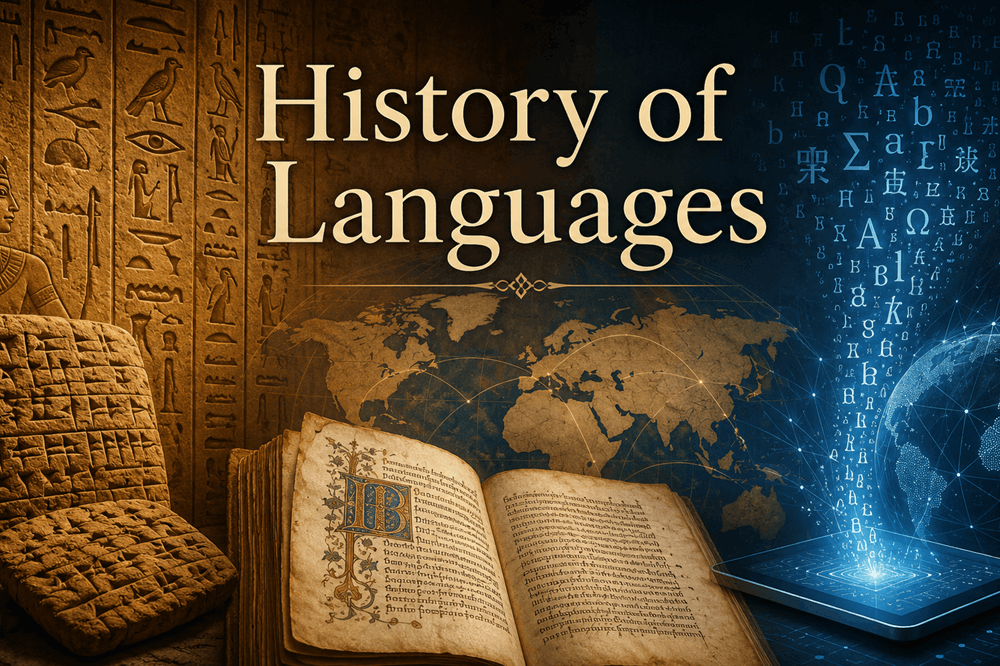
The history of languages is the history of how humans learned to share ideas, preserve memory, and build societies. Long before books, schools, printed newspapers, or the internet, people used language to teach, warn, plan, pray, trade, and tell stories. Languages changed as people moved, mixed, fought, worshiped, governed, and created new tools. To study language history is to study human history itself.
What Language Means in Human History
Language is a system people use to communicate meaning. Most people think of language as speech, but language can also include signs, gestures, writing, symbols, grammar, tone, and shared social rules. A language is not only a list of words. It is a living system that helps people explain the world and understand one another.
Language matters in history because it carries culture. Through language, people pass down stories, laws, songs, prayers, jokes, family knowledge, place names, and ideas about how life should be lived. A community’s language can show how people farmed, traded, worshiped, governed, and understood nature.
Language also helps historians study movement and contact. When related words or grammar patterns appear across different regions, they can sometimes point to ancient migration, trade, conquest, or shared ancestry. Language is one of the clues scholars use to understand where people came from and how communities changed over time.
That is why language history is not only about grammar. It is about people. As humans moved, settled, built cities, created religions, formed empires, and developed new technologies, their languages changed with them.
The Mystery of the First Human Languages
No one knows the name of the first human language. That may sound surprising, but it makes sense. Spoken language existed long before writing, and spoken words disappear unless someone records them. The earliest humans did not leave audio recordings, dictionaries, or grammar books. Because of that, the beginning of language remains one of the great mysteries of human history.
Researchers study the origin of language through many fields. They look at fossils, brain development, genetics, archaeology, animal communication, child language learning, and the structure of modern languages. The Max Planck Institute describes human language evolution as an ongoing research question involving biology, genetics, cognition, culture, and social behavior.
Most careful explanations avoid saying that language began on one exact date. Human language probably did not appear all at once in a single moment. It likely developed over a long period as early humans became better at sharing information, planning together, naming things, remembering events, and teaching skills.
Early language would have been useful in many ways. It could help people warn each other about danger, organize hunting or gathering, explain where food could be found, teach children how to make tools, and settle conflicts inside a group. It also helped people build trust. When people could share thoughts, promises, emotions, and memories, they could form stronger communities.
Still, historians must be honest about what they do not know. We cannot point to one ancient language and say, “This was the first.” The first spoken languages are gone from the record. What we can study is the long process by which language became one of the main features of human life.
Speech Came Before Writing
One of the most important things to understand is that speech came before writing. People were speaking, singing, telling stories, naming places, and teaching children long before anyone carved words into stone or pressed symbols into clay.
Writing is easier for historians to study because it leaves evidence behind. Spoken words vanish unless they are remembered or recorded. Written marks can survive for thousands of years on clay tablets, stone monuments, bones, shells, metal, parchment, paper, or walls. Because of this, the history of writing is much clearer than the history of early speech.
This can create confusion. Sometimes people call Sumerian, Egyptian, or Chinese “ancient languages” because they appear in old written records. That does not mean they were the first languages humans ever spoke. It means they were among the languages preserved through early writing systems.
For most of human history, language lived mainly in the voice and memory. Elders passed down stories. Parents taught children. Religious leaders recited prayers. Travelers carried news from place to place. Songs helped people remember history, law, and family identity. In many societies, oral tradition was the main way knowledge survived.
Writing changed that. Once people could record language, they could store information outside the human memory. A law could be preserved. A ruler’s order could travel. A business agreement could be checked later. A story could be copied. A prayer could be read by people who lived far away or long after the writer died.
A Simple Timeline of Language History
| Period | Language Development |
|---|---|
| Before writing | Humans used spoken language, signs, songs, memory, and oral tradition to share knowledge. |
| Fourth millennium BCE | Early writing systems, including cuneiform in Mesopotamia, began recording trade, law, religion, and government activity. |
| Ancient empires | Languages such as Akkadian, Aramaic, Greek, Latin, and others spread through administration, conquest, trade, and education. |
| Medieval and early modern periods | Religious texts, manuscripts, schools, printing, and expanding states shaped written and spoken languages. |
| Colonial era | European languages spread globally through empire, settlement, missions, schools, trade, and colonial government. |
| Information Age | Digital tools, Unicode, translation apps, social media, online archives, and AI changed how languages are written, learned, preserved, and shared. |
The First Writing Systems Changed Human History
Once people began building cities, storing goods, collecting taxes, and organizing governments, language needed a new tool. Writing became that tool. It did not replace speech, but it gave language a new kind of power. Writing allowed people to record information across time and distance.
Cuneiform in Mesopotamia
One of the earliest known writing systems was cuneiform, developed by the ancient Sumerians in Mesopotamia around the fourth millennium BCE. Cuneiform used wedge-shaped marks pressed into clay tablets. At first, it was closely tied to practical needs such as counting goods, recording trade, tracking grain, and managing temple or government activity.
Over time, cuneiform became much more than a record-keeping tool. It was used for laws, letters, myths, hymns, royal orders, contracts, school exercises, and literature. This shows an important pattern in language history: writing often began with practical needs, then grew into a way to preserve culture, religion, and learning.
Egyptian Hieroglyphs and Sacred Writing
Ancient Egypt developed hieroglyphic writing, which appeared on monuments, tombs, temples, and objects connected to religion and government. Egyptian writing helped preserve royal names, religious beliefs, funerary texts, historical events, and administrative records.
Hieroglyphs also show that writing could be more than a simple tool for information. It could be part of art, ceremony, and sacred tradition. In Egypt, writing was closely tied to power, religion, and ideas about life after death.
Chinese Writing and Oracle Bones
Early Chinese writing is known from ancient inscriptions, including oracle bones used during the Shang dynasty. These records were often connected to divination, royal questions, ancestors, warfare, weather, harvests, and political decisions.
Chinese writing became one of the longest continuing writing traditions in the world. Its history shows how a writing system can connect many generations, even as spoken forms of language change over time.
Alphabets and the Spread of Writing
Alphabets were another major step in language history. An alphabet uses signs to represent sounds, usually consonants and vowels or mainly consonants, depending on the system. Alphabetic writing could be easier to adapt to different languages than some older systems.
The Phoenician alphabet, Greek alphabet, Latin alphabet, Aramaic scripts, Arabic script, Hebrew script, and many others helped shape how people wrote across large regions. Writing systems spread through trade, religion, schools, empire, migration, and scholarship.
Writing systems also shaped social power. People who could read and write often held important roles as scribes, priests, scholars, officials, teachers, or rulers. Written language helped governments collect taxes, religions preserve sacred texts, merchants track trade, and communities remember their past.
How Languages Change Over Time
Languages are always changing. A language may look stable because it has a name, a dictionary, or a writing system, but real language lives through people. As people change how they speak, the language changes too.
Pronunciation changes. Words that once sounded one way may sound very different centuries later. Grammar changes. Old endings may disappear, new sentence patterns may become common, and old rules may weaken. Vocabulary changes quickly because people constantly need words for new tools, foods, technologies, beliefs, jobs, and social habits.
Languages also borrow from each other. When groups trade, fight, live near each other, intermarry, or share religion, they often exchange words. English is a strong example. It includes words from Old English, Norse, French, Latin, Greek, and many other sources. That mixture reflects centuries of invasion, settlement, religion, scholarship, trade, and empire.
Latin gives another helpful example. Latin was spoken in the Roman world, but over time spoken forms of Latin changed in different regions. These regional forms eventually developed into the Romance languages, including Spanish, Portuguese, French, Italian, Romanian, and others. These languages are not identical, but they share roots because they grew from Latin over many centuries.
Old English also changed dramatically. Early English was shaped by Germanic-speaking peoples in Britain. Later contact with Norse-speaking Vikings influenced English vocabulary and grammar. After the Norman Conquest of 1066, French became powerful in law, government, literature, and elite life in England. Over time, English absorbed many French and Latin words.
Slang is another force of change. People often treat slang as temporary or informal, but some slang becomes normal language. Words that begin in youth culture, trade, war, sports, music, technology, or local speech can spread widely. If enough people use them for long enough, they may become part of standard vocabulary.
Language change can feel uncomfortable to people who are used to older forms. Every generation worries that language is being “ruined.” But change is not a sign that language is dying. Change is one of the ways language stays alive.
Language Families and Ancient Connections
Many languages belong to language families. A language family is a group of languages that developed from a common older language. It is similar to a family tree. Just as cousins may share grandparents, related languages may share an older ancestor.
Linguists study language families by comparing sounds, grammar, word roots, and patterns of change. They do not simply look for words that sound alike by accident. They look for regular patterns. For example, if certain sounds in one language often match certain sounds in another language, that may suggest a historical relationship.
The Indo-European language family is one of the best-known examples. It includes many languages spoken in Europe and parts of Asia, including English, German, Spanish, French, Greek, Russian, Persian, Hindi, and many others. These languages are not all close to each other, but they share deep historical roots.
Language families help historians think about ancient movement. If related languages appear across a wide area, scholars ask how that happened. Did people migrate? Did farming spread? Did trade connect regions? Did conquest or social power encourage language shift? The answers can be complicated, but language gives historians an important clue.
Other major language families include Sino-Tibetan, Afro-Asiatic, Niger-Congo, Austronesian, Dravidian, Turkic, Uralic, Mayan, and many more. Some languages are isolates, meaning they have no proven relationship to any other living language. Basque, spoken in parts of Spain and France, is a famous example.
Studying language families reminds us that languages are historical evidence. They can preserve traces of older worlds, even when written records are missing. A word for a tool, animal, plant, family member, or natural feature may help scholars understand what mattered to an ancient community.
How Languages Spread Through Migration, Trade, Religion, and Power
Languages spread when people move, but they also spread when institutions support them. Migration, trade, religion, education, conquest, colonization, and government policy can all shape which languages grow and which languages decline.
Migration is one of the oldest forces in language history. When people move into new regions, they bring their languages with them. Sometimes they keep their language for generations. Sometimes they mix with local communities and create new forms of speech. Sometimes their language replaces older languages in the area. Often, the result is a long period of contact and blending.
Trade also spreads language. Merchants need to communicate across borders, ports, markets, and caravan routes. Trade can spread words for foods, animals, tools, fabrics, money, ships, measurements, and ideas. Some trade languages become lingua francas. A lingua franca is a common language used by people who do not share the same first language.
Empires often make certain languages more powerful. In the ancient Near East, Aramaic became widely used across large areas because of empire, trade, and administration. Greek spread after the conquests of Alexander the Great and became an important language of culture, learning, and government in the eastern Mediterranean and beyond. Latin spread through the Roman Empire and later remained important in law, religion, scholarship, and education in Europe.
Religion has also preserved and spread languages. Sacred texts, prayers, schools, missionaries, scholars, and religious law can give a language importance beyond everyday speech. Arabic spread with Islam and became a major language of religion, scholarship, science, law, and literature across many regions. Sanskrit held great importance in South Asian religious, philosophical, and literary traditions. Hebrew survived for centuries as a sacred and scholarly language before its modern revival as a spoken national language. Latin remained central in the Roman Catholic Church and European scholarship long after it was no longer spoken as an everyday community language.
Colonization spread European languages across much of the world. Spanish and Portuguese spread through conquest, settlement, mission activity, trade, and colonial rule in the Americas, Africa, and Asia. French spread through empire, diplomacy, education, and colonial administration. English spread through the British Empire and later through the influence of the United States, global business, science, aviation, entertainment, and the internet.
The spread of powerful languages often came with pressure on local languages. In many places, schools and governments promoted one official language while discouraging or punishing others. Children were sometimes forced to use colonial or national languages instead of the languages they spoke at home.
At the same time, language contact created new forms of expression. Creole languages, bilingual communities, mixed vocabularies, and regional varieties developed in many parts of the world. These forms of speech are not “broken” language. They have their own rules, histories, and cultural value.
Language spread is never just about words moving from one place to another. It is about people making choices under real historical conditions. Some people learn a powerful language for work, safety, education, or status. Others work to preserve a local language because it connects them to home, family, and community.
Why Some Languages Become Endangered or Disappear
A language becomes endangered when fewer children learn it as a first language and fewer people use it in daily life. A language may still have living speakers, songs, stories, and dictionaries, but if young people are not learning it naturally at home or in the community, its future becomes uncertain.
Today, Ethnologue lists more than 7,000 living languages in use around the world, and roughly 44 percent are considered endangered. That means language loss is not only an ancient problem. It is happening in the modern world too.
Languages can become endangered for many reasons. War, forced migration, disease, land loss, slavery, boarding schools, government bans, economic pressure, and social discrimination can all weaken a language. Sometimes families stop teaching a language because they believe another language will give their children better chances in school or work. That decision is often made under pressure, not because people do not value their heritage.
Language loss is not only the loss of vocabulary. It can also mean the loss of oral history, humor, ceremonies, place names, ecological knowledge, family stories, and ways of describing the world. Some languages include detailed knowledge about local plants, animals, seasons, landscapes, farming methods, or spiritual traditions. When a language fades, that knowledge can become harder to pass down.
Indigenous languages have been especially affected by colonization and forced assimilation. In many countries, Indigenous children were punished for speaking their languages in schools. Governments often promoted one national language while treating local languages as obstacles to progress. UNESCO’s International Decade of Indigenous Languages focuses on protecting and promoting Indigenous languages as part of cultural diversity, education, heritage, and community life.
Today, many communities are working to protect and revive endangered languages. Some create language classes, immersion schools, dictionaries, children’s books, radio programs, songs, apps, videos, and online archives. Elders may work with younger speakers to record stories and pronunciation. Schools may bring local languages back into the classroom. Families may choose to use heritage languages at home again.
Revitalization is difficult, but it is possible. A language is strongest when it is used in daily life: at home, in schools, in ceremonies, in music, in jokes, in texting, in public signs, and in community events. Saving a language is not just about preserving old words. It is about giving future generations a living connection to their own history.
Language in the Information Age
The Information Age has changed language again. People now communicate through text messages, search engines, social media, video calls, translation apps, online classes, digital archives, and artificial intelligence tools. Words can spread across the world in minutes.
Major languages have gained even more power online. English, Chinese, Spanish, Arabic, Hindi, French, Portuguese, Russian, and other widely used languages appear across huge parts of the internet. People who know a global language may have easier access to education, jobs, entertainment, technology, and international communication.
But digital technology can also help smaller languages. Communities can record elders, build online dictionaries, create video lessons, design keyboards, publish stories, share songs, and teach children through apps. Digital archives can protect recordings that might otherwise be lost. Social media can help young speakers use a heritage language in modern life instead of treating it as something only for ceremonies or classrooms.
Unicode is important because it gives computers a standard way to represent many scripts. A script is not the same thing as a language, but digital script support can make it easier for communities to type, publish, search, and teach their languages online.
Artificial intelligence and machine translation add another new chapter. Translation tools can help people communicate across languages, but they work best for languages with large amounts of digital text. Many endangered or minority languages do not have enough online material for strong technology support. This means the digital future could either widen language inequality or help reduce it, depending on how communities, schools, governments, and technology companies respond.
The Information Age has also created new kinds of language change. Internet slang, emojis, memes, abbreviations, hashtags, and voice notes are now part of everyday communication. Some people worry that digital writing weakens language, but history suggests something different. New technology does not end language. It changes how people use it.
Why the History of Languages Still Matters
The history of languages matters because language is one of the clearest signs of human connection. It shows how people moved, traded, fought, governed, worshiped, taught, remembered, and adapted. It helps us understand ancient migrations, powerful empires, sacred traditions, colonial history, cultural survival, and modern technology.
Language also reminds us that history is not only written by rulers, armies, and governments. It is carried by families, storytellers, teachers, children, workers, travelers, and communities. Every language holds part of the human story.
Some languages became powerful because they were tied to empires, schools, religions, trade, or technology. Others survived because communities protected them through memory and daily use. Some disappeared under pressure. Others are being revived by people who believe their words still matter.
The story of language is still being written. Every time people teach a child a word, translate a story, record an elder, invent slang, write a message, or revive a nearly forgotten phrase, they are taking part in the long history of human language.