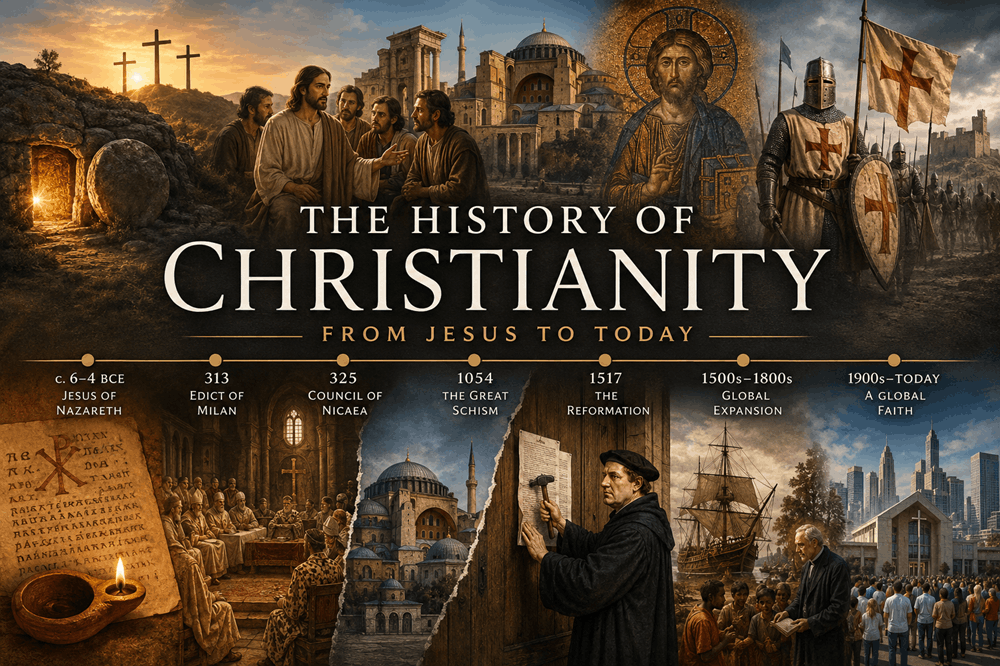
The history of Christianity stretches from first-century Judea to communities on every continent today. This timeline follows the major turning points: the life of Jesus, the early Christian movement, Roman persecution, Constantine, church councils, medieval Christianity, the Great Schism, the Reformation, worldwide expansion, and modern Christianity.
Christianity Timeline at a Glance
| Date / Period | Major Event | Why It Matters |
|---|---|---|
| c. 6–4 BCE–c. 30 CE | Life of Jesus of Nazareth | Christianity centers on Jesus’s teachings, death, and the belief in his resurrection. |
| c. 30s CE | Early Christian movement begins | Jesus’s followers begin preaching in Jerusalem and nearby regions. |
| c. 50s–60s CE | Paul’s letters and missionary work | Christian communities spread among Gentiles across the Roman world. |
| 64 CE | Nero’s persecution in Rome | Christians face suspicion and punishment in parts of the Roman Empire. |
| 70 CE | Destruction of the Second Temple | This changes the Jewish world in which early Christianity first developed. |
| 313 CE | Edict of Milan | Christianity receives legal toleration in the Roman Empire. |
| 325 CE | First Council of Nicaea | Church leaders meet to address major disputes about Christian doctrine. |
| 380 CE | Edict of Thessalonica | Nicene Christianity becomes the official state religion of the Roman Empire. |
| 451 CE | Council of Chalcedon | Debates about the nature of Christ shape later divisions among Christian churches. |
| 1054 CE | East-West Schism | Eastern Orthodox and Roman Catholic Christianity become formally divided. |
| 1095 CE | First Crusade called | Crusading movements reshape medieval Christianity, politics, and Christian-Muslim relations. |
| 1517 CE | Martin Luther and the Reformation | Western Christianity divides into Catholic and Protestant movements. |
| 1545–1563 CE | Council of Trent | The Catholic Church responds to the Reformation with doctrine clarification and internal reform. |
| 1500s–1800s | Christianity expands globally in new ways | Empire, missions, migration, printing, education, and local churches reshape Christianity’s global reach. |
| 1900s–Today | Christianity becomes a global religion | Christianity grows strongly in Africa, Latin America, and parts of Asia while changing in Europe and North America. |
1st Century: Jesus, the Apostles, and the First Christian Communities
Christianity began in the first century in the Jewish world of Roman-controlled Palestine. Jesus of Nazareth lived and taught in a region shaped by Jewish religious life, Roman rule, Greek cultural influence, local politics, and deep hopes for deliverance. Christians believe Jesus was the Son of God, was crucified, and rose from the dead. Historically, the early Christian movement formed around those beliefs and spread through preaching, travel, letters, and small communities.
Early Christianity did not begin as a separate world religion with large buildings, official schools, or a global organization. It began as a movement within Judaism. The first followers of Jesus were Jewish, and the earliest Christian message was tied to Jewish Scripture, worship, prophecy, and expectations about God’s kingdom. Britannica’s overview of early Christianity explains how the movement developed from Jewish roots in Roman Palestine before spreading through the Roman world.
Jerusalem was an important early center. The apostles and other followers of Jesus preached there, gathered believers, and explained Jesus’s life and death through the lens of Jewish tradition. Over time, the message spread beyond Jerusalem to cities such as Antioch, Ephesus, Corinth, and Rome.
Paul of Tarsus became one of the most important figures in early Christianity. His missionary journeys and letters helped spread Christianity among Gentiles, meaning non-Jewish peoples. Many of Paul’s letters later became part of the New Testament. These letters show that early Christian communities were already debating questions about belief, behavior, leadership, worship, and the relationship between Jewish law and Gentile converts.
Early Christians often met in homes rather than public church buildings. They prayed, shared meals, taught one another, collected money for the poor, and read letters from Christian teachers. These small communities became the foundation for Christianity’s growth across the Roman Empire.
2nd–3rd Centuries: Persecution, Growth, and Early Christian Writings
During the second and third centuries, Christianity continued to grow, even though it did not have official support from the Roman government. Christian communities appeared in many cities around the Mediterranean world. They developed leaders, teachers, writings, worship practices, and arguments about correct belief.
Christians were sometimes viewed with suspicion by Roman authorities and neighbors. They refused to worship the traditional Roman gods or honor the emperor as divine. This made some Romans think Christians were disloyal or dangerous. Persecution did happen, but it was not constant everywhere. It varied by region, emperor, local politics, and period.
Some persecutions were especially severe. The persecution under Emperor Nero after the fire of Rome in 64 CE became one of the most famous early examples. Later persecutions under emperors such as Decius and Diocletian were broader and more organized. Still, Christianity continued to spread.
One reason Christianity grew was its strong community life. Christian groups cared for members, supported widows and orphans, buried the dead, taught moral discipline, and welcomed people across social lines. Its message also appealed to many people in cities connected by Roman roads, trade routes, and shared languages.
This period also saw important Christian writings and debates. Church leaders wrote defenses of Christianity, explained beliefs, argued against teachings they considered false, and tried to define Christian identity. Questions about Jesus, Scripture, baptism, church leadership, and the Trinity became more urgent as Christian communities expanded.
4th–5th Centuries: Constantine, Councils, and the Christian Roman Empire
The fourth century changed Christian history dramatically. Christianity moved from being a sometimes-persecuted religion to a legal and eventually favored religion within the Roman Empire.
In 313 CE, Emperor Constantine and Licinius issued the Edict of Milan, which granted religious toleration in the empire and restored property that had been taken from Christians during earlier persecution. This did not immediately make Christianity the official religion of Rome, but it gave Christians legal standing and imperial protection.
Constantine’s support changed Christianity’s public position. Church leaders gained influence. Christian buildings became more visible. Bishops became important public figures. The relationship between church and empire grew closer, which brought both opportunity and new problems. Christianity could now shape public life more openly, but it also became connected to imperial power and politics.
In 325 CE, Constantine called the First Council of Nicaea. This council gathered bishops to address a major controversy about the relationship between God the Father and Jesus Christ. The council rejected Arius’s teaching that Christ was a created being and affirmed the equality of God the Father and God the Son. It also produced the Creed of Nicaea, an important statement of Christian belief.
In 380 CE, Emperor Theodosius I issued the Edict of Thessalonica, making Nicene Christianity the official state religion of the Roman Empire. This was another turning point. Christianity was no longer only tolerated. It became tied to the identity and authority of the Roman state.
The fifth century brought more councils and more disputes. The Council of Chalcedon in 451 addressed debates about Christ’s divine and human nature. The decisions made at Chalcedon became important for many churches, but not all Christian communities accepted them. These disagreements helped shape later divisions among Eastern Orthodox, Roman Catholic, Oriental Orthodox, and other Christian traditions.
6th–10th Centuries: Monks, Missionaries, and Medieval Christian Culture
After the western Roman Empire weakened and collapsed, Christianity remained a major force in Europe and the eastern Mediterranean. In the West, bishops, monasteries, and local churches became important centers of learning, record-keeping, charity, and authority. In the East, the Byzantine Empire continued a Christian Roman tradition centered on Constantinople.
Monasteries played a major role in medieval Christianity. Monks and nuns prayed, worked, copied manuscripts, preserved texts, taught, farmed, and cared for travelers or the poor. In a world where books were copied by hand, monasteries helped preserve religious writings, classical texts, and historical records.
Missionaries also helped spread Christianity into new regions of Europe. Christianity reached many Germanic, Celtic, Slavic, and Scandinavian peoples over time. This process was not always peaceful or simple. Some conversions were connected to kings, politics, marriage alliances, conquest, or trade. Others grew through preaching, local communities, and gradual cultural change.
Christianity also shaped art and architecture. Churches, mosaics, icons, manuscripts, music, and later cathedrals became ways of teaching faith and expressing power. Many people in medieval Europe learned biblical stories and church teachings through images, festivals, sermons, and rituals rather than books.
At the same time, medieval Christianity was not one simple story. Popes, patriarchs, bishops, kings, emperors, monks, and local rulers often disagreed. Church authority and political authority were deeply connected, and that connection created cooperation, reform, conflict, and power struggles.
1054: The Great Schism Between Eastern and Western Christianity
By the Middle Ages, Christianity in the Latin-speaking West and the Greek-speaking East had developed different customs, languages, political settings, and church structures. Rome was the major center in the West. Constantinople was the major center in the East.
The split between East and West did not happen overnight. It grew over centuries. Disagreements involved papal authority, theology, worship practices, language, politics, and relations between the pope in Rome and the patriarch of Constantinople. One famous dispute involved the wording of the Nicene Creed and whether the Western church had the authority to add language about the Holy Spirit.
In 1054, representatives of Rome and Constantinople excommunicated each other. The date became a symbol of the East-West Schism, a long division between Eastern Christian churches and the Western church.
The result was the formal division between what became known as Roman Catholic Christianity in the West and Eastern Orthodox Christianity in the East. The split shaped church history, European politics, Byzantine history, and relations between Christian communities for centuries.
1095–1291: Crusading Movements and the Eastern Mediterranean
In 1095, Pope Urban II called for the First Crusade at the Council of Clermont. The Crusades were military movements launched by western European Christians with religious, political, and military goals. One major aim was to take control of Jerusalem and other holy sites in the eastern Mediterranean.
The Crusades cannot be understood only as religious devotion or only as political ambition. They involved faith, papal authority, knightly culture, land, wealth, fear, violence, and relations between Latin Christians, Eastern Christians, Muslims, and Jews. Britannica describes the First Crusade as a military expedition launched in 1095 by western European Christians.
Crusaders captured Jerusalem in 1099 and established Latin Christian states in the eastern Mediterranean. Later crusades followed, with mixed results. Some were aimed at the Holy Land, while others targeted different regions or groups.
The Crusades also brought terrible violence. Jewish communities in Europe were attacked by some crusaders. Muslims and Christians fought brutal wars. The Fourth Crusade was especially damaging because western crusaders sacked Constantinople in 1204, a disaster that deepened the divide between Eastern and Western Christians.
By 1291, Acre, the last major Crusader stronghold on the mainland, had fallen. The Crusades left a long legacy in European, Middle Eastern, Byzantine, Jewish, Muslim, and Christian history.
1517–1648: Reformation, Catholic Reform, and Religious Wars
The Protestant Reformation began in the early 1500s, but its roots reached back into late medieval Europe. Many people criticized church corruption, the sale of indulgences, poor clergy education, wealth, and abuses of power. Calls for reform had existed before Martin Luther, but Luther’s challenge spread quickly because of timing, politics, and the printing press.
In 1517, Martin Luther criticized the sale of indulgences and other church practices. His writings spread rapidly through print. Luther argued that salvation came by faith and that Scripture had higher authority than church tradition as interpreted by the Roman Catholic hierarchy. His ideas challenged the authority of the pope and helped divide Western Christianity.
The Reformation did not create only one Protestant movement. Lutheran churches developed in parts of Germany and Scandinavia. Reformed traditions grew through leaders such as Huldrych Zwingli and John Calvin. The English Reformation produced the Church of England. Anabaptist groups called for adult baptism and different ideas about church and state.
The Catholic Church also responded. The Council of Trent met between 1545 and 1563. It clarified Catholic doctrine, addressed abuses, strengthened church discipline, and became a major part of the Catholic Reformation.
The Reformation period also brought religious wars and political conflict. Rulers and communities fought over church authority, territory, belief, and political independence. The Thirty Years’ War, which ended in 1648, devastated parts of Europe and helped reshape the relationship between religion and state power.
1500s–1800s: Christianity Spreads Through Empire, Missions, and Local Churches
From the 1500s through the 1800s, Christianity expanded across the world in new ways. European exploration, colonization, trade, migration, missionary activity, education, and printing carried Christian ideas and institutions into the Americas, Africa, Asia, and the Pacific.
This expansion was complicated. In some places, Christianity spread through force, colonial rule, mission schools, or pressure from European empires. Indigenous religions and cultures were sometimes suppressed, and forced conversion occurred in some contexts. In other places, people adopted Christianity voluntarily, adapted it to local cultures, or built independent Christian communities.
In Latin America, Spanish and Portuguese colonization brought Roman Catholic Christianity into many regions. Missionaries built churches, schools, and missions, but their work was also tied to colonial systems that harmed Indigenous peoples. Over time, Christianity in Latin America developed local traditions, devotions, art, festivals, and communities.
In Africa, Christianity had ancient roots in places such as Egypt, Ethiopia, and North Africa. Later missionary movements and colonial expansion changed the religious map again. African Christians did not simply copy European forms. Many built churches with local leadership, music, languages, and worship styles.
In Asia, Christianity developed in many different settings. Some communities formed through Catholic missions, Protestant missions, trade contacts, migration, or local movements. In some regions, Christians faced persecution. In others, Christianity became part of education, medicine, printing, and social reform.
Christianity’s expansion cannot be told as one simple story. It included empire and resistance, mission and local leadership, conflict and adaptation. By the modern era, Christianity was no longer mainly a Mediterranean or European religion. It had become a worldwide tradition with many languages, cultures, and forms of worship.
1900s–Today: Christianity Becomes a Global Religion
In the 20th and 21st centuries, Christianity became more visibly global. Europe and North America remained important, but the fastest growth shifted toward Africa, Latin America, and parts of Asia. Churches in Nigeria, Brazil, the Philippines, South Korea, Kenya, Mexico, Ethiopia, and many other places became major parts of world Christianity.
Pentecostal and charismatic Christianity grew rapidly during the 1900s. These movements emphasized the Holy Spirit, healing, lively worship, prophecy, speaking in tongues, and personal religious experience. They became especially influential in parts of Africa, Latin America, and Asia.
Roman Catholicism remained the largest Christian tradition, but Catholic populations changed geographically. Protestant, evangelical, Pentecostal, Orthodox, Oriental Orthodox, Anglican, and independent churches also shaped modern Christianity. Many Christian communities today are deeply local, with worship, music, preaching, language, and leadership shaped by their own culture and history.
According to Pew Research Center, Christians remained the world’s largest religious group as of 2020, though Christianity’s share of the world population declined from 30.6 percent in 2010 to 28.8 percent in 2020.
Modern Christianity is not one single cultural form. It includes ancient liturgies, megachurches, village congregations, monasteries, house churches, liberation theology, evangelical missions, Orthodox icons, Catholic parishes, Pentecostal worship, and independent local movements. Its history is global, diverse, and still changing.
Key Takeaways From the Christianity Timeline
- Christianity began in the first-century Jewish and Roman world, not as a separate global religion from the start.
- Early Christians spread their message through preaching, letters, travel, house churches, and urban communities.
- Constantine, Nicaea, and later imperial decisions changed Christianity’s relationship with Roman power.
- The Great Schism and the Protestant Reformation created major divisions that still shape Christianity today.
- Christianity became global through both powerful institutions and local communities.
- Modern Christianity includes many traditions, regions, languages, and forms of worship.
A Christianity timeline helps readers see the larger pattern. The religion began with small first-century communities, became part of the Roman imperial world, divided into major branches, spread through medieval and early modern history, and developed into a global faith with many traditions today.