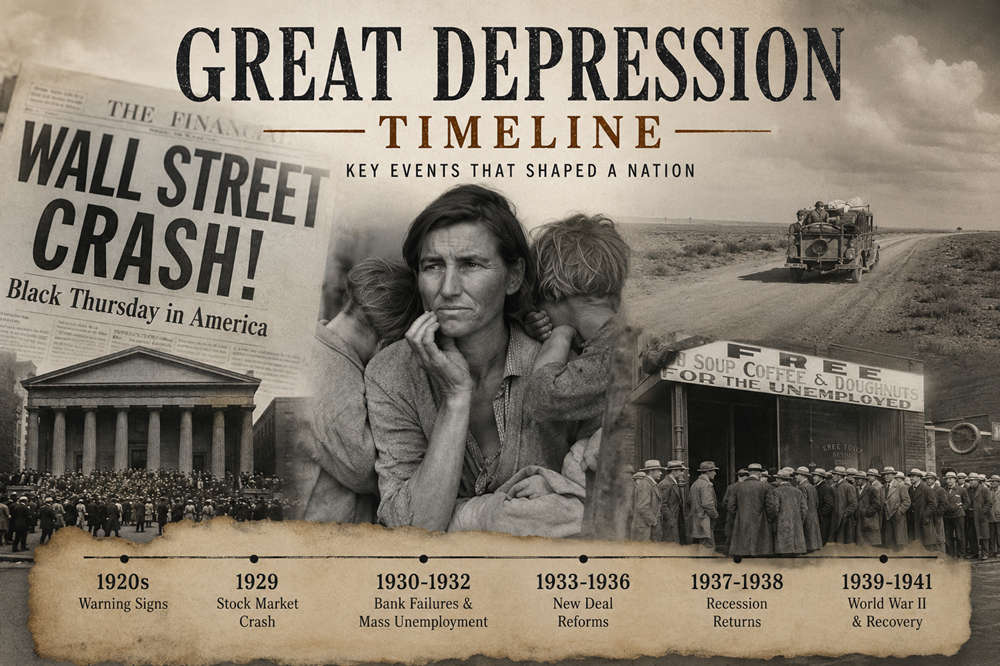
The Great Depression was one of the most serious economic crises in modern history. In the United States, it began after the economic boom of the 1920s collapsed and lasted through most of the 1930s. The crisis brought bank failures, business closures, mass unemployment, farm hardship, and major changes in the role of the federal government. This Great Depression timeline explains the key events from the warning signs of the 1920s to recovery during World War II.
Great Depression Timeline at a Glance
The Great Depression did not happen all at once. It developed in stages. The stock market crash of 1929 became the most famous starting point, but deeper economic problems had already been building for years.
| Period | Main Development |
|---|---|
| 1920s | Economic growth hides serious weaknesses, including farm debt, uneven wealth, and stock speculation. |
| 1929 | The stock market crashes, damaging confidence and exposing deeper economic problems. |
| 1930–1932 | Bank failures, unemployment, poverty, and public frustration grow worse. |
| 1933 | Franklin D. Roosevelt takes office and launches the First New Deal. |
| 1934–1936 | New Deal programs expand relief, jobs, banking reform, labor protections, and social welfare. |
| 1930s | The Dust Bowl worsens hardship for many farming families in the Great Plains. |
| 1937–1938 | A new recession shows that recovery is still fragile. |
| 1939–1941 | World War II production increases jobs and helps end the Depression in the United States. |
Before 1929: Warning Signs in the 1920s Economy
The 1920s are often called the Roaring Twenties because the decade brought new consumer goods, rising stock prices, expanding cities, and a feeling of modern prosperity. Many Americans bought radios, cars, appliances, and other products that became symbols of a changing society.
But the economy was not as strong as it looked. Wealth was unevenly distributed, meaning many families did not share equally in the decade’s growth. Farmers had struggled through much of the 1920s because crop prices fell after World War I. Many rural families carried debt and had little protection when prices dropped further.
Another warning sign was speculation in the stock market. Many people bought stocks because they believed prices would keep rising. Some investors bought “on margin,” meaning they borrowed money to buy stocks. This could bring large profits when prices rose, but it could also create heavy losses when prices fell.
Businesses also produced more goods than many consumers could afford to buy. As the decade went on, the gap between production and purchasing power became harder to ignore. By 1929, the economy looked energetic on the surface, but it rested on weak foundations.
1929: The Stock Market Crash
The most famous turning point in the Great Depression timeline came in October 1929. Stock prices had risen sharply during the 1920s, but confidence began to crack. On October 24, 1929, known as Black Thursday, panic selling hit the market. A few days later, on October 29, known as Black Tuesday, the market suffered another major collapse.
The crash wiped out huge amounts of paper wealth. Investors who had borrowed money to buy stocks were hit especially hard. Banks and businesses connected to the market also felt the shock. As fear spread, consumers and companies became more cautious with money.
The crash did not cause every part of the Great Depression by itself. The economy already had problems in farming, banking, credit, wages, and trade. Still, the crash became the event that made the crisis visible. The Library of Congress primary source timeline explains how the prosperity of the 1920s ended abruptly with the crash and the depression that followed.
1930: The Depression Spreads Beyond Wall Street
In 1930, the crisis moved beyond investors and stockbrokers. Businesses sold fewer goods because people were spending less. When sales dropped, companies cut wages, reduced hours, or laid off workers. Those workers then had less money to spend, which hurt more businesses.
This created a dangerous cycle. Fear led to less spending. Less spending led to falling profits. Falling profits led to more unemployment. More unemployment led to even less spending.
Banks also came under pressure. Many banks had made risky loans or invested in assets that lost value. When depositors became nervous, they rushed to withdraw their money. If too many people demanded their savings at once, banks could fail. In an age before strong federal deposit insurance, a bank failure could mean that families lost their savings completely.
1931: Bank Failures and Global Economic Trouble
By 1931, the Depression had become worse and more widespread. Bank failures increased, and fear spread through communities. A local bank failure could hurt more than depositors. It could also reduce credit for farms, stores, factories, and families.
The Depression was also international. Countries were connected through trade, loans, war debts, and financial markets. When economies weakened in one place, the effects moved across borders. Falling trade made conditions worse for countries that depended on selling goods abroad.
Many governments tried to protect their own economies, but some policies made global trade even weaker. Tariffs and trade barriers reduced international buying and selling. Instead of solving the crisis, these barriers often deepened economic isolation.
1932: Unemployment, Poverty, and Hoover’s Final Year
By 1932, the human cost of the Great Depression was impossible to ignore. Millions of Americans were unemployed. Families lost homes, farms, and savings. Breadlines and soup kitchens became common signs of hardship in cities. Informal homeless settlements, often called Hoovervilles, appeared in different parts of the country.
President Herbert Hoover believed in voluntary cooperation among businesses, charities, local governments, and individuals. He did support some federal action, including public works and loans to businesses and banks, but many Americans believed his response was too limited for the scale of the crisis.
Public frustration grew. One important example was the Bonus Army, a group of World War I veterans who marched to Washington, D.C., in 1932 to demand early payment of a promised bonus. The government’s handling of the protest damaged Hoover’s public image and showed how desperate many Americans had become.
In the presidential election of 1932, Franklin D. Roosevelt defeated Hoover. Roosevelt promised a “New Deal” for the American people, though many details were still unclear. Voters wanted action, relief, and hope.
1933: Roosevelt Takes Office and the First Hundred Days Begin
Franklin D. Roosevelt became president in March 1933, when the banking crisis was severe. One of his first actions was a national bank holiday, temporarily closing banks so the government could inspect them and restore public confidence.
Congress quickly passed the Emergency Banking Act, signed on March 9, 1933. The law aimed to stabilize the banking system and help sound banks reopen. Roosevelt also used radio speeches, known as fireside chats, to explain his policies directly to Americans.
This period became known as the First Hundred Days. Roosevelt and Congress passed a wave of laws aimed at relief, recovery, and reform. Relief meant helping people who were suffering immediately. Recovery meant restarting economic activity. Reform meant changing the financial and economic systems so a similar crisis would be less likely in the future.
The Federal Reserve History overview of the Great Depression describes the crisis as the longest and deepest downturn in the history of the United States and the modern industrial economy. Roosevelt’s early actions did not end the Depression immediately, but they changed the relationship between the federal government and the economy.
1933–1934: Relief Programs and Banking Reform
Early New Deal programs tried to address urgent problems. The Civilian Conservation Corps, often called the CCC, gave work to young men on conservation and public projects. Workers planted trees, improved parks, fought soil erosion, and sent part of their wages home to their families.
Other programs focused on public works, farm relief, and emergency aid. The goal was not only to give people jobs, but also to rebuild confidence. For many families, a government work program meant food, rent money, and a sense of dignity during a difficult time.
Banking reform became one of the most lasting parts of the New Deal. The Federal Deposit Insurance Corporation, or FDIC, was created in 1933 to protect bank depositors and help restore confidence in the banking system. The FDIC historical timeline explains that the agency was created during the Great Depression to maintain stability and public confidence in the nation’s financial system.
1935: The Second New Deal and Social Security
By 1935, Roosevelt’s administration moved into what historians often call the Second New Deal. This stage focused more heavily on long-term reforms, labor rights, and social welfare.
One of the most important laws was the Social Security Act of 1935. It created a federal system of old-age benefits and also supported unemployment insurance and aid for several vulnerable groups. Before the 1930s, help for older Americans often depended mainly on family, local charity, or state programs. The Depression showed that local support systems could be overwhelmed by a national crisis.
The Social Security Act became one of the most important pieces of New Deal legislation. It did not solve every problem of poverty, and many groups were left out or unevenly covered at first. Still, it marked a major expansion of federal responsibility for economic security.
Other New Deal measures supported workers’ rights and public employment. The Works Progress Administration, or WPA, became one of the best-known job programs. It employed workers on roads, bridges, schools, parks, arts projects, and other public efforts. These programs helped millions of people while also leaving behind public buildings and infrastructure.
The Dust Bowl and Migration During the Depression
While the economic crisis affected the entire country, the Great Plains faced another disaster: the Dust Bowl. During the 1930s, drought, high winds, and farming practices that exposed dry soil created massive dust storms. These storms damaged crops, buried equipment, darkened skies, and made breathing dangerous.
The Dust Bowl hit parts of Oklahoma, Texas, Kansas, Colorado, New Mexico, and nearby areas especially hard. Families who were already struggling with low crop prices and debt now faced environmental disaster. Many could no longer make a living from the land.
Some families migrated west, especially toward California, hoping to find farm work or other jobs. Their journeys became one of the most powerful images of the Great Depression. The National Drought Mitigation Center’s Dust Bowl overview explains how drought, heat, wind, insects, dust storms, and agricultural damage contributed to wider economic hardship.
The Dust Bowl matters in the Great Depression timeline because it shows that the crisis was not only financial. It was also environmental, agricultural, and social. For many rural families, recovery required more than a better stock market. It required land conservation, farm support, migration, and new ways of managing soil.
1936–1938: Recovery Slows and the Recession of 1937–1938
By the mid-1930s, some parts of the economy had improved. Banks were more stable than they had been in 1933. New Deal programs had provided work and relief. Industrial production and employment had recovered somewhat from the worst years.
But the Depression was not over. Millions of people still needed jobs, and many families remained poor. Recovery was uneven by region, race, occupation, and class. African Americans, Mexican Americans, Native Americans, migrant workers, and many women often faced discrimination in relief, employment, and wages.
In 1937 and 1938, the economy fell into another recession. Production dropped, unemployment rose again, and many Americans feared that the country was sliding backward. Historians continue to debate the exact mix of causes, but the downturn showed that recovery was still fragile.
This moment is important because it prevents a simple misunderstanding of the New Deal. Roosevelt’s programs helped many Americans and changed the federal government’s role, but they did not fully end the Great Depression. The economy remained weaker than normal until the demands of World War II transformed production and employment.
1939–1941: World War II and the End of the Depression in the United States
World War II began in Europe in 1939. At first, the United States did not enter the war directly, but American industry began producing more supplies for countries fighting against Germany, Italy, and Japan. Defense spending increased, and factories received new orders.
After Japan attacked Pearl Harbor on December 7, 1941, the United States entered World War II. The federal government directed enormous resources toward war production. Factories made ships, planes, tanks, weapons, uniforms, and supplies. Millions of people entered military service, while millions more worked in war industries.
This mobilization sharply reduced unemployment. The war did not erase the suffering of the 1930s, and it brought new sacrifices of its own. But in economic terms, World War II created the demand, spending, and employment that finally ended the Great Depression in the United States.
Key Effects of the Great Depression
The Great Depression changed American life in lasting ways. It reshaped politics, economics, family life, labor, banking, and public expectations of government.
The Federal Government Took a Larger Role in the Economy
Before the 1930s, many Americans expected economic relief to come mainly from local communities, private charity, families, churches, or state governments. The Depression showed that a national crisis could overwhelm those systems. New Deal programs made the federal government more active in relief, job creation, regulation, and social welfare.
Banking and Financial Rules Changed
The banking crisis convinced many leaders that the financial system needed stronger safeguards. Deposit insurance and banking regulation helped restore trust. These reforms became part of the long-term legacy of the Depression.
Workers and Older Americans Gained New Protections
The New Deal did not protect everyone equally, but it expanded the idea that workers, retirees, and unemployed people needed stronger support. Labor protections, unemployment insurance, and Social Security became part of a new national conversation about economic security.
The Depression Changed American Culture
The Great Depression also shaped literature, photography, music, film, and public memory. Images of breadlines, Dust Bowl migrants, jobless workers, and struggling farms became symbols of the era. Writers and photographers documented hardship, but they also recorded resilience, protest, family survival, and community action.
Great Depression Timeline Summary
The Great Depression began with economic weaknesses that built up during the 1920s. The stock market crash of 1929 exposed those weaknesses and damaged confidence. From 1930 to 1932, bank failures, unemployment, poverty, and business collapse made the crisis worse.
In 1933, Franklin D. Roosevelt took office and launched the New Deal. His administration used federal programs to provide relief, create jobs, reform banking, support farmers, and build a stronger safety net. The Dust Bowl added environmental disaster to the economic crisis, especially for families in the Great Plains.
Although the New Deal helped stabilize the country, the Depression did not fully end during the 1930s. The recession of 1937–1938 showed that recovery was still uncertain. In the United States, the Depression finally ended as World War II brought massive government spending, industrial production, military service, and job creation.
The Great Depression remains important because it shows how financial systems, government policy, work, farming, and everyday life are connected. It also explains why the 1930s became a turning point in American history, changing what many citizens expected from the federal government during times of national crisis.