The Middle Ages lasted for about one thousand years, from the weakening of Roman power in western Europe to the beginning of the Renaissance and early modern age. It was not one simple “dark” period. Medieval history included war, disease, and political instability, but it also included the growth of kingdoms, towns, universities, law, trade, art, and architecture.
This Middle Ages timeline focuses mainly on medieval Europe from about 500 to 1500 CE. It also includes major events in the Byzantine Empire, the Islamic world, and the Mediterranean region when they directly shaped medieval European history.
What Was the Middle Ages?
The Middle Ages, also called the medieval period, is the period of European history between the ancient world and the early modern world. Historians usually place it between about 500 and 1400–1500 CE, though the exact beginning and ending dates vary by region. The Middle Ages are commonly divided into three broad phases: the Early Middle Ages, the High Middle Ages, and the Late Middle Ages.
The period began after Roman political authority weakened in western Europe. The Western Roman Empire had collapsed in 476 CE, but Roman influence did not disappear. Latin remained important in religion, law, and learning. Roman roads, cities, ideas, and legal traditions continued to shape medieval life. In the east, the Byzantine Empire preserved many Roman traditions from its capital at Constantinople.
The Middle Ages ended gradually. There was no single year when medieval life suddenly stopped. Instead, changes in trade, warfare, religion, learning, technology, and politics slowly moved Europe toward the Renaissance and the early modern period.
How to Read This Middle Ages Timeline
The Middle Ages are easier to understand when you look for patterns instead of memorizing isolated dates. Three major changes run through this timeline.
First, western Europe moved away from direct Roman rule and developed new kingdoms, local power structures, and Christian institutions. Second, medieval society became more organized through monarchies, castles, manors, towns, guilds, and universities. Third, the crises of the Late Middle Ages, including famine, plague, war, and social unrest, helped weaken older systems and prepare the way for major changes after 1500.
For students, the most useful question is not only “What happened?” but also “How did this event change medieval society?” That approach makes the timeline easier to remember and more meaningful.
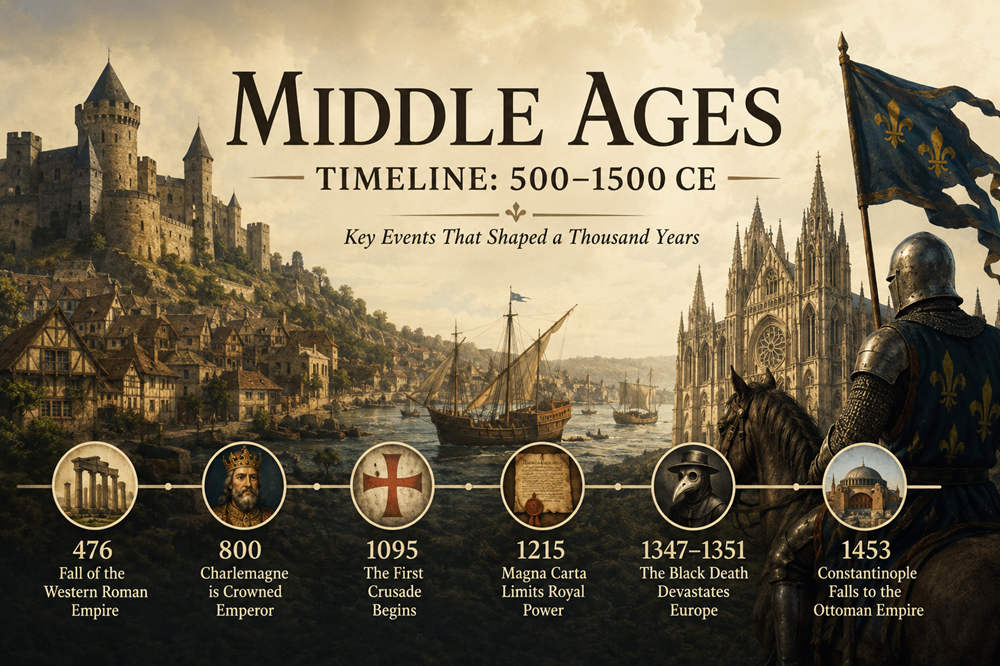
Middle Ages Timeline at a Glance
- 476 CE: The Western Roman Empire collapses.
- 527–565: Justinian rules the Byzantine Empire.
- 622: The Islamic calendar begins with Muhammad’s migration from Mecca to Medina.
- 732: Frankish forces defeat an Umayyad army at the Battle of Tours.
- 800: Charlemagne is crowned emperor in Rome.
- 843: The Treaty of Verdun divides the Carolingian Empire.
- c. 800–1100: Viking raids, trade, and settlement reshape parts of Europe.
- 962: Otto I is crowned emperor, helping form what later became known as the Holy Roman Empire.
- 1054: The East-West Schism divides western Catholic and eastern Orthodox Christianity.
- 1066: William of Normandy conquers England after the Battle of Hastings.
- 1095: Pope Urban II calls for the First Crusade.
- 1215: Magna Carta is sealed in England.
- 1315–1317: The Great Famine strikes parts of northern Europe.
- 1337–1453: England and France fight the Hundred Years’ War.
- 1347–1351: The Black Death spreads through much of Europe.
- 1453: Constantinople falls to the Ottoman Empire.
- c. 1500: Europe moves further into the Renaissance and early modern period.
Early Middle Ages Timeline: c. 500–1000 CE
The Early Middle Ages began in a world shaped by the fall of Roman power in western Europe. Many former Roman provinces came under the rule of new kingdoms, including the Franks, Visigoths, Ostrogoths, Lombards, and Anglo-Saxons. Political authority became more local, while the Christian Church became one of the most stable institutions in western Europe.
476 CE: The Western Roman Empire Falls
In 476 CE, the last western Roman emperor, Romulus Augustulus, was removed from power. This date is often used as a symbolic starting point for the Middle Ages. The change was not sudden everywhere, but it marked the end of the Western Roman Empire as a political structure.
Roman influence continued through language, law, roads, cities, and Christianity. Many medieval rulers wanted to connect themselves to Roman authority, even while they governed very different societies.
527–565: Justinian Rules the Byzantine Empire
While western Europe changed, the eastern Roman world remained powerful. Emperor Justinian ruled the Byzantine Empire from 527 to 565. His reign is remembered for legal reform, church building, and efforts to restore Roman territory in the Mediterranean.
One of Justinian’s most important achievements was the organization of Roman law into what became known as the Justinian Code. Byzantine culture preserved Greek and Roman learning while also developing its own religious, artistic, and political traditions.
622: The Rise of Islam Begins a New Era
In the 7th century, Islam began in Arabia through the teachings of the Prophet Muhammad. After Muhammad’s migration from Mecca to Medina in 622, Muslim communities and states expanded rapidly across the Middle East, North Africa, Spain, and parts of Central Asia.
This changed the medieval Mediterranean world. Europe, the Byzantine Empire, and Islamic states were often rivals, but they were also connected through trade, diplomacy, scholarship, and cultural exchange. Knowledge in mathematics, medicine, astronomy, philosophy, and literature moved across regions in complex ways.
732: The Battle of Tours
In 732, Frankish forces led by Charles Martel defeated an Umayyad army near Tours in present-day France. The battle has often been remembered as a major moment in western European history, though historians debate exactly how much it changed the long-term balance of power.
What is clear is that the Franks became one of the strongest political powers in western Europe. Charles Martel’s family later produced Charlemagne, one of the most important rulers of the medieval period.
800: Charlemagne Is Crowned Emperor
Charlemagne, king of the Franks, built a large empire across much of western and central Europe. In 800, he was crowned emperor by the pope in Rome. His coronation connected Frankish power with Roman memory and Christian authority.
Charlemagne supported education, religious reform, administration, and manuscript copying. His empire did not survive as a united state for long, but his rule became a model for later medieval ideas about kingship, empire, and Christian government.
843: The Treaty of Verdun Divides the Carolingian Empire
After Charlemagne’s death, his empire was eventually divided among his grandsons by the Treaty of Verdun in 843. This division helped shape political regions later associated with France, Germany, and the lands between them.
The treaty also showed a major problem in medieval politics. Kingdoms were often treated as family inheritance, so royal lands could be divided among heirs. That made long-term political unity difficult.
c. 800–1100: Viking Raids, Trade, and Settlement
From roughly the late 8th century onward, Vikings from Scandinavia raided, traded, explored, and settled across Europe and beyond. They attacked monasteries, towns, and coastal areas, but they were not only raiders. They were also sailors, merchants, settlers, and political founders.
Vikings settled in places such as England, Ireland, Normandy, Iceland, and parts of the North Atlantic. Their activity forced European rulers to improve defenses, strengthen local authority, and negotiate with powerful warrior groups.
High Middle Ages Timeline: c. 1000–1300 CE
The High Middle Ages were a period of growth in many parts of Europe. Population increased, farming improved, towns expanded, trade networks grew, and monarchies became stronger. Castles, knights, guilds, universities, and Gothic cathedrals became major features of medieval society.
c. 1000: Many Parts of Europe Begin to Grow
Around the year 1000, many parts of western Europe entered a period of greater stability and growth. Better farming tools, heavier plows, the use of horse collars, and the three-field system helped increase food production in some regions.
More food could support larger populations. As villages grew, towns also expanded. Markets became more active, merchants gained influence, and craft workers organized into guilds. Medieval Europe was still mostly rural, but urban life became more important during this period.
1054: The East-West Schism Divides Christianity
In 1054, tensions between the western Latin Church and the eastern Greek Church led to what is often called the East-West Schism. This division helped separate Roman Catholic Christianity in western Europe from Eastern Orthodox Christianity centered in the Byzantine world.
The split was not caused by one disagreement alone. It grew from differences in language, church authority, theology, politics, and culture. The schism mattered because religion shaped medieval identity, diplomacy, education, and political power.
1066: The Norman Conquest Changes England
In 1066, William, Duke of Normandy, invaded England and defeated King Harold II at the Battle of Hastings. This event, known as the Norman Conquest, changed England’s ruling class, language, landholding system, and government.
After the conquest, William became king of England. Norman nobles received large estates, castles were built across the kingdom, and French-speaking elites influenced English law and culture. The conquest connected England more closely to continental Europe.
1095: The First Crusade Begins
In 1095, Pope Urban II called for a military expedition to the eastern Mediterranean. This became the First Crusade. The Crusades were religious wars involving western European Christians, Muslim powers, Byzantine politics, and other groups over several centuries.
The Crusades were not caused by religion alone. They also involved land, power, trade, pilgrimage, violence, and political ambition. They increased contact between Europe and the eastern Mediterranean, often through warfare and conquest.
c. 1100–1200: Castles, Knights, and Feudal Society Expand
During the High Middle Ages, castles became important military and political centers. Nobles built castles to defend land, control local populations, and display power. Knights served as mounted warriors, often connected to noble households and landholding arrangements.
Feudalism is a term used to describe relationships among kings, nobles, knights, and landholders. In simple terms, powerful people exchanged land, loyalty, military service, and protection. At the local level, many peasants lived and worked on manors, where they owed labor or payments to lords.
Medieval society was not exactly the same everywhere. Customs varied by region, and historians often warn that “feudalism” can oversimplify a complicated system. Still, it is a useful starting point for understanding land and power in much of medieval Europe.
c. 1100–1300: Towns, Guilds, and Universities Expand
As trade increased, towns became more important. Merchants sold cloth, grain, metal goods, spices, wine, and other products. Craft workers formed guilds to regulate training, quality, prices, and competition.
Universities also developed during the High Middle Ages. Schools in places such as Bologna, Paris, and Oxford became centers of advanced learning. Students studied theology, law, medicine, philosophy, and the liberal arts. Medieval universities helped preserve ancient knowledge while also creating new intellectual traditions.
1215: Magna Carta Limits Royal Power
In 1215, English nobles forced King John to accept Magna Carta. At first, it was a political agreement between the king and his barons. Over time, however, Magna Carta became a powerful symbol of the idea that rulers should be subject to law.
Magna Carta did not create modern democracy, and it did not give equal rights to all people. Its original purpose was narrower. Still, its later influence on legal traditions made it one of the most famous documents of the Middle Ages.
c. 1200–1300: Gothic Cathedrals Show Medieval Ambition
The High Middle Ages produced some of Europe’s most famous cathedrals. Gothic architecture used pointed arches, ribbed vaults, flying buttresses, tall towers, and large stained-glass windows.
These buildings were religious spaces, but they were also signs of wealth, skill, community identity, and artistic ambition. Cathedrals could take generations to complete, showing how medieval communities organized labor, money, faith, and design across long periods of time.
Late Middle Ages Timeline: c. 1300–1500 CE
The Late Middle Ages were marked by crisis and transformation. Famine, plague, war, and social unrest caused deep suffering across Europe. At the same time, these pressures weakened older systems and encouraged changes in politics, labor, trade, and culture.
1315–1317: The Great Famine Strikes Northern Europe
In the early 1300s, bad weather and poor harvests caused severe famine in parts of northern Europe. Food shortages led to hunger, disease, rising prices, and population stress.
The famine showed how dependent medieval society was on local agriculture and climate conditions. It also came before the Black Death, meaning many communities were already under pressure before the plague arrived.
1337–1453: The Hundred Years’ War Reshapes England and France
The Hundred Years’ War was a long conflict between England and France. It was not one continuous battle for 116 years, but a series of wars, truces, campaigns, and political struggles.
The war changed medieval warfare. Longbows, infantry tactics, gunpowder weapons, and stronger royal taxation became more important. It also helped strengthen political identities in England and France, even though both kingdoms faced serious internal problems.
1347–1351: The Black Death Devastates Europe
The Black Death was one of the deadliest pandemics in human history. It spread across much of Europe in the mid-14th century, killing a large portion of the population. The disease caused fear, grief, labor shortages, religious anxiety, and social change.
The plague reached London in 1348, where it became known as the Great Pestilence. The Black Death did not simply end after one outbreak. Plague returned many times in later centuries.
The effects were enormous. With fewer workers available, many surviving laborers could demand better wages or conditions. Landowners struggled to maintain older labor systems. In some places, governments tried to control wages, which increased tension between elites and common people.
1381: The Peasants’ Revolt Challenges Authority in England
In 1381, the Peasants’ Revolt broke out in England. Rebels protested taxes, labor restrictions, and unfair treatment. Although the revolt was suppressed, it showed that ordinary people were willing to challenge authority when economic pressure and political anger became too great.
Similar unrest appeared in other parts of Europe during the Late Middle Ages. These revolts did not immediately create equality, but they revealed cracks in the old social order.
1415–1431: Joan of Arc and the Later Hundred Years’ War
In the early 15th century, France was under great pressure during the Hundred Years’ War. Joan of Arc, a young woman from northeastern France, became a powerful symbol of French resistance. She helped inspire French forces during a key stage of the conflict before she was captured, tried, and executed in 1431.
Joan’s story shows how religion, monarchy, war, and popular belief could come together in medieval politics. She later became one of the most remembered figures of the Late Middle Ages.
1453: Constantinople Falls to the Ottoman Empire
In 1453, Constantinople fell to the Ottoman Empire under Sultan Mehmed II. This event ended the Byzantine Empire, which had preserved eastern Roman traditions for nearly a thousand years after the fall of the Western Roman Empire.
The Fall of Constantinople was a major turning point. It strengthened Ottoman power, changed politics in the eastern Mediterranean, and became one of the events often associated with the end of the medieval period.
c. 1450–1500: Printing, Renaissance Culture, and Early Modern Change
By the late 1400s, Europe was changing quickly. The printing press made books easier to produce. Renaissance learning spread in parts of Europe. Monarchies became stronger in some regions, while overseas exploration began to connect Europe more directly with Africa, Asia, and the Americas.
These changes did not erase the medieval world overnight. Many medieval institutions, beliefs, and social patterns continued. Still, by about 1500, Europe had clearly moved toward a new historical period.
Key Themes in the Middle Ages Timeline
Power and Government
Medieval government was often local and personal. Kings depended on nobles, nobles controlled land, and peasants worked much of that land. Over time, some monarchies became stronger through royal courts, written records, taxation, and law.
Religion and the Church
Christianity played a central role in western medieval Europe. The Church influenced education, art, law, morality, festivals, politics, and everyday life. Monasteries preserved manuscripts, cared for travelers and the poor, and became centers of prayer and learning.
Religion also shaped conflict. The Crusades, disputes between popes and rulers, heresy trials, and reform movements all show how deeply faith and power were connected in the medieval world.
Daily Life and Society
Most medieval people were peasants. They lived in villages, farmed land, raised animals, paid dues, and followed the rhythm of seasons and church calendars. Life could be difficult, especially during famine, war, or disease.
Medieval society also included nobles, clergy, merchants, students, monks, nuns, artisans, sailors, soldiers, and townspeople. The Middle Ages were socially unequal, but they were not frozen in place. Trade, plague, war, and urban growth all created opportunities for change.
Trade, Towns, and Learning
The growth of towns was one of the most important developments of the High and Late Middle Ages. Markets connected rural producers with merchants and craftspeople. Trade routes linked Europe with the Mediterranean, the Islamic world, Asia, and Africa.
Universities and cathedral schools helped organize learning. Scholars debated theology, law, medicine, philosophy, and ancient texts. Medieval learning later influenced Renaissance thinkers, even when Renaissance writers claimed they were breaking from the medieval past.
War, Disease, and Change
The medieval period included frequent violence: Viking raids, noble conflicts, crusades, civil wars, and international wars. War also changed technology and government because rulers needed money, soldiers, records, and stronger administration.
Disease transformed society as well. The Black Death caused terrible suffering, but it also changed labor conditions and weakened some older social structures. The Late Middle Ages were a time of crisis, but crisis often forced change.
Important People from the Middle Ages
Charlemagne — Early Middle Ages: Charlemagne was king of the Franks and later emperor. His rule helped shape medieval ideas about Christian kingship, empire, education, and law.
William the Conqueror — High Middle Ages: William led the Norman invasion of England in 1066. His victory changed English government, landholding, language, and culture.
Eleanor of Aquitaine — High Middle Ages: Eleanor was one of the most powerful women of the 12th century. She was queen of France, later queen of England, and mother of kings.
Thomas Aquinas — High Middle Ages: Thomas Aquinas was a major medieval scholar and theologian. His writings connected Christian theology with the philosophy of Aristotle.
Marco Polo — Late Middle Ages: Marco Polo became famous for accounts of travel in Asia. His story reflected wider connections between Europe and the world beyond it.
Joan of Arc — Late Middle Ages: Joan became a symbol of French resistance during the Hundred Years’ War. Her life shows the importance of religion, politics, and war in the Late Middle Ages.
Mehmed II — Late Middle Ages: Mehmed II was the Ottoman sultan who conquered Constantinople in 1453. His victory marked the end of the Byzantine Empire and a major shift in world history.
Middle Ages Timeline Summary
The Middle Ages began with the weakening of Roman authority in western Europe and ended as stronger monarchies, expanding trade, new military technology, wider learning, and Renaissance culture changed European society.
The Early Middle Ages were shaped by new kingdoms, the survival of Byzantium, the spread of Christianity, the rise of Islam, Charlemagne’s empire, and Viking expansion. The High Middle Ages brought population growth, castles, knights, crusades, towns, universities, Gothic cathedrals, and Magna Carta. The Late Middle Ages brought famine, plague, war, revolt, and major political change.
The medieval period was not simply a gap between ancient and modern history. It shaped law, religion, government, education, architecture, language, and social life in ways that continued long after 1500. Understanding the Middle Ages timeline helps explain how Europe changed over time and why medieval history remains important today.