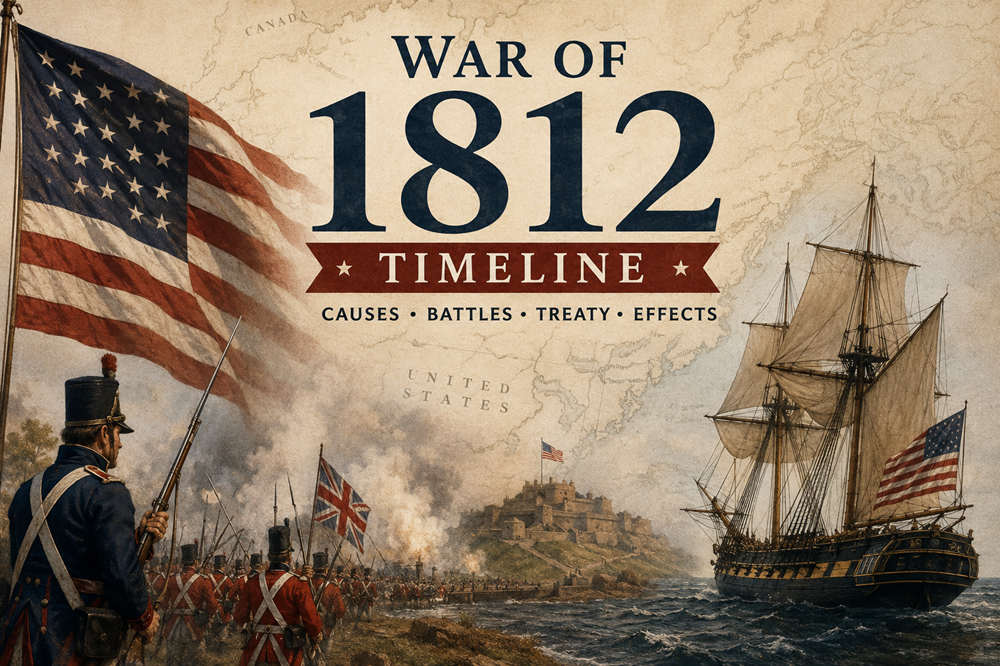
The War of 1812 was fought between the United States and Great Britain from 1812 to 1815. It began with disputes over maritime rights, trade restrictions, British impressment of sailors, frontier conflict, and American anger toward British policy during the Napoleonic Wars. Although the war ended without major territorial changes, it shaped American national identity, Canadian memory, Indigenous history, and future relations between the United States and Britain.
This War of 1812 timeline explains the major causes, battles, turning points, and results in a clear year-by-year order.
Quick Facts About the War of 1812
| Topic | Details |
|---|---|
| Dates | June 18, 1812 to February 1815 |
| Main Opponents | United States and Great Britain |
| Important Regions | Great Lakes, Canada, Atlantic Ocean, Chesapeake Bay, Gulf Coast, and the U.S. frontier |
| Major Causes | Impressment, trade restrictions, maritime disputes, frontier conflict, and expansion pressure |
| Peace Agreement | Treaty of Ghent |
| Final Major Battle | Battle of New Orleans |
| Overall Result | Military stalemate and return to prewar boundaries, with important long-term effects |
Background Before 1812: Why Tensions Were Rising
The War of 1812 did not begin with one single event. For years, Americans had grown frustrated with British actions at sea, limits on trade, and conflict along the western frontier. These problems were connected to the larger struggle between Britain and France in Europe, but they also reflected the young United States’ desire to defend its independence and expand its influence in North America.
British Impressment and Maritime Rights
One of the strongest causes of the war was impressment, the British practice of forcing sailors into naval service. During the Napoleonic Wars, Britain needed sailors for the Royal Navy. British ships sometimes stopped American vessels and took sailors they claimed were British deserters.
Many Americans saw this as a violation of national independence. Even when some impressed sailors had British origins, the practice angered the United States because it seemed to ignore American sovereignty and the rights of American ships at sea.
Trade Restrictions During the Napoleonic Wars
Britain and France both tried to weaken each other by limiting trade. The United States wanted to remain neutral and continue trading, but British restrictions made that difficult. American merchants complained that British policy interfered with their ships, cargo, and profits.
These trade disputes made the larger issue clear: the United States wanted to be treated as an independent nation with the right to trade freely.
Frontier Conflict and Indigenous Resistance
Conflict on the western frontier also helped push the country toward war. Many Native nations were resisting U.S. expansion into their homelands. Some Americans believed Britain was encouraging or supplying Indigenous resistance, especially in the Great Lakes region.
For Native communities, the conflict was not simply about Britain and the United States. It was also about land, survival, sovereignty, and the future of Indigenous nations in North America.
The War Hawks and the Push for War
In Congress, a group of younger leaders often called the War Hawks pushed for a stronger response to Britain. Some believed war would defend American honor. Others hoped the United States could invade Canada and weaken British influence in North America.
By 1812, President James Madison and many members of Congress believed diplomacy had failed. On June 18, 1812, the United States declared war on Great Britain.
1812: The War Begins
June 18, 1812: The United States Declares War
The United States officially declared war on Great Britain on June 18, 1812. This was the first time the United States declared war as an independent nation. The decision was controversial. Supporters argued that war was necessary to defend American rights, while opponents feared the country was not prepared for a major conflict.
The United States had a small regular army, limited military supplies, and political divisions at home. Many leaders expected the invasion of Canada to be easier than it became.
Summer and Fall 1812: Failed U.S. Invasions of Canada
Early in the war, American leaders tried to invade Canada from several directions. They hoped that capturing parts of Canada would pressure Britain and possibly expand U.S. influence. Instead, the campaigns exposed weaknesses in American planning, leadership, and military readiness.
Militia forces were often reluctant to cross into Canada, communication was poor, and British and Canadian defenders proved stronger than some U.S. leaders expected.
August 1812: Detroit Falls to British Forces
One of the most serious early setbacks came when Detroit surrendered to British forces in August 1812. The surrender damaged American morale and gave Britain an important position in the Great Lakes region.
The fall of Detroit also strengthened British and Indigenous resistance in the Old Northwest. In this context, the Old Northwest means the region around present-day Ohio, Indiana, Illinois, Michigan, Wisconsin, and nearby areas south of the Great Lakes.
Late 1812: Early Naval Successes Lift American Spirits
Although the United States struggled on land, it had some important early successes at sea. American naval victories, including actions involving the USS Constitution, gave the public something to celebrate. The War of 1812 became closely connected with stories of American ships challenging the much larger British navy.
These victories did not decide the war, but they helped build confidence at a time when land campaigns were going badly.
1813: Fighting Expands Across the Great Lakes and Frontier
January 1813: Battle of Frenchtown/River Raisin
In January 1813, American forces suffered a major defeat near the River Raisin in present-day Michigan. The battle became especially remembered because of the violence that followed and because the phrase “Remember the Raisin” became a rallying cry for some American troops.
The defeat showed how brutal frontier warfare could be. It also reinforced American determination to regain control in the region around Detroit and the Great Lakes.
April 1813: U.S. Forces Capture York
In April 1813, American forces captured York, the capital of Upper Canada, now Toronto. The attack gave the United States a temporary success, but it did not permanently change the course of the war.
The capture of York also had consequences later. British anger over destruction during the attack helped shape the cycle of retaliation that would eventually include the British attack on Washington, D.C.
September 1813: Battle of Lake Erie
One of the most important American victories came at the Battle of Lake Erie in September 1813. U.S. naval forces under Oliver Hazard Perry defeated a British squadron and gained control of Lake Erie.
Control of the lake mattered because armies depended on water routes for movement, supplies, and communication. Perry’s victory helped the United States regain momentum in the Northwest.
October 1813: Battle of the Thames
After the American victory on Lake Erie, British forces and their Indigenous allies retreated. In October 1813, U.S. forces defeated them at the Battle of the Thames in present-day Ontario.
This battle was a major turning point in the western theater. Tecumseh, the Shawnee leader who had worked to build a broad Indigenous confederacy against U.S. expansion, was killed. His death weakened organized resistance in the region and made it harder for Native nations to continue fighting with the same level of unity and British support.
1814: The War Reaches Its Most Dramatic Stage
Early 1814: Britain Sends More Forces After Napoleon’s Defeat
In 1814, the war changed because events in Europe changed. After Napoleon’s defeat, Britain could send more attention and military resources to North America. This made the war more dangerous for the United States.
The British planned several campaigns, including attacks through the north, pressure along the Atlantic coast, and operations near the Gulf Coast.
July 1814: Battle of Chippewa
In July 1814, American troops won the Battle of Chippewa near the Niagara River. The victory showed that parts of the U.S. Army had become better trained and more disciplined since the beginning of the war.
Chippewa did not end the fighting in the region, but it helped prove that American regular troops could stand against experienced British soldiers.
July 1814: Battle of Lundy’s Lane
Later that month, the Battle of Lundy’s Lane became one of the bloodiest battles of the War of 1812. The fighting was fierce, confused, and costly for both sides.
Lundy’s Lane showed how intense the Niagara campaign had become. Neither side won a clear strategic victory, but the battle left both armies weakened and exhausted.
August 1814: British Troops Burn Washington, D.C.
In August 1814, British forces entered Washington, D.C., after defeating American troops at Bladensburg. They burned several public buildings, including the Capitol and the White House.
The burning of Washington was one of the most dramatic moments of the war. It shocked Americans and showed how vulnerable the capital could be. At the same time, it did not force the United States to surrender.
September 12–14, 1814: Battle of Baltimore and Fort McHenry
After Washington, British forces turned toward Baltimore. Baltimore was an important port city and a center of privateering against British shipping.
American defenders resisted the British attack from September 12 to 14, 1814. During the bombardment of Fort McHenry, Francis Scott Key saw the American flag still flying after the attack. That moment inspired the poem that later became “The Star-Spangled Banner”.
The defense of Baltimore became one of the most remembered American moments of the war. It helped restore morale after the burning of Washington.
September 1814: Battle of Plattsburgh/Lake Champlain
Another major American success came at Plattsburgh, near Lake Champlain, in September 1814. American naval and land forces stopped a British invasion from Canada.
This victory mattered because peace negotiations were already underway in Europe. The American success at Plattsburgh weakened Britain’s position and made it less likely that Britain could demand major territorial changes.
December 15, 1814–January 5, 1815: The Hartford Convention Shows Domestic Opposition
Not all Americans supported the War of 1812. In New England, many Federalists opposed the war because it damaged trade and seemed to give too much power to the national government. From December 1814 to January 1815, delegates met at the Hartford Convention to discuss their complaints and propose constitutional changes.
The convention later hurt the Federalist Party’s reputation. After news of peace and the victory at New Orleans spread, many Americans viewed the meeting as disloyal or out of step with the country’s growing nationalism.
December 24, 1814: The Treaty of Ghent Is Signed
On December 24, 1814, American and British representatives signed the Treaty of Ghent in present-day Belgium. The treaty ended the war on paper, but news traveled slowly across the Atlantic.
The treaty mostly restored the situation that had existed before the war. It did not directly settle every issue that had caused the conflict, including impressment and maritime trade disputes. However, the end of the Napoleonic Wars reduced the pressure behind many of those problems.
1815: The War Ends After One Last Major Battle
January 8, 1815: Battle of New Orleans
The Battle of New Orleans took place on January 8, 1815, after the Treaty of Ghent had already been signed. Because news had not yet reached the Gulf Coast, British and American forces continued fighting.
American troops under Andrew Jackson won a major victory against the British. The battle made Jackson a national hero and became one of the most famous events of the war. Even though it did not change the treaty, it strongly shaped how many Americans remembered the conflict.
February 16–17, 1815: The Treaty of Ghent Takes Effect
The U.S. Senate ratified the Treaty of Ghent on February 16, 1815, and the formal exchange with Britain followed the next day. With that final diplomatic step, the War of 1812 officially came to an end.
The treaty did not create a clear winner in the traditional sense. Instead, it restored peace and left most boundaries as they had been before the war.
What Changed After the War of 1812?
American National Confidence Grew
Even though the war ended in a stalemate, many Americans remembered it as proof that the young republic had survived another major conflict with Britain. Victories at sea, Baltimore, Plattsburgh, and New Orleans became part of national memory.
This helped create a stronger sense of American identity in the years after the war.
U.S.-British Relations Slowly Improved
The war marked one of the last major military conflicts between the United States and Great Britain. After 1815, relations slowly became more stable. The two countries still had disagreements, but they increasingly settled them through diplomacy rather than war.
Over time, this helped shape a more peaceful border between the United States and British Canada.
Indigenous Nations Faced Greater Pressure
For many Native nations, the end of the War of 1812 brought serious consequences. British support became less reliable, and Indigenous resistance to U.S. expansion became more difficult in the Old Northwest.
The death of Tecumseh and the weakening of British-Indigenous alliances opened the way for greater U.S. pressure on Native lands. This makes the war an important part of both U.S. history and Indigenous history.
The War Shaped American Symbols and Memory
The War of 1812 gave the United States several powerful symbols. The USS Constitution became famous as “Old Ironsides.” The defense of Fort McHenry helped inspire the national anthem. Andrew Jackson’s victory at New Orleans helped launch his national political reputation.
Some Americans later called the War of 1812 a “Second War of Independence.” That phrase shows how the war was remembered, but it should be used carefully. The treaty did not give the United States a dramatic victory or new independence. Instead, the phrase reflects how many Americans felt after surviving another war against Britain.
War of 1812 Timeline Summary
| Year | Main Events |
|---|---|
| 1812 | The United States declares war; early invasions of Canada fail; Detroit falls; American naval victories boost morale. |
| 1813 | Fighting expands around the Great Lakes; U.S. forces capture York; the Battle of Lake Erie and Battle of the Thames become major turning points. |
| 1814 | Britain sends more forces after Napoleon’s defeat; Washington, D.C., is burned; Baltimore and Fort McHenry are defended; Plattsburgh helps shape peace talks; the Hartford Convention meets; the Treaty of Ghent is signed. |
| 1815 | The Battle of New Orleans is fought; the Treaty of Ghent is ratified and formally exchanged; the war officially ends. |
Conclusion: Why the War of 1812 Timeline Matters
The War of 1812 timeline shows how a conflict that began with maritime rights and trade disputes became a wider war across Canada, the Great Lakes, the Atlantic coast, the Chesapeake, and the Gulf Coast. The United States struggled early, gained important victories later, and ended the war without major territorial change.
The war’s meaning depends on whose experience is being studied. For many Americans, it became a story of survival and national confidence. For Canadians, it became part of the memory of resisting invasion. For Native nations, it marked a major setback in the fight to defend land and sovereignty.
Studying the War of 1812 timeline helps explain how the young United States tested its independence, how Canada and Britain remembered the defense of British North America, and how Native nations faced even greater pressure as U.S. expansion continued westward.