American history is easier to understand when its major events are placed in order. A US history timeline shows how different eras connect, from Indigenous America and European colonization to revolution, expansion, Civil War, industrial growth, civil rights, digital change, and recent political conflict.
This guide gives a clear overview of the most important periods in U.S. history. It is not a complete list of every event, but it highlights the dates, changes, and turning points that students and general readers most need to know.
How This US History Timeline Is Organized
This timeline is arranged by historical eras instead of isolated dates alone. That makes the story easier to follow because major changes often developed over many years. For example, westward expansion, slavery, Native resistance, immigration, industrialization, and political reform often overlapped.
Each section explains the main idea of the period, then lists key events in chronological order. For readers who want to explore original documents, images, maps, and other classroom materials, the Library of Congress U.S. History Primary Source Timeline is a useful resource.
Indigenous America and European Contact
American history began long before the United States existed. For thousands of years, Indigenous peoples lived across North America in many different societies. They built towns, trade networks, farms, governments, spiritual traditions, and diplomatic relationships. There was no single Native American culture. The continent was home to many nations with distinct languages, homelands, economies, and political systems.
European contact after 1492 changed life across the Americas. The arrival of Europeans brought new trade goods, animals, weapons, diseases, religious missions, and imperial land claims. These changes were often devastating for Indigenous communities, especially because diseases introduced from Europe caused major population losses. European colonization also led to land seizures, warfare, forced labor, and long struggles over sovereignty.
Indigenous history did not end with European colonization. Native nations continued to shape diplomacy, war, law, land policy, culture, and sovereignty throughout U.S. history.
Key Events Before 1607
- Before 1492: Diverse Indigenous societies develop across North America.
- 1492: Christopher Columbus’s voyage begins sustained European contact with the Americas.
- 1500s: Spanish, French, Dutch, and English exploration expands across parts of North America.
- Late 1500s: European empires compete for land, trade, and influence.
- Early 1600s: Permanent European settlements begin to reshape the Atlantic world.
Colonial America and the Atlantic World, 1607–1763
The English colony at Jamestown, founded in 1607, became the first permanent English settlement in what later became the United States. Other colonies followed, including Plymouth in 1620 and Massachusetts Bay in 1630.
Over time, the British colonies developed regional differences. New England had small farms, towns, churches, shipbuilding, and trade. The Middle Colonies became known for farming, commerce, and religious diversity. The Southern Colonies depended heavily on plantation agriculture.
Slavery became central to the colonial economy, especially in the South, where enslaved Africans and their descendants were forced to labor on tobacco, rice, and later cotton plantations. The colonies were also part of a larger Atlantic world that connected Europe, Africa, the Caribbean, and the Americas through trade, migration, war, and forced labor.
Colonial expansion created conflict with Native nations. European settlement pushed into Indigenous lands, while different Native groups responded through diplomacy, trade, alliance-building, and armed resistance.
Key Events, 1607–1763
- 1607: Jamestown is founded in Virginia.
- 1620: Plymouth Colony is established by English Separatists.
- 1630: Massachusetts Bay Colony begins.
- 1676: Bacon’s Rebellion exposes tensions over land, class, race, and colonial authority in Virginia.
- 1730s–1740s: The First Great Awakening spreads religious revivalism through the colonies.
- 1754–1763: The French and Indian War changes the balance of power in North America.
- 1763: Britain wins the war but faces large debts and new questions about governing its colonies.
Road to Revolution and the Founding of the United States, 1763–1791
After the French and Indian War, Britain tried to raise money and tighten control over its North American colonies. Many colonists objected to new taxes and policies because they believed they were being taxed without proper representation in Parliament. Protests over the Stamp Act, Townshend Acts, Tea Act, and other measures gradually turned a political dispute into a revolutionary movement.
The American Revolution began in 1775 with fighting at Lexington and Concord. In 1776, the Continental Congress approved the Declaration of Independence, announcing that the colonies considered themselves free and independent states. The war lasted until 1783, when the Treaty of Paris recognized American independence.
After independence, the new country struggled under the Articles of Confederation, which created a weak national government. In 1787, delegates met in Philadelphia to write a new Constitution. The Constitution created a stronger federal government, while the Bill of Rights added protections for individual liberties. The National Archives describes the Declaration of Independence, Constitution, and Bill of Rights as the Charters of Freedom because of their central role in the founding of the United States.
Key Events, 1763–1791
- 1765: The Stamp Act sparks colonial protests.
- 1770: The Boston Massacre increases tension between colonists and British troops.
- 1773: The Boston Tea Party protests British tea policy.
- 1775: Battles of Lexington and Concord begin the Revolutionary War.
- 1776: The Declaration of Independence is adopted.
- 1781: The Articles of Confederation take effect.
- 1783: The Treaty of Paris recognizes American independence.
- 1787: The Constitutional Convention meets in Philadelphia.
- 1788: The Constitution is ratified.
- 1791: The Bill of Rights is ratified.
The Early Republic and National Expansion, 1790s–1848
The early United States faced major questions about power, territory, citizenship, and national identity. Leaders disagreed over how strong the federal government should be, how the economy should develop, and how the country should respond to foreign conflicts. These disagreements helped create the first political parties.
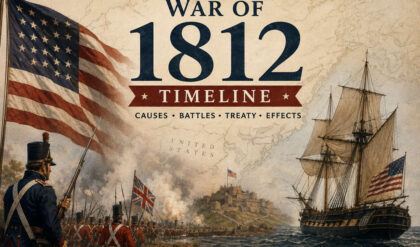
The Louisiana Purchase in 1803 doubled the size of the United States and opened new debates over land, Native sovereignty, slavery, and western settlement. The War of 1812 tested the young nation’s independence and strengthened national identity for many Americans.
Expansion also came at a terrible cost for Native nations. The Indian Removal Act of 1830 led to forced removals, including the Trail of Tears, during which thousands of Cherokee people and members of other Native nations were forced from their homelands. At the same time, reform movements grew around abolition, education, religion, temperance, prisons, and women’s rights.
Key Events, 1790s–1848
- 1800: Thomas Jefferson is elected president, marking a peaceful transfer of power between political parties.
- 1803: The Louisiana Purchase greatly expands U.S. territory.
- 1812–1815: The War of 1812 is fought between the United States and Britain.
- 1823: The Monroe Doctrine warns European powers against new colonization in the Americas.
- 1830: The Indian Removal Act authorizes forced removal of Native peoples from southeastern lands.
- 1838–1839: The Trail of Tears forces Cherokee people westward.
- 1845: The United States annexes Texas.
- 1846–1848: The Mexican-American War leads to major U.S. territorial gains.
- 1848: The Seneca Falls Convention calls for women’s rights, including suffrage.
Slavery, Sectional Crisis, Civil War, and Reconstruction, 1848–1877
By the mid-1800s, the United States was deeply divided over slavery. Each new western territory raised a major political question: would slavery be allowed to expand there? Compromises delayed conflict but did not solve the issue. The Kansas-Nebraska Act, violence in Kansas, the Dred Scott decision, and the election of Abraham Lincoln all increased sectional tension.
The Civil War began in 1861 after southern states seceded from the Union. At first, the war centered on preserving the Union, but slavery was always at the heart of the crisis. In 1863, Lincoln issued the Emancipation Proclamation, declaring enslaved people in rebelling areas to be free. The 13th Amendment abolished slavery in 1865.
Reconstruction was the period after the Civil War when the United States tried to rebuild the South and define freedom, citizenship, and voting rights after slavery. The 14th Amendment established birthright citizenship and equal protection under the law, while the 15th Amendment protected voting rights for Black men. The National Park Service explains that Reconstruction changed the federal system and the meaning of American citizenship.
Reconstruction also faced violent opposition, including white supremacist groups and political efforts to limit Black freedom. Many later civil rights battles in the 20th century returned to the promises of the 13th, 14th, and 15th Amendments.
Key Events, 1848–1877
- 1850: The Compromise of 1850 attempts to settle disputes over slavery and territory.
- 1854: The Kansas-Nebraska Act allows settlers to vote on slavery in new territories.
- 1857: The Dred Scott decision denies citizenship to Black Americans and intensifies sectional conflict.
- 1860: Abraham Lincoln is elected president.
- 1861–1865: The Civil War is fought between the Union and the Confederacy.
- 1863: The Emancipation Proclamation takes effect.
- 1865: The 13th Amendment abolishes slavery.
- 1868: The 14th Amendment defines citizenship and equal protection.
- 1870: The 15th Amendment protects voting rights regardless of race, color, or previous condition of servitude.
- 1877: Reconstruction ends as federal troops withdraw from the South.
Industrial America, Immigration, and the Gilded Age, 1870s–1900
After the Civil War, the United States changed rapidly. Railroads connected distant regions, factories expanded, cities grew, and corporations became more powerful. Steel, oil, banking, and railroad industries helped create great fortunes, but also deep inequality. This period is often called the Gilded Age because glittering wealth existed alongside poverty, corruption, and difficult working conditions.
Millions of immigrants arrived in the United States during this period, especially from Europe and Asia. They helped build cities, railroads, factories, farms, and communities. At the same time, immigrants often faced discrimination, dangerous work, and restrictive laws such as the Chinese Exclusion Act of 1882.
The United States also continued to expand federal power in the West. Native nations faced military campaigns, broken treaties, land loss, forced assimilation, and boarding schools. The Wounded Knee Massacre in 1890 became one of the most tragic symbols of this era.
Key Events, 1870s–1900
- 1869: The first transcontinental railroad is completed.
- 1870s–1890s: Industrial growth transforms the U.S. economy.
- 1882: The Chinese Exclusion Act restricts Chinese immigration.
- 1886: The Haymarket Affair highlights conflict over labor rights.
- 1887: The Dawes Act divides Native lands into individual allotments.
- 1890: The Wounded Knee Massacre takes place in South Dakota.
- 1898: The Spanish-American War marks a major step in U.S. overseas expansion.
Progressive Era, World War I, and the 1920s, 1900–1929
The Progressive Era grew from concerns about industrialization, poverty, corruption, unsafe food, child labor, public health, and political power. Reformers pushed for government action to regulate business, improve cities, protect consumers, and expand democracy.
World War I changed America’s role in global affairs. The United States entered the war in 1917, helping the Allied Powers but also experiencing wartime limits on speech, suspicion toward immigrants, and debates over whether the country should take a larger role in world politics.
The 1920s brought consumer culture, automobiles, radio, movies, jazz, and new forms of mass entertainment. The Harlem Renaissance became a major flowering of Black art, literature, music, and intellectual life. The decade also saw immigration restriction, racial violence, labor conflict, and cultural debates over religion, gender, race, and modern life.
Key Events, 1900–1929
- 1906: The Pure Food and Drug Act strengthens consumer protection.
- 1913: The 16th and 17th Amendments are ratified.
- 1914–1918: World War I is fought in Europe and beyond.
- 1917: The United States enters World War I.
- 1920: The 19th Amendment protects women’s right to vote.
- 1920s: The Harlem Renaissance reshapes American arts and culture.
- 1929: The stock market crash marks the beginning of the Great Depression.
Great Depression, New Deal, and World War II, 1929–1945
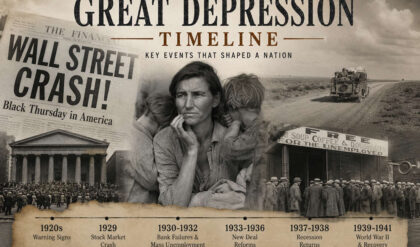
The Great Depression was one of the worst economic crises in American history. After the stock market crash of 1929, banks failed, businesses closed, unemployment rose, and millions of people struggled to afford food and housing. The crisis changed how many Americans thought about the federal government’s responsibility for economic security.
President Franklin D. Roosevelt’s New Deal created programs for relief, jobs, financial reform, and public works. The Social Security Act of 1935 became one of the most important laws of the period because it created a federal system of old-age pensions and unemployment support.
World War II transformed the United States again. After Japan attacked Pearl Harbor on December 7, 1941, the country entered the war. Wartime production helped end the Great Depression, while millions served in the military or worked in defense industries. The war also exposed contradictions in American democracy, including the incarceration of Japanese Americans and continued segregation at home. By 1945, the United States had emerged as a global superpower.
Key Events, 1929–1945
- 1929: The stock market crash begins the Great Depression.
- 1933: Franklin D. Roosevelt takes office and launches the New Deal.
- 1935: The Social Security Act is signed into law.
- 1941: The attack on Pearl Harbor brings the United States into World War II.
- 1942: Japanese American incarceration begins after Executive Order 9066.
- 1944: D-Day opens a major Allied front in Western Europe.
- 1945: World War II ends after Germany’s surrender and Japan’s surrender following the atomic bombings of Hiroshima and Nagasaki.
Cold War America and the Civil Rights Era, 1945–1968
After World War II, the United States and the Soviet Union became rival superpowers. This rivalry, known as the Cold War, shaped foreign policy, military spending, education, science, space exploration, and domestic politics. The Korean War, nuclear arms race, Cuban Missile Crisis, and Vietnam War all grew out of Cold War tensions.
At home, the postwar years brought economic growth for many Americans, but prosperity was not shared equally. Segregation, discrimination, and unequal access to housing, education, jobs, and voting remained major issues. The civil rights movement challenged these injustices through lawsuits, boycotts, marches, sit-ins, voter registration campaigns, and grassroots organizing.
Major civil rights victories included Brown v. Board of Education, the Civil Rights Act of 1964, and the Voting Rights Act of 1965. The National Archives Voting Rights Act page provides historical background on one of the most important voting-rights laws in U.S. history.
Key Events, 1945–1968
- 1947: The Truman Doctrine announces U.S. support for countries resisting communism.
- 1948: President Harry Truman orders desegregation of the U.S. military.
- 1950–1953: The Korean War is fought.
- 1954: Brown v. Board of Education rules school segregation unconstitutional.
- 1955–1956: The Montgomery Bus Boycott challenges segregation in public transportation.
- 1962: The Cuban Missile Crisis brings the United States and Soviet Union close to nuclear war.
- 1963: The March on Washington calls for jobs and freedom.
- 1964: The Civil Rights Act bans many forms of segregation and discrimination.
- 1965: The Voting Rights Act protects voting access against racial discrimination.
- 1968: Martin Luther King Jr. is assassinated in Memphis, Tennessee.
Vietnam, Social Change, and Political Realignment, 1960s–1980s
The Vietnam War deeply divided the United States. Supporters argued that the war was necessary to contain communism, while critics saw it as costly, unjust, and difficult to win. Television coverage, the draft, rising casualties, and antiwar protests made Vietnam one of the defining issues of the 1960s and early 1970s.
This era also saw major social movements. Women’s rights activists challenged discrimination in work, education, politics, and family law. Native activists pushed for sovereignty and treaty rights. Latino activists fought for labor rights, education, and political representation. Environmental activists helped create a national movement for cleaner air, cleaner water, and conservation. LGBTQ+ activism became more visible after the Stonewall uprising in 1969.
Trust in government was damaged by the Vietnam War and the Watergate scandal, which led President Richard Nixon to resign in 1974. During the late 1970s and 1980s, inflation, energy crises, and changing political values helped reshape national politics. Ronald Reagan’s election in 1980 marked a conservative shift toward tax cuts, deregulation, stronger anti-communist policy, and a different view of the federal government’s role.
Key Events, 1960s–1980s
- 1964: The Gulf of Tonkin Resolution expands U.S. involvement in Vietnam.
- 1969: The Stonewall uprising becomes a major turning point in LGBTQ+ history.
- 1970: The first Earth Day reflects growing environmental concern.
- 1973: U.S. combat troops leave Vietnam.
- 1974: Richard Nixon resigns after the Watergate scandal.
- 1979: The Iran hostage crisis begins.
- 1980: Ronald Reagan is elected president.
- 1989: The Berlin Wall falls, signaling the weakening of Soviet control in Eastern Europe.
The United States After the Cold War, 1990s–2000s
The end of the Cold War changed America’s place in the world. With the Soviet Union gone, the United States became the world’s leading military and economic power. The 1990s brought debates over globalization, trade, crime, welfare reform, immigration, and America’s role in international conflicts.
Technology also transformed daily life. Personal computers, the internet, email, mobile phones, and later social media changed communication, work, education, news, and entertainment. These changes helped create the Information Age, when digital tools became central to modern society.
On September 11, 2001, terrorist attacks on New York City and Washington, D.C., reshaped American politics and foreign policy. The United States launched the War on Terror, including wars in Afghanistan and Iraq. The early 2000s also brought growing debates over national security, civil liberties, immigration, military power, and the cost of war.
Key Events, 1990s–2000s
- 1991: The Soviet Union collapses, ending the Cold War.
- 1991: The Gulf War is fought after Iraq invades Kuwait.
- 1990s: Internet use expands rapidly.
- 2001: The September 11 attacks lead to major changes in national security and foreign policy.
- 2001: The War in Afghanistan begins.
- 2003: The Iraq War begins.
- 2008: The financial crisis triggers a severe recession.
Recent U.S. History, 2008–Present
Recent history should be handled carefully because its long-term effects are still unfolding. Still, several events clearly shaped American life in the early 21st century.
The Great Recession affected jobs, housing, banks, public trust, and politics. Barack Obama’s election in 2008 was historic because he became the first Black president of the United States. In 2010, the Affordable Care Act became a major health-care law and a long-running political debate.
The 2016 and 2024 elections showed continuing debates over immigration, trade, courts, executive power, media, and the role of government. In 2020, the COVID-19 pandemic disrupted schools, workplaces, travel, health care, and the economy. The murder of George Floyd in 2020 led to nationwide and global protests against police violence and racial injustice.
On January 6, 2021, a mob attacked the U.S. Capitol while Congress was meeting to count electoral votes from the 2020 presidential election. In 2022, the Supreme Court’s decision in Dobbs v. Jackson Women’s Health Organization overturned Roe v. Wade and returned many abortion-law decisions to states. In 2024, Donald Trump won the presidential election, and on January 20, 2025, he began a second, nonconsecutive term as president.
Future historians will continue to study how the pandemic, political polarization, legal changes, technology, climate issues, immigration debates, and global conflicts reshaped the United States.
Key Events, 2008–Present
- 2008: Barack Obama is elected president.
- 2010: The Affordable Care Act is signed into law.
- 2016: Donald Trump is elected president.
- 2020: The COVID-19 pandemic disrupts American life.
- 2020: George Floyd protests bring renewed attention to policing and racial justice.
- 2021: The January 6 attack on the U.S. Capitol takes place.
- 2022: Dobbs v. Jackson Women’s Health Organization changes federal abortion-rights precedent.
- 2024: Donald Trump wins the presidential election.
- 2025: Donald Trump begins a second, nonconsecutive presidential term.
Quick US History Timeline Table
| Date or Period | Event | Main Idea | Why It Matters |
|---|---|---|---|
| Before 1492 | Indigenous societies across North America | Many Native nations develop distinct cultures, governments, and economies. | Shows that American history began long before European settlement. |
| 1607 | Jamestown founded | England establishes a permanent colony in Virginia. | Marks a major beginning of English colonization in North America. |
| 1776 | Declaration of Independence | The colonies declare independence from Britain. | Creates the founding statement of American independence and ideals. |
| 1787–1791 | Constitution and Bill of Rights | The new federal government is created and individual rights are protected. | Forms the basic structure of U.S. government. |
| 1803 | Louisiana Purchase | The United States buys a vast territory from France. | Expands the country and increases conflict over land, slavery, and Native sovereignty. |
| 1861–1865 | Civil War | The Union and Confederacy fight over slavery, secession, and national power. | Preserves the Union and leads to the end of slavery. |
| 1865–1877 | Reconstruction | The nation attempts to rebuild after slavery and civil war. | Redefines citizenship and voting rights, though many gains are later restricted. |
| 1870s–1900 | Gilded Age | Industrial growth transforms cities, labor, wealth, and immigration. | Creates modern industrial America but also deep inequality. |
| 1929–1939 | Great Depression and New Deal | Economic crisis leads to major federal relief and reform programs. | Expands the role of the federal government in economic life. |
| 1941–1945 | World War II | The United States fights as part of the Allied Powers. | Helps make the United States a global superpower. |
| 1950s–1960s | Civil rights movement | Activists challenge segregation, discrimination, and voting barriers. | Leads to landmark civil rights laws and expands American democracy. |
| 1945–1991 | Cold War | The United States and Soviet Union compete globally. | Shapes foreign policy, military spending, technology, and politics. |
| 2001 | September 11 attacks | Terrorist attacks change U.S. national security and foreign policy. | Begins a new era of war, surveillance, and security debates. |
| 2020 | COVID-19 pandemic | A public health crisis disrupts daily life. | Changes schools, work, politics, health care, and the economy. |
| 2021 | January 6 Capitol attack | A mob attacks the Capitol during certification of the 2020 election results. | Becomes a major event in debates over democracy and political violence. |
| 2022 | Dobbs decision | The Supreme Court overturns Roe v. Wade. | Changes abortion law and returns many decisions to states. |
| 2024–2025 | 2024 election and presidential transition | Donald Trump wins the 2024 election and begins a second nonconsecutive term. | Continues debates over executive power, courts, immigration, and the direction of U.S. politics. |
Key Themes in US History
Several themes appear across the full timeline. These themes help explain how separate events connect to one another.
Democracy and Citizenship
U.S. history includes repeated debates over who has political rights and what citizenship means. The Revolution, Reconstruction, women’s suffrage movement, civil rights movement, and modern voting-rights debates all connect to this theme.
Freedom and Inequality
U.S. history often shows a tension between ideals of liberty and realities such as slavery, segregation, Native dispossession, discrimination, and unequal opportunity. Many major reform movements grew from efforts to challenge that gap.
Expansion and Land
Territorial expansion shaped American politics, economics, and identity. It also caused war, forced removal, treaty violations, and lasting conflicts over land and sovereignty.
Economic Change and Labor
The economy changed from farming and trade to industrial production, corporate capitalism, service work, and digital technology. Each shift changed where people lived, how they worked, and what political problems they faced.
War and Global Power
Wars shaped American independence, national unity, territorial growth, foreign policy, and global influence. By the end of World War II, the United States had become one of the most powerful countries in the world.
Technology and Communication
Printing, railroads, telegraphs, radio, television, computers, the internet, and social media all changed how Americans learned, organized, worked, and argued about public life. Technology often changes how quickly historical events unfold and how people respond to them.
Final Summary
The US history timeline is a story of change over time. It begins with Indigenous societies long before European colonization and continues through revolution, expansion, civil war, industrial growth, reform, global conflict, civil rights, technological change, and modern political debate.
Learning the timeline helps readers see how major events connect. The American Revolution created a new nation, but it did not settle questions about slavery, citizenship, or equality. The Civil War ended slavery, but Reconstruction showed how difficult freedom and equal rights were to protect. Industrialization created wealth and modern cities, but also inequality and labor conflict. The civil rights movement expanded democracy, while recent events show that debates over rights, power, and national identity continue.
In the end, U.S. history is not only about presidents, wars, and laws. It is also about ordinary people, social movements, communities, workers, families, immigrants, enslaved people, Indigenous nations, activists, and citizens who shaped the country’s direction. A good timeline helps us remember the dates, but it also helps us understand why those dates still matter.