The Cold War was a long rivalry between the United States, the Soviet Union, and their allies after World War II. It was called “cold” because the two superpowers did not fight each other directly in a full-scale war. Instead, they competed through military alliances, nuclear weapons, propaganda, espionage, economic pressure, technology, and proxy wars in other parts of the world.
The Cold War did not begin on one exact day. It developed gradually between 1945 and 1949 as the wartime alliance broke down, Europe was divided, and both sides began building rival political and military systems. By the time NATO formed and the Soviet Union tested its first atomic bomb in 1949, the world had clearly entered a new era of global tension.
Cold War Timeline at a Glance
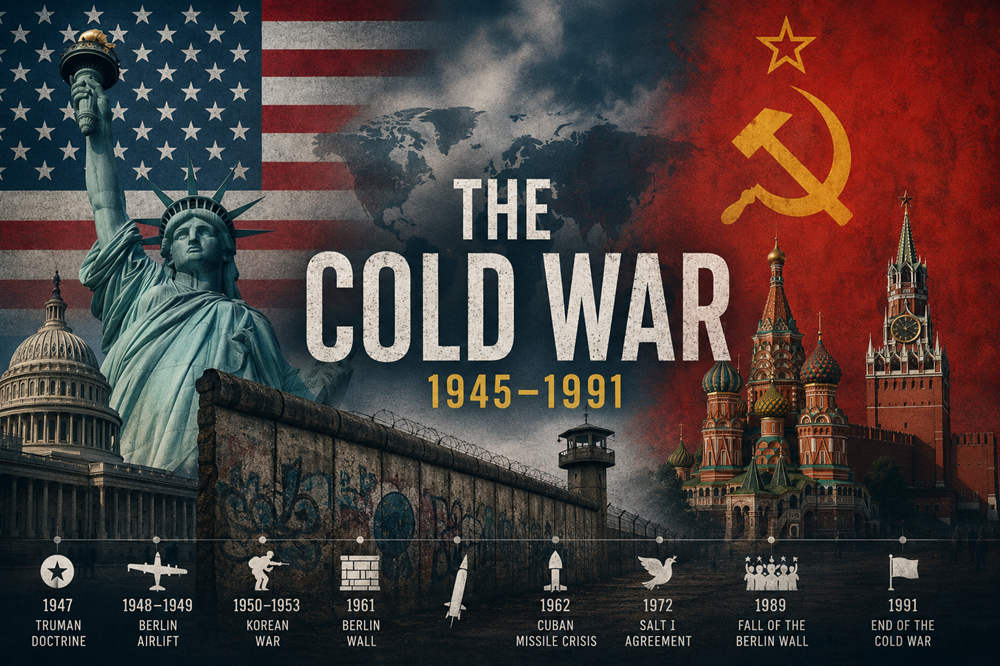
This quick timeline shows the major turning points before the article explains each phase in more detail.
| Year or Date | Event | Why It Matters |
|---|---|---|
| 1945 | Yalta and Potsdam Conferences | Allied leaders planned the postwar world, but disagreements over Germany and Eastern Europe grew. |
| 1947 | Truman Doctrine | Containment became a central U.S. Cold War policy. |
| 1948–1949 | Berlin Blockade and Airlift | Berlin became the first major Cold War crisis in Europe. |
| 1949 | NATO Formed | The Western military alliance took shape. |
| 1950–1953 | Korean War | The Cold War became a major military conflict in Asia. |
| 1957 | Sputnik Launched | The Space Race began. |
| 1961 | Berlin Wall Built | The wall became the clearest symbol of Cold War division. |
| 1962 | Cuban Missile Crisis | The world came close to nuclear war. |
| 1972 | SALT I Signed | Arms control became an important part of Cold War diplomacy. |
| 1979 | Soviet Invasion of Afghanistan | Détente weakened and Cold War tension rose again. |
| 1980 | Solidarity Movement Begins in Poland | A major challenge to communist rule emerged inside the Soviet bloc. |
| 1987 | INF Treaty Signed | The U.S. and Soviet Union agreed to eliminate an entire class of nuclear missiles. |
| 1989 | Fall of the Berlin Wall | Communist control in Eastern Europe was collapsing. |
| 1991 | Soviet Union Collapses | The Cold War ended with the breakup of the U.S.S.R. |
1945–1949: The Cold War Begins
The first phase of the Cold War grew out of the unsettled world left behind by World War II. Germany had been defeated, Europe was damaged, and the Soviet Union had enormous influence in Eastern Europe. The United States and Britain wanted free elections and open political systems. The Soviet Union wanted friendly governments on its western border as protection against future invasion.
1945: Yalta and Potsdam Conferences
At Yalta and Potsdam, Allied leaders discussed how to manage postwar Europe. They agreed that Germany would be occupied and divided into zones, but they disagreed over political freedom in Eastern Europe. Those disagreements became more serious after the war ended.
1945: Germany and Berlin Are Divided
Germany was divided into American, British, French, and Soviet occupation zones. Berlin was also divided, even though the city sat inside the Soviet zone. This unusual arrangement made Berlin one of the most important Cold War flashpoints.
1946: Churchill’s “Iron Curtain” Speech
In 1946, Winston Churchill warned that an “iron curtain” had descended across Europe. The phrase described the growing boundary between Soviet-controlled Eastern Europe and the Western democracies. It became one of the most famous images of the Cold War.
1947: Truman Doctrine
In 1947, President Harry S. Truman announced that the United States would support countries resisting communist pressure. The Truman Doctrine made containment a central part of U.S. foreign policy. Instead of withdrawing from world affairs after World War II, the United States committed itself to limiting the spread of communism.
1948: Marshall Plan
The Marshall Plan provided U.S. economic aid to help rebuild Western Europe. It was meant to restore damaged economies, reduce instability, and make communist movements less appealing. The plan showed how economics became a major Cold War weapon.
1948–1949: Berlin Blockade and Berlin Airlift
In 1948, the Soviet Union blocked land access to West Berlin. The United States and its allies responded with the Berlin Airlift, flying food, fuel, and supplies into the city for nearly a year. The Berlin Airlift showed that the West would defend its position in Berlin without starting a direct war with the Soviet Union.
1949: NATO Is Formed
In 1949, the United States, Canada, and several Western European countries formed the North Atlantic Treaty Organization. NATO was based on collective defense, meaning an attack on one member would be treated as an attack on all. The alliance made the military division of Europe more formal. NATO’s own history explains how the alliance developed during this early Cold War period in its overview of NATO’s history.
1949: Soviet Union Tests an Atomic Bomb
Also in 1949, the Soviet Union tested its first atomic bomb. The United States no longer had a monopoly on nuclear weapons. This event began a more dangerous phase of the Cold War because both superpowers could now threaten massive destruction.
1949: Communist Victory in China
In China, communist forces led by Mao Zedong won the Chinese Civil War and established the People’s Republic of China. This made the Cold War feel more global. For U.S. leaders, it increased fear that communism might spread across Asia.
1950–1959: War, Alliances, and Nuclear Fear
During the 1950s, the Cold War expanded beyond Europe. Asia became a major battleground, military alliances grew stronger, and nuclear fear became part of everyday politics.
1950–1953: Korean War
The Korean War began when North Korea invaded South Korea in 1950. The United States and other United Nations forces supported South Korea, while China entered the war on North Korea’s side. The Soviet Union supported North Korea but avoided open direct war with the United States.
The war ended in 1953 with an armistice, not a final peace treaty. Korea remained divided. The conflict showed how containment could turn into a costly war fought far from Europe.
1953: Death of Joseph Stalin
Joseph Stalin died in 1953. His death created uncertainty inside the Soviet Union and raised hopes that Cold War tension might ease. Some changes followed under later Soviet leadership, but the basic rivalry between the Soviet bloc and the Western bloc continued.
1955: Warsaw Pact Is Formed
In 1955, the Soviet Union and its Eastern European allies created the Warsaw Pact. It served as the Soviet-led answer to NATO. Europe was now divided into two armed alliance systems facing each other.
1956: Hungarian Revolution
In 1956, Hungarians rose up against Soviet-backed communist rule. Soviet forces crushed the revolt. The event showed that the Soviet Union would use force to keep control over Eastern Europe.
1957: Sputnik and the Space Race
In 1957, the Soviet Union launched Sputnik 1, the first artificial satellite to orbit Earth. The launch shocked many Americans and began the Space Race. Space technology became tied to military power, scientific education, and national prestige. NASA’s history of the dawn of the Space Age explains why Sputnik became such a major Cold War moment.
1958–1959: Berlin Crisis Grows
By the late 1950s, Berlin remained a serious problem. Many East Germans were leaving for the West through Berlin, weakening East Germany and embarrassing the communist government. This pressure helped lead to the Berlin Wall in the next decade.
1960–1969: Berlin, Cuba, Vietnam, and Space
The 1960s brought some of the most dangerous and memorable events of the Cold War. The decade included the Berlin Wall, the Cuban Missile Crisis, the expansion of the Vietnam War, and the Moon landing.
1960: U-2 Spy Plane Incident
In 1960, an American U-2 spy plane was shot down over the Soviet Union. The pilot, Francis Gary Powers, survived and was captured. The incident damaged relations between the superpowers and showed how important espionage had become.
1961: Berlin Wall Is Built
In August 1961, East Germany built the Berlin Wall to stop people from leaving for the West. The wall divided families, neighborhoods, and political systems. It became the most visible symbol of the Cold War in Europe. The National Archives provides useful historical material on the Berlin Wall, including its construction and later fall.
1961: Bay of Pigs Invasion
In 1961, a U.S.-supported invasion by Cuban exiles failed at the Bay of Pigs. The goal was to overthrow Fidel Castro’s government in Cuba. The failure strengthened Castro and pushed Cuba closer to the Soviet Union.
1962: Cuban Missile Crisis
In October 1962, the United States discovered Soviet nuclear missile sites in Cuba. President John F. Kennedy ordered a naval blockade, called a quarantine, around the island. For nearly two weeks, the world faced the possibility of nuclear war.
The crisis ended when the Soviet Union agreed to remove the missiles from Cuba. The United States publicly promised not to invade Cuba and privately agreed to remove U.S. missiles from Turkey. The National Archives describes the Cuban Missile Crisis as a moment when the world came close to thermonuclear war.
1963: Limited Nuclear Test Ban Treaty
After the Cuban Missile Crisis, the United States, Soviet Union, and Britain signed the Limited Nuclear Test Ban Treaty. It banned nuclear tests in the atmosphere, underwater, and in outer space. It did not end the arms race, but it showed that nuclear danger could push rivals toward diplomacy.
1964–1965: U.S. Involvement in Vietnam Expands
U.S. involvement in Vietnam expanded sharply in the mid-1960s. American leaders saw South Vietnam as part of the containment struggle, while North Vietnam received support from communist allies. The war became one of the most divisive conflicts in U.S. history.
1968: Nuclear Non-Proliferation Treaty Opens for Signature
In 1968, the Nuclear Non-Proliferation Treaty opened for signature. Its purpose was to slow the spread of nuclear weapons while allowing peaceful nuclear technology under international rules. The treaty reflected a growing fear that the nuclear arms race could become even more dangerous if more countries developed nuclear weapons.
1968: Prague Spring Is Crushed
In Czechoslovakia, reformers tried to create a more open form of socialism during the Prague Spring. Soviet-led Warsaw Pact forces invaded and ended the reforms. Like Hungary in 1956, this showed that Moscow would not allow Eastern European communist states to move too far from Soviet control.
1969: Apollo 11 Moon Landing
In 1969, the United States landed astronauts on the Moon during Apollo 11. The Moon landing gave the United States a major symbolic victory in the Space Race. It also showed how Cold War competition could drive scientific and technological achievement.
1970–1979: Détente and Cold War Diplomacy
The 1970s are often connected with détente, a period when the United States and Soviet Union tried to reduce tension. Détente did not end the Cold War. It meant both sides tried to manage the rivalry more carefully, especially because nuclear war would be so destructive.
1972: SALT I Agreement
In 1972, the United States and Soviet Union signed the first Strategic Arms Limitation Talks agreement, known as SALT I. It limited certain nuclear weapons systems and created a framework for future arms control.
1972: Nixon Visits China
President Richard Nixon visited China in 1972. This changed Cold War diplomacy because China and the Soviet Union, although both communist, had serious disagreements. The United States used the opening to China to shift the global balance.
1973: U.S. Withdrawal from Vietnam
The United States withdrew its combat forces from Vietnam in 1973. In 1975, North Vietnam captured Saigon, and Vietnam was unified under communist rule. The war weakened public trust in U.S. leadership and made future military intervention more politically difficult.
1975: Helsinki Accords
The Helsinki Accords recognized existing European borders and included human rights commitments. The agreement did not free Eastern Europe, but its human rights language later gave dissidents a powerful tool for criticizing communist governments.
1979: Soviet Invasion of Afghanistan
In December 1979, the Soviet Union invaded Afghanistan to support a friendly communist government. The war became long, costly, and damaging for Moscow. The U.S. Office of the Historian’s page on the Soviet invasion of Afghanistan explains how the invasion affected U.S.–Soviet relations.
1979: SALT II Signed but Not Fully Ratified
SALT II was signed in 1979, but the Soviet invasion of Afghanistan made U.S.–Soviet relations worse. The U.S. Senate did not ratify the treaty. By the end of the decade, détente was weakening.
1980–1985: Renewed Cold War Tensions
The early 1980s brought a sharper tone to the Cold War. The Soviet war in Afghanistan, new weapons debates, and stronger anti-communist language increased tension between the superpowers.
1980: U.S. Boycott of the Moscow Olympics
In response to the Soviet invasion of Afghanistan, the United States led a boycott of the 1980 Summer Olympics in Moscow. The boycott showed how Cold War rivalry reached beyond politics and war into sports and culture.
1980: Solidarity Movement Begins in Poland
In Poland, workers formed the Solidarity movement after strikes in 1980. Solidarity became one of the most important challenges to communist rule in Eastern Europe. The U.S. Office of the Historian notes that Solidarity began after strikes that paralyzed the Polish economy and later played a major role in the fall of communist rule in the region in its overview of the fall of communism in Eastern Europe.
1981: Ronald Reagan Becomes U.S. President
Ronald Reagan became president in 1981 and took a more confrontational approach toward the Soviet Union. His administration increased defense spending and used strong language against communism. This helped define the Cold War’s final decade.
1983: Strategic Defense Initiative Announced
In 1983, Reagan announced the Strategic Defense Initiative, often called SDI. The plan aimed to develop technology that could defend the United States from missile attacks. The Soviet Union viewed the program with concern because it seemed to threaten the balance of nuclear deterrence.
1983: Korean Air Lines Flight 007 Shot Down
In 1983, Soviet forces shot down Korean Air Lines Flight 007 after it entered Soviet airspace. Everyone aboard was killed. The incident worsened U.S.–Soviet relations and increased fear of dangerous misunderstandings.
1983: Able Archer Nuclear Scare
Able Archer was a NATO exercise that Soviet leaders feared might be cover for a real attack. No war began, but the scare revealed how easily mistrust could turn a military exercise into a nuclear danger.
1985: Mikhail Gorbachev Becomes Soviet Leader
Mikhail Gorbachev became leader of the Soviet Union in 1985. He introduced reforms known as glasnost, or openness, and perestroika, or restructuring. His goal was to reform the Soviet system, but his policies also loosened political controls and encouraged demands for change.
1986–1991: Reform, Revolution, and the End of the Cold War
The final years of the Cold War moved quickly. Arms control improved, Soviet control weakened in Eastern Europe, and reform movements gained strength. By the end of 1991, the Soviet Union no longer existed.
1986: Chernobyl Disaster
In April 1986, a reactor exploded at the Chernobyl nuclear power plant in the Soviet Union. It was the worst disaster in the history of nuclear power generation. Beyond its human and environmental damage, Chernobyl weakened public trust in Soviet authorities and exposed problems with secrecy and government control. Britannica’s article on the Chernobyl disaster explains the accident and its consequences.
1986: Reykjavik Summit
Reagan and Gorbachev met in Reykjavik, Iceland, in 1986. The summit did not produce a final agreement, but it showed that both leaders were willing to discuss major nuclear reductions. It helped prepare the way for later arms control progress.
1987: INF Treaty
In 1987, the United States and Soviet Union signed the Intermediate-Range Nuclear Forces Treaty. The INF Treaty required the destruction of ground-launched ballistic and cruise missiles with ranges between 500 and 5,500 kilometers, along with related launchers and equipment. It was one of the most important arms control agreements of the Cold War.
1988–1989: Soviet Withdrawal from Afghanistan
The Soviet Union began withdrawing from Afghanistan in 1988 and completed the withdrawal in 1989. The war had drained Soviet resources and damaged Soviet prestige. Its end showed that Moscow was less willing and less able to maintain costly military commitments.
1989: Revolutions Across Eastern Europe
In 1989, communist governments across Eastern Europe began to fall. Poland, Hungary, East Germany, Czechoslovakia, Bulgaria, and Romania all experienced major political change. These revolutions were not all the same, but together they showed that Soviet control over the region was breaking apart.
1989: Fall of the Berlin Wall
On November 9, 1989, the Berlin Wall opened. People crossed freely between East and West Berlin, and soon crowds began tearing down parts of the wall. The fall of the wall became the most famous symbol of the Cold War’s collapse in Europe.
1989: Malta Summit
In December 1989, U.S. President George H. W. Bush and Soviet leader Mikhail Gorbachev met at the Malta Summit. Coming shortly after the fall of the Berlin Wall, the meeting signaled that the superpower relationship was changing. The Malta government’s historical overview of the 1989 Malta Summit describes it as a major moment in reducing Cold War tensions.
1990: German Reunification
East Germany and West Germany reunified in 1990. This was a major turning point because divided Germany had been one of the central symbols of the Cold War. A reunited Germany showed that the postwar order in Europe had changed dramatically.
1991: Warsaw Pact Dissolves
The Warsaw Pact officially dissolved in 1991. Since it had organized the Soviet-led military bloc in Eastern Europe, its end showed that the old Cold War alliance system was falling apart.
1991: Soviet Union Collapses
In December 1991, the Soviet Union collapsed and was replaced by independent republics, including Russia. This event is usually treated as the final end of the Cold War. Britannica’s overview of the collapse of the Soviet Union explains how Gorbachev’s reforms, political backlash, economic weakness, and nationalist movements helped bring down the Soviet state.
Turning Points That Changed the Cold War
Some Cold War events were important because they changed the direction of the conflict. They did more than add another date to the timeline. They revealed new risks, forced new policies, or showed that one side’s strategy was weakening.
The Berlin Airlift Proved Containment Could Be Firm Without War
The Berlin Airlift showed that the Western Allies could resist Soviet pressure without directly attacking Soviet forces. That pattern became important throughout the Cold War. Both sides often tried to avoid open superpower war while still defending their positions.
The Korean War Globalized the Cold War
Before Korea, the Cold War was often centered on Europe. The Korean War showed that containment could lead to major military conflict in Asia. It also made the Cold War feel worldwide, not just European.
The Cuban Missile Crisis Changed Nuclear Thinking
The Cuban Missile Crisis forced both sides to face the real possibility of nuclear disaster. After the crisis, communication and arms control became more urgent. The danger did not disappear, but leaders had a clearer understanding of how quickly a crisis could become catastrophic.
Vietnam and Afghanistan Exposed the Limits of Superpower Power
The Vietnam War and the Soviet war in Afghanistan showed that superpowers could struggle against local resistance, difficult terrain, nationalism, and long wars of attrition. Both conflicts damaged public confidence and made military intervention look less certain to succeed.
The Revolutions of 1989 Showed Soviet Control Was Failing
The fall of communist governments in Eastern Europe revealed that the Soviet Union could no longer hold the region together by force. Once Moscow stopped threatening military intervention, reform movements moved quickly. The fall of the Berlin Wall became the clearest image of that larger collapse.
Major Themes in the Cold War Timeline
Containment
Containment was the U.S. strategy of preventing communism from spreading to new countries. It shaped the Truman Doctrine, the Korean War, the Vietnam War, and many American decisions during the Cold War.
Nuclear Arms Race
The nuclear arms race made the Cold War especially dangerous. Both superpowers built weapons powerful enough to cause massive destruction. This threat helped prevent direct war, but it also created constant fear.
Proxy Wars
Proxy wars were conflicts in which the superpowers supported opposing sides without fighting each other directly. Korea, Vietnam, and Afghanistan are major examples. These wars caused enormous suffering in the countries where they were fought.
Space Race
The Space Race turned science and technology into a Cold War competition. Sputnik, NASA, and Apollo 11 showed how space achievements could become symbols of national power.
Propaganda and Ideology
The Cold War was also a battle of ideas. The United States promoted democracy and capitalism, while the Soviet Union promoted communism and state socialism. Each side used speeches, schools, media, films, and cultural programs to argue that its system was stronger.
Espionage and Intelligence
Spying shaped many Cold War decisions. Governments relied on secret information, surveillance, codebreaking, and aircraft to understand the other side’s weapons and plans. The U-2 incident and Cuban Missile Crisis both show how intelligence could change world events.
Détente and Diplomacy
Even during intense rivalry, diplomacy mattered. SALT I, the Helsinki Accords, the Reykjavik Summit, and the INF Treaty showed that the United States and Soviet Union could negotiate when the risks of conflict became too serious.
Collapse of Communist Rule in Eastern Europe
The Cold War ended through political change as much as through diplomacy. Economic problems, reform movements, public protests, and weakened Soviet control all helped bring down communist governments in Eastern Europe. By 1991, the Soviet Union itself had dissolved, ending the conflict that had shaped global politics for nearly half a century.