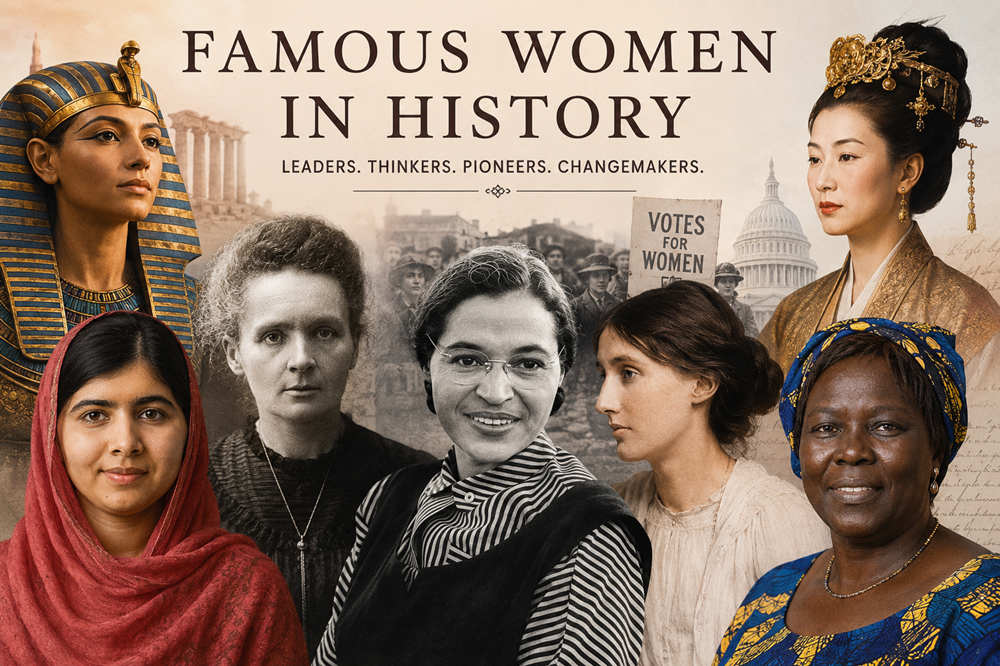
Women have shaped history in every era. They ruled kingdoms, wrote important books, made scientific discoveries, led movements, fought injustice, and changed how people understood the world. Some became famous during their lifetimes. Others were ignored, misunderstood, or recognized much later.
This guide highlights a selection of famous women from different regions, time periods, and fields. It is not a complete list of every important woman in history. Instead, it gives readers a useful starting point for understanding how women helped shape politics, science, literature, freedom movements, education, and global change.
Ancient and Early Women Who Shaped History
Hatshepsut
Hatshepsut was one of ancient Egypt’s most powerful female rulers. She began as a regent for her young stepson, Thutmose III, but later took on the full role and symbols of a pharaoh. In a society where kingship was usually male, this was a remarkable step.
Her reign is often remembered for stability, trade, and major building projects. One of her most famous monuments was her mortuary temple at Deir el-Bahri, near Thebes. Hatshepsut’s rule helps students see that political power in the ancient world could sometimes be more flexible than people assume, even in a strongly male-centered royal system.
Cleopatra VII
Cleopatra VII was the last active ruler of the Ptolemaic Kingdom of Egypt. She ruled during a dangerous time when Rome was becoming the strongest power in the Mediterranean world. Her political life was closely tied to Roman leaders Julius Caesar and Mark Antony, but Cleopatra should not be remembered only through romance or legend.
She was a ruler working to protect Egypt’s independence in a changing world. Cleopatra used diplomacy, alliances, language, and royal image-making to strengthen her position. Her death in 30 BCE marked the end of Ptolemaic rule and the beginning of Egypt’s life as a Roman province.
Boudica
Boudica was queen of the Iceni, a people who lived in what is now eastern England. Around 60 or 61 CE, she led a major revolt against Roman rule after Roman officials abused her family and tried to take control of Iceni lands.
Her rebellion attacked several Roman settlements before it was finally defeated. Although Boudica did not win, she became a lasting symbol of resistance against empire. Her revolt also reminds readers that Roman expansion was not simply a story of roads, cities, and armies. It was also a story of conquest, local resistance, and violence.
Women Leaders and Thinkers of the Medieval and Early Modern World
Wu Zetian
Wu Zetian was the only woman in Chinese history to rule as emperor in her own name. She rose to power during the Tang dynasty and later founded her own Zhou dynasty. Her path to power was unusual, complicated, and controversial, but it required remarkable political skill.
Wu Zetian used court alliances, government reforms, religious symbolism, and administrative talent to strengthen her rule. Historians have debated her legacy for centuries. Some older accounts described her harshly, while more recent scholarship has paid closer attention to her ability as a ruler in a difficult political world.
Murasaki Shikibu
Murasaki Shikibu was a Japanese writer and court lady during the Heian period. She is best known as the author of The Tale of Genji, a major work of Japanese literature often described as one of the world’s earliest novels.
Her writing gives readers a detailed look at court life, relationships, status, beauty, emotion, and power in Heian Japan. Murasaki’s importance is not only that she wrote a famous book. Her work also preserves the inner life of a society, including the feelings, limits, and choices of people living inside strict social rules.
Joan of Arc
Joan of Arc was a young French peasant girl who became a major figure during the Hundred Years’ War. She believed she had been called by God to help France. In 1429, she helped inspire French forces during the relief of Orléans, a victory that boosted French morale.
Joan was later captured, put on trial, and burned at the stake in 1431. She was only about nineteen years old. Over time, she became a national heroine of France and a saint in the Roman Catholic Church. Her life is often studied because it brings together religion, war, politics, gender expectations, and public memory.
Queen Nzinga
Queen Nzinga ruled the kingdoms of Ndongo and Matamba in what is now Angola during the 1600s. She lived during a period of Portuguese expansion and the growth of the Atlantic slave trade.
Nzinga is remembered for her diplomacy, military strategy, and ability to build alliances. She negotiated with European powers, resisted Portuguese influence, and worked to protect her people’s political independence. Her life is an important part of African history and Atlantic world history because it shows how African leaders responded to colonial pressure with strategy, adaptation, and resistance.
Women Who Changed Ideas, Literature, and Education
Mary Wollstonecraft
Mary Wollstonecraft was an English writer and one of the most important early advocates for women’s education and equality. Her 1792 book A Vindication of the Rights of Woman argued that women were not naturally less intelligent than men, but were often made weaker by poor education and limited opportunities.
Her ideas were bold for her time. Wollstonecraft believed that women should be educated as rational human beings, not trained only to be pleasing or dependent. Her work later became an important part of the history of feminist thought.
Sor Juana Inés de la Cruz
Sor Juana Inés de la Cruz was a writer, scholar, and nun in colonial Mexico, then part of New Spain. She became known for her poetry, plays, essays, and deep learning at a time when women’s education was often restricted.
Sor Juana defended women’s right to study and think seriously. Her life connects education, religion, gender, and colonial society. She is remembered as one of the great literary figures of the Spanish-speaking world and an important voice for women’s intellectual life.
Jane Austen
Jane Austen was an English novelist whose books are still widely read today. Her novels, including Pride and Prejudice, Sense and Sensibility, and Emma, explored family, class, marriage, manners, money, and women’s choices.
Austen’s writing may seem quiet compared with stories of war or revolution, but her novels carefully studied the social rules that shaped women’s lives. She showed how marriage could be emotional, social, and economic at the same time. Her work remains important because it helps readers understand everyday power in family and society.
Women in Science, Medicine, and Discovery
Marie Curie
Marie Curie was a scientist known for her pioneering work on radioactivity. She became the first woman to win a Nobel Prize and later won a second Nobel Prize in a different scientific field. Readers can learn more about her 1903 award through the official Nobel Prize biography of Marie Curie.
Curie worked with radioactive elements at a time when the dangers of radiation were not fully understood. Her discoveries opened new paths in science, including later medical uses of radiation. She is remembered for her brilliance, persistence, and influence in a scientific world that often made recognition difficult for women.
Ada Lovelace
Ada Lovelace was an English mathematician connected to Charles Babbage’s Analytical Engine, an early design for a mechanical computing machine. In 1843, she wrote notes that included a method for the machine to calculate Bernoulli numbers.
Because of this work, Lovelace is often called the first computer programmer. That title can be debated depending on how people define a computer program, but her importance is clear. She understood that such a machine might do more than simple arithmetic. Her ideas helped later generations see computing as a tool for symbols, patterns, and complex operations.
Rosalind Franklin
Rosalind Franklin was a British scientist whose X-ray crystallography work helped reveal the structure of DNA. While working at King’s College London, she helped produce important images of DNA molecules, including Photograph 51.
Franklin’s data helped other scientists build the first accurate model of DNA’s double-helix structure. For many years, her role was not fully recognized in popular accounts of the discovery. Today, she is remembered as a careful and important scientist whose work contributed to one of the biggest breakthroughs in modern biology.
Women Who Fought for Freedom and Civil Rights
Sojourner Truth
Sojourner Truth was born into slavery in New York as Isabella Baumfree. After gaining her freedom, she became a powerful speaker, abolitionist, and advocate for women’s rights.
Truth spoke from personal experience about slavery, freedom, faith, and equality. She challenged the idea that women were weak or incapable, especially by pointing to the strength and labor of Black women. Her activism connects two major reform movements in American history: the fight against slavery and the fight for women’s rights.
Harriet Tubman
Harriet Tubman escaped slavery and then repeatedly risked her life to help others escape through the Underground Railroad. She became known as “Moses” because she guided enslaved people toward freedom.
Tubman also served during the Civil War as a nurse, scout, and spy for the Union. Her courage was practical, not symbolic. She planned routes, avoided danger, gathered information, and acted even when capture could have meant death. Her work is central to the history of slavery, resistance, and freedom in the United States.
Emmeline Pankhurst
Emmeline Pankhurst was a British suffrage leader who helped organize the campaign for women’s voting rights in the United Kingdom. She and other suffragettes used direct action to draw attention to the fact that women were denied political representation.
Pankhurst’s methods were controversial, but her movement helped make women’s suffrage impossible to ignore. Her career shows that rights are often won through long campaigns, public pressure, organization, and sacrifice.
Rosa Parks
Rosa Parks is often remembered for refusing to give up her bus seat to a white passenger in Montgomery, Alabama, in 1955. That act helped spark the Montgomery Bus Boycott, a major event in the U.S. civil rights movement.
But Parks was not simply a tired passenger who made a sudden decision. According to the National Park Service biography of Rosa Parks, she had been secretary of the local NAACP for years before the boycott. That background matters because major historical moments often grow out of long periods of organizing, planning, and courage.
Women Who Shaped Modern Politics and Global Change
Eleanor Roosevelt
Eleanor Roosevelt was First Lady of the United States from 1933 to 1945, but her influence went far beyond that role. She traveled widely, wrote, spoke publicly, supported social reform, and became an important advocate for human rights.
After World War II, Roosevelt served at the United Nations and helped guide the creation of the Universal Declaration of Human Rights. Her work helped shape a global language for human dignity, freedom, and basic rights after the destruction of the war.
Indira Gandhi
Indira Gandhi was India’s first female prime minister and one of the most powerful political leaders in modern Indian history. She led the country during periods of war, social change, political tension, and economic difficulty.
Her legacy is complex. She is remembered as a strong and skilled political leader, but also as a controversial one, especially because of the Emergency period from 1975 to 1977, when civil liberties were restricted and political opponents were arrested. Studying Indira Gandhi helps readers understand both leadership and the dangers of concentrated political power.
Wangari Maathai
Wangari Maathai was a Kenyan environmental and political activist who founded the Green Belt Movement. The movement encouraged tree planting, environmental protection, women’s participation, and community action.
Maathai connected environmental problems to democracy, poverty, and human rights. In 2004, she became the first African woman to receive the Nobel Peace Prize. Her work showed that environmental history is also social history. Protecting land, forests, and water can be tied to justice, political freedom, and everyday survival.
Malala Yousafzai
Malala Yousafzai is a Pakistani education activist who became known around the world after speaking out for girls’ education under Taliban pressure in Pakistan’s Swat Valley. In 2012, she survived an assassination attempt.
Malala continued her advocacy and became the youngest person to receive the Nobel Peace Prize in 2014. Her place in modern history connects education, gender equality, violence, media, and global human rights. She remains a symbol of the belief that education is not a privilege for a few, but a right for all children.
Quick Timeline of Famous Women in History
| Person | Approximate Time Period | Main Significance |
|---|---|---|
| Hatshepsut | 15th century BCE | Female pharaoh of ancient Egypt known for power, trade, and building projects |
| Cleopatra VII | 1st century BCE | Last active ruler of Ptolemaic Egypt |
| Boudica | 1st century CE | Led a major revolt against Roman rule in Britain |
| Murasaki Shikibu | Late 10th to early 11th century | Author of The Tale of Genji |
| Joan of Arc | 15th century | French heroine of the Hundred Years’ War |
| Queen Nzinga | 17th century | African ruler who resisted Portuguese expansion |
| Mary Wollstonecraft | 18th century | Early advocate for women’s education and rights |
| Sojourner Truth | 19th century | Abolitionist and women’s rights advocate |
| Harriet Tubman | 19th century | Underground Railroad conductor and Civil War figure |
| Marie Curie | 19th to 20th century | Scientist known for research on radioactivity |
| Rosa Parks | 20th century | Civil rights activist connected to the Montgomery Bus Boycott |
| Wangari Maathai | 20th to 21st century | Environmental and democracy activist |
| Malala Yousafzai | 21st century | Global advocate for girls’ education |
Common Themes in Their Stories
These women lived in different places and centuries, but several common themes appear across their lives. One is access to education. Writers and thinkers such as Sor Juana, Mary Wollstonecraft, Murasaki Shikibu, and Ada Lovelace show how powerful learning could be, especially when women were discouraged from serious study.
Another theme is political power. Hatshepsut, Cleopatra, Wu Zetian, Queen Nzinga, and Indira Gandhi all held authority in worlds where women’s leadership was often questioned. Their experiences show that leadership can involve diplomacy, strategy, public image, reform, and controversy.
Resistance is also central to this history. Boudica, Harriet Tubman, Sojourner Truth, Rosa Parks, Wangari Maathai, and Malala Yousafzai challenged systems that limited freedom or dignity. Their actions remind readers that history is not only shaped by rulers and governments. It is also shaped by people who refuse to accept injustice.
Why Some Women Were Left Out of History
Many women were left out of older history books because of the societies they lived in and the way history was recorded. For a long time, historians often focused on wars, kings, presidents, empires, and formal politics. Since women were frequently excluded from official power, their work was easier to overlook.
Some women’s writings were not preserved. Some discoveries were credited mainly to men. Many women worked in homes, communities, schools, churches, farms, hospitals, or reform groups where their labor shaped society but did not always appear in official records.
This does not mean women were absent from history. It means readers have to look more carefully at the sources, ask better questions, and pay attention to the many forms of influence people can have.