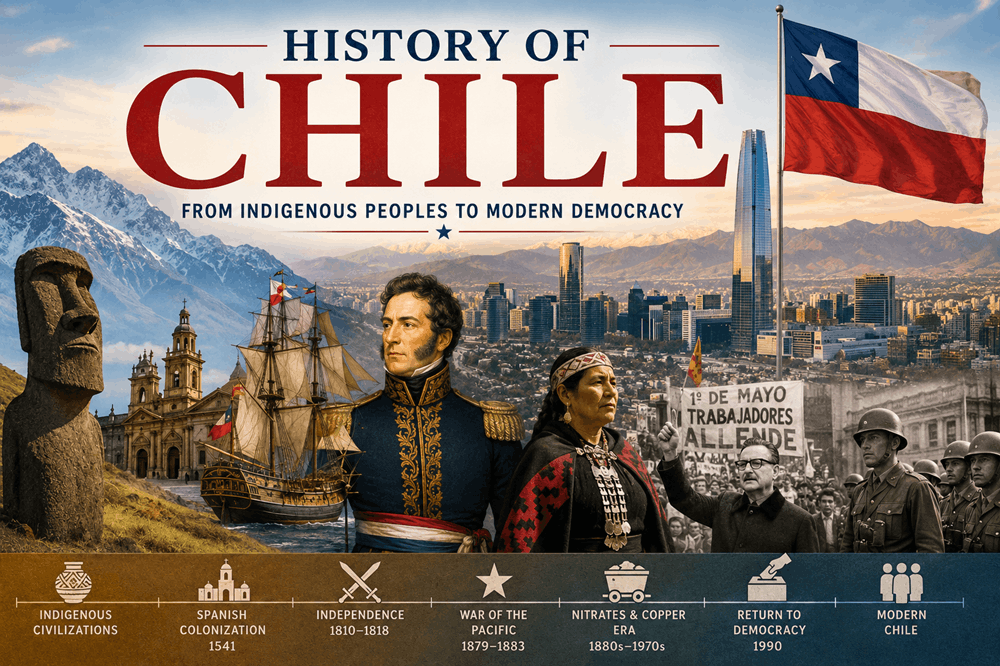
Chile’s history is shaped by geography, Indigenous resistance, Spanish colonization, republican politics, military conflict, economic change, dictatorship, and democracy. Stretching along the Pacific coast of South America, Chile developed in a narrow land of deserts, valleys, mountains, forests, and ports. Its location helped shape how people lived, traded, fought, governed, and imagined the nation.
This study guide gives a clear overview of Chile’s history, from Indigenous societies and Spanish conquest to independence, the rise of the republic, the Pinochet dictatorship, and the country’s modern democratic era.
Key Facts About Chile’s History
- Region: Western South America, along the Pacific coast
- Important Indigenous peoples: Mapuche, Aymara, Atacameño, Diaguita, Rapa Nui, and others
- Spanish conquest: Began in the 16th century
- Independence period: Early 1800s
- Major 19th-century conflict: War of the Pacific
- Major 20th-century turning point: 1973 military coup
- Dictatorship: Augusto Pinochet’s military rule, 1973–1990
- Modern period: Democratic rule, economic growth, social reform debates, and constitutional conflict
Chile Before Spanish Colonization
Long before Europeans arrived, the region now called Chile was home to many Indigenous communities. These groups lived in very different environments, from the dry northern desert to the fertile central valleys, the rainy south, the Andes, and the islands of the Pacific.
In the north, peoples such as the Aymara and Atacameño developed farming, herding, trade, and settlement patterns shaped by desert and highland conditions. In central and southern Chile, Mapuche communities became one of the most important Indigenous forces in the region. On Easter Island, or Rapa Nui, a separate Polynesian society developed with its own language, culture, and famous stone statues.
Chile’s Indigenous history is not just a “before colonization” chapter. Indigenous communities, especially the Mapuche, continued to shape Chilean history after Spanish conquest and remain central to modern debates about land, rights, identity, and state power.
The Mapuche and Indigenous Resistance
The Mapuche are one of the most important Indigenous peoples in Chilean history. They lived mainly in central and southern Chile and became known for their long resistance to outside control.
Before the Spanish arrived, the Inca Empire expanded into parts of northern and central Chile but did not fully conquer the Mapuche farther south. After the Spanish conquest began, Mapuche resistance became one of the strongest obstacles to colonial expansion.
The long conflict between Spanish forces and the Mapuche is often called the Arauco War. It lasted for generations and helped create a frontier zone in southern Chile. Unlike many Indigenous societies in the Americas, the Mapuche were able to preserve a significant degree of autonomy for a long time.
This resistance shaped Chile’s colonial society, military culture, land politics, and national identity. It also left a legacy of conflict that continued after independence, when the Chilean state later expanded into Mapuche territory.
Spanish Conquest and Colonial Chile
Spanish conquest in Chile began in the 16th century. Pedro de Valdivia, one of the most important Spanish conquerors in the region, founded Santiago in 1541. From there, Spanish settlers tried to build towns, control land, convert Indigenous peoples to Christianity, and connect Chile to the larger Spanish Empire.
Colonial Chile was not as wealthy as some other Spanish territories. It did not have the same level of silver wealth as Peru or Mexico. Instead, its economy relied heavily on agriculture, ranching, local trade, and frontier military activity.
Chile was also shaped by its distance from Spain’s main centers of power. The Andes separated it from much of South America, the Pacific connected it to trade routes, and the southern frontier limited Spanish expansion. These conditions made colonial Chile a frontier society with strong military, rural, and regional features.
Life in Colonial Chile
Colonial Chile had a social order based on Spanish rule, Catholic religion, landholding, race, and class. Spanish officials and landowners held much of the power. Indigenous people, mestizos, enslaved Africans, and poorer settlers had fewer rights and opportunities.
The Catholic Church played a major role in education, culture, politics, and daily life. Landed estates, known as haciendas, became important in rural areas. Many people worked as tenant laborers, servants, small farmers, artisans, soldiers, or traders.
Colonial society was unequal, but it was not frozen. Over time, local-born elites, known as criollos, became more important. These elites later played a major role in the independence movement.
Chile’s Independence Movement
Chile’s independence movement was part of the larger wave of independence struggles across Spanish America in the early 19th century.
Several forces helped push Chile toward independence. Spain’s authority weakened after Napoleon invaded the Iberian Peninsula. Local elites wanted more control over government and trade. Enlightenment ideas, resentment of Spanish restrictions, and the example of other independence movements also mattered.
Chile’s path to independence was not simple. It included political divisions, military campaigns, royalist resistance, and help from leaders such as Bernardo O’Higgins and José de San Martín. O’Higgins became one of Chile’s central independence figures and later served as Supreme Director.
Chile formally moved away from Spanish rule in the early 1800s, but independence did not immediately create a stable democracy. Like many new nations, Chile had to decide how power would be organized, who would govern, and what kind of republic it would become.
The Early Republic
After independence, Chile entered a period of political conflict and institution-building. Leaders debated the balance between central authority and regional power, conservative and liberal ideas, church influence, military leadership, and the role of the elite.
By the 1830s, Chile developed a relatively strong central state compared with many of its neighbors. Conservative leaders helped build institutions that emphasized order, authority, and political stability. This did not mean full democracy for all people. Voting rights were limited, and the political system favored elite groups.
Still, Chile’s early republic gained a reputation for institutional continuity. Its government was often more stable than many other Latin American republics during the 19th century.
The War of the Pacific
One of the most important events in 19th-century Chilean history was the War of the Pacific, fought from 1879 to 1883. Chile fought against Peru and Bolivia in a conflict tied to control of valuable nitrate-rich territory in the Atacama Desert.
Chile won the war and gained territory. Bolivia lost its access to the Pacific coast, becoming landlocked. The victory strengthened Chile’s regional position and gave it control over valuable nitrate resources.
The war had long-term consequences. It changed borders, shaped national identity, deepened regional rivalries, and connected Chile’s economy more closely to export wealth from the north.
Nitrates, Copper, and Economic Change
Chile’s economy has often depended heavily on natural resources. In the late 19th and early 20th centuries, nitrate exports became central to national wealth. Nitrates were used in fertilizers and explosives, making them valuable in global markets.
Later, copper became even more important. Chile developed into one of the world’s major copper producers. Copper exports helped fund the state, attract foreign investment, and shape labor politics.
Resource wealth brought growth, but it also created vulnerability. When global demand changed or prices fell, Chile felt the effects. This pattern became a recurring issue in Chilean economic history: natural resources could bring money and modernization, but also dependence and inequality.
Politics and Social Reform in the 20th Century
By the 20th century, Chile was becoming more urban, organized, and politically divided. Workers, miners, students, middle-class reformers, socialists, communists, Christian democrats, conservatives, and business groups all competed for influence.
Chile developed a strong political party system. Elections mattered, public debate was active, and social reform became a major issue. At the same time, many Chileans faced poverty, poor housing, unequal land ownership, and limited access to education and health care.
Reform movements grew because many people believed the old order did not serve the majority. Land reform, labor rights, education, housing, national control of resources, and economic justice became central political questions.
Salvador Allende and Popular Unity
In 1970, Salvador Allende was elected president as the candidate of the Popular Unity coalition. He became one of the first Marxist leaders in the world to come to power through democratic elections.
Allende’s government sought major changes. It expanded social programs, deepened land reform, increased state control over important industries, and nationalized copper. Supporters saw these policies as a path toward social justice and national independence from foreign economic power.
Opponents feared that Allende was leading Chile toward socialism, economic breakdown, and political authoritarianism. His government faced inflation, shortages, strikes, political polarization, business resistance, and pressure from foreign interests, including the United States during the Cold War.
By 1973, Chile was deeply divided. The crisis ended in a military coup.
The 1973 Coup and Pinochet Dictatorship
On September 11, 1973, Chile’s armed forces overthrew Salvador Allende’s government. General Augusto Pinochet became the central figure of the military regime that followed.
The dictatorship ruled from 1973 to 1990. It dissolved Congress, restricted political parties, censored media, and used state violence against opponents. Thousands of people were killed, disappeared, imprisoned, tortured, or forced into exile.
The Pinochet regime also transformed Chile’s economy. It adopted free-market policies, privatized many state-owned industries, reduced trade barriers, weakened unions, and changed social welfare systems. Supporters argued that these reforms helped create long-term growth. Critics point to human rights abuses, inequality, repression, and the social costs of rapid economic restructuring.
The dictatorship remains one of the most painful and debated periods in Chilean history.
The Return to Democracy
Chile’s transition back to democracy began in the late 1980s. In a 1988 plebiscite, voters rejected another term for Pinochet. Elections followed, and civilian democratic government returned in 1990 under President Patricio Aylwin.
The return to democracy did not erase the dictatorship’s legacy. Chile had to deal with human rights investigations, constitutional limits inherited from military rule, economic inequality, and arguments over memory and justice.
Even so, Chile became one of Latin America’s more stable democratic countries in the decades after 1990. It saw economic growth, poverty reduction, and expanding international ties, while also facing demands for deeper social reform.
Modern Chile
Modern Chile is often described as one of Latin America’s stronger economies, but its success has come with tensions. The country has a developed mining sector, open trade, strong institutions in many areas, and a large middle class. At the same time, many Chileans have criticized inequality, expensive education, pension problems, health care gaps, and the high cost of living.
Large protests in the 2010s showed that many citizens wanted a new social contract. Constitutional reform became a major national debate. Voters rejected proposed new constitutions, showing that Chile’s democratic arguments are still active and unresolved.
Today, Chile’s history continues to shape debates about Indigenous rights, economic fairness, political memory, environmental protection, education, and the role of the state.
Why Chile’s History Matters
Chile’s history matters because it shows how geography, resources, Indigenous resistance, colonial rule, democracy, dictatorship, and social reform can shape a nation over centuries.
It also shows that stability and conflict can exist side by side. Chile built strong institutions in some periods, but also experienced deep inequality, military rule, and painful political division.
For students, Chile is a useful case study in Latin American history. Its past connects major themes such as Spanish colonization, Indigenous resistance, independence, resource economies, Cold War politics, dictatorship, human rights, and democratic transition.
Quick Timeline of Chilean History
- Before 1500s: Indigenous societies develop across the region now known as Chile.
- 1541: Pedro de Valdivia founds Santiago.
- 1500s–1600s: Spanish conquest expands, while Mapuche resistance limits colonial control in the south.
- 1810: Chile begins its independence process.
- 1818: Chile secures independence from Spain.
- 1830s: A stronger central state takes shape in the early republic.
- 1879–1883: Chile fights Peru and Bolivia in the War of the Pacific.
- Late 1800s–early 1900s: Nitrate wealth shapes the economy and state finances.
- 1970: Salvador Allende is elected president.
- 1973: The military overthrows Allende’s government.
- 1973–1990: Augusto Pinochet’s military dictatorship rules Chile.
- 1988: Chileans vote against extending Pinochet’s rule.
- 1990: Civilian democratic government returns.
- 2010s–2020s: Social protests and constitutional debates shape modern Chilean politics.
Key Terms
Mapuche: An Indigenous people of central and southern Chile known for long resistance to Inca, Spanish, and later Chilean state control.
Arauco War: The long conflict between Spanish colonists and Mapuche communities in southern Chile.
Criollos: People of Spanish descent born in the Americas, many of whom became important in independence movements.
War of the Pacific: The 1879–1883 war in which Chile fought Peru and Bolivia and gained nitrate-rich territory.
Popular Unity: The left-wing coalition that supported Salvador Allende’s presidency.
Pinochet dictatorship: Chile’s military regime under Augusto Pinochet from 1973 to 1990.
Plebiscite: A direct vote by citizens on a major political question, such as the 1988 vote on whether Pinochet should remain in power.