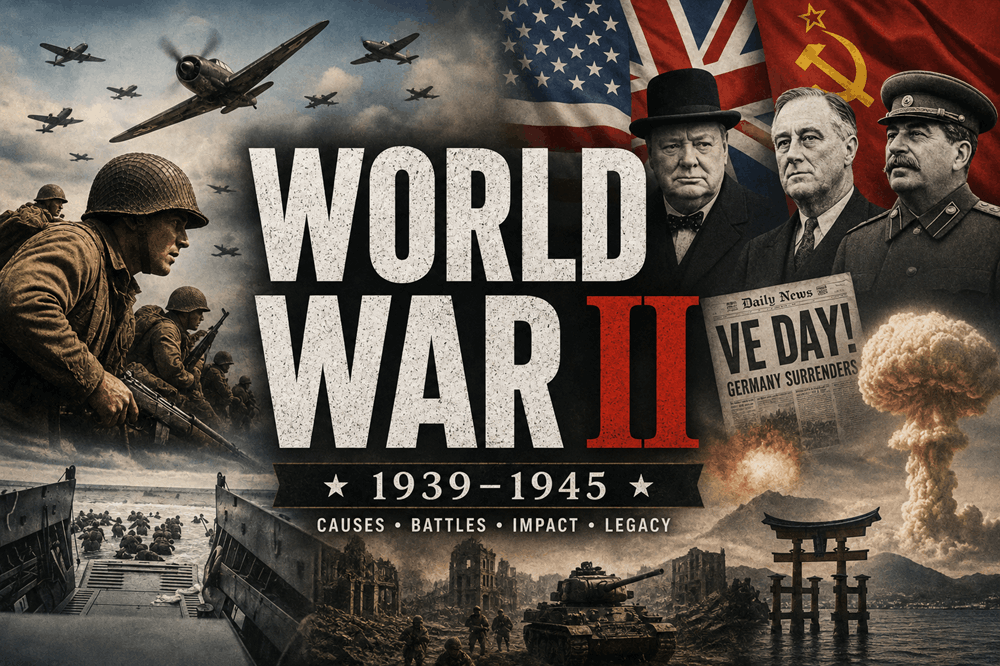
World War II was the largest and most destructive war of the 20th century. Fought mainly from 1939 to 1945, it involved countries across Europe, Asia, Africa, the Pacific, and the Americas. The war changed borders, destroyed cities, exposed the horror of genocide, ended empires, and reshaped global power for decades.
At its simplest, World War II was fought between the Axis powers, led by Germany, Italy, and Japan, and the Allied powers, which included Britain, China, the Soviet Union, the United States, France/Free France, and many other nations. But the war was more than a military conflict. It was also a struggle over empire, race, ideology, resources, dictatorship, democracy, and the future of the world order.
Key Facts About World War II
- Dates: 1939–1945, though Japan’s war in Asia began earlier
- Main sides: Axis powers vs. Allied powers
- Main Axis powers: Germany, Italy, and Japan
- Main Allied powers: Britain, China, the Soviet Union, the United States, and France/Free France
- Main theaters: Europe, North Africa, East Asia, the Atlantic, and the Pacific
- Major turning points: Battle of Britain, Pearl Harbor, Midway, Stalingrad, D-Day, and the Soviet advance on Berlin
- Outcome: Allied victory
- Long-term impact: United Nations, Cold War, decolonization, nuclear age, and a new global balance of power
What Was World War II?
World War II was a global conflict that grew out of the unresolved problems of World War I, the Great Depression, the rise of aggressive dictatorships, and the failure of international peace efforts during the 1930s.
The war officially began in Europe on September 1, 1939, when Nazi Germany invaded Poland. Britain and France declared war on Germany shortly afterward. In Asia, however, major fighting had already begun earlier. Japan invaded Manchuria in 1931 and launched a wider war against China in 1937.
For that reason, many study guides use 1939–1945 as the main date range for World War II, while also noting that Japan’s war in Asia began before the wider global conflict.
By the early 1940s, conflicts in Europe and Asia had merged into a worldwide war. Germany sought control over Europe. Japan aimed to dominate East Asia and the Pacific. Italy pursued empire in the Mediterranean and Africa. The Allies fought to stop Axis expansion and eventually demanded unconditional surrender.
Main Causes of World War II
World War II did not happen because of one single event. Several causes built up over time.
The Treaty of Versailles
After World War I, the Treaty of Versailles punished Germany by forcing it to accept blame for the war, pay reparations, give up territory, and limit its military. Many Germans viewed the treaty as humiliating. Adolf Hitler later used anger over Versailles to gain support for Nazi expansion.
The Great Depression
The global economic crisis of the 1930s caused unemployment, poverty, and political instability. In several countries, people lost faith in democratic governments. Extremist movements promised strength, order, jobs, and national renewal.
The Rise of Fascism and Militarism
Fascist governments in Germany and Italy promoted nationalism, dictatorship, military strength, and obedience to the state. In Japan, military leaders gained increasing influence and pushed for expansion across Asia.
Appeasement
Britain and France tried to avoid another major war by giving in to some of Hitler’s demands during the 1930s. This policy, known as appeasement, failed because it encouraged more aggression instead of stopping it.
Expansion by Germany, Italy, and Japan
Germany reoccupied the Rhineland, annexed Austria, took the Sudetenland, and then invaded Poland. Italy invaded Ethiopia and later entered the war on Germany’s side. Japan expanded into Manchuria, China, Southeast Asia, and the Pacific. These actions made a larger war increasingly likely.
The Axis Powers
The Axis powers were the main aggressors in World War II. Their goals were not identical, but each wanted to expand power through conquest.
- Germany: Led by Adolf Hitler and the Nazi Party, Germany sought domination in Europe and promoted a racist ideology based on conquest, antisemitism, and the idea of German racial superiority.
- Italy: Led by Benito Mussolini, Fascist Italy wanted to build a new empire and gain influence in the Mediterranean and Africa.
- Japan: Japan’s military leaders wanted control over East Asia and the Pacific, including access to oil, raw materials, and strategic territory.
The Axis powers used military force to revise the global order. Their expansion created war across continents.
The Allied Powers
The Allied powers formed gradually as Axis aggression spread. Britain and France entered the war after Germany invaded Poland. China had already been resisting Japan. The Soviet Union joined the Allied side after Germany invaded it in 1941. The United States entered the war after Japan attacked Pearl Harbor on December 7, 1941.
The Allies did not all share the same political system or long-term goals. Britain and the United States were democratic powers. The Soviet Union was a communist dictatorship. China was fighting a long and brutal war against Japan. France was defeated in 1940, but Free French forces and resistance groups continued the fight. What united the Allies was the need to defeat the Axis powers.
World War II Timeline
- 1931: Japan invades Manchuria.
- 1937: Japan launches a wider war against China.
- 1938: Germany annexes Austria and takes the Sudetenland.
- September 1, 1939: Germany invades Poland.
- September 3, 1939: Britain and France declare war on Germany.
- 1940: Germany conquers much of Western Europe, including France.
- 1940: Britain resists German air attacks during the Battle of Britain.
- June 1941: Germany invades the Soviet Union.
- December 7, 1941: Japan attacks Pearl Harbor.
- 1942: The United States defeats Japan at Midway.
- 1942–1943: The Soviet Union defeats Germany at Stalingrad.
- June 6, 1944: Allied forces land in Normandy on D-Day.
- May 8, 1945: Germany surrenders; Victory in Europe Day.
- August 1945: The United States drops atomic bombs on Hiroshima and Nagasaki.
- September 2, 1945: Japan formally signs surrender documents, ending World War II.
The War in Europe
In Europe, Germany’s early victories shocked the world. Using fast-moving tactics often called blitzkrieg, German forces defeated Poland, Denmark, Norway, Belgium, the Netherlands, Luxembourg, and France. By the summer of 1940, Britain stood largely alone against Nazi Germany in Western Europe.
The Battle of Britain became one of the first major turning points. Germany tried to weaken Britain through air attacks, but the Royal Air Force resisted. Hitler postponed plans for invasion, and Britain remained in the war.
In 1941, Germany invaded the Soviet Union in Operation Barbarossa. This opened the Eastern Front, the largest and deadliest front of the war. The fighting between Germany and the Soviet Union involved enormous armies, extreme conditions, and massive civilian suffering.
The Battle of Stalingrad became a decisive moment. German forces failed to capture the city, and the Soviet victory marked the beginning of a long German retreat in the east.
The Battle of the Atlantic
The Battle of the Atlantic was one of the longest and most important campaigns of World War II. German submarines, known as U-boats, tried to cut off Allied shipping across the Atlantic Ocean. Allied convoys carried food, weapons, fuel, troops, and supplies between North America and Europe.
Keeping the Atlantic sea lanes open was critical. Britain depended on imported supplies to survive, and the Allies needed the ocean routes to prepare for future offensives in Europe. The struggle involved submarines, escort ships, aircraft, radar, codebreaking, and convoy tactics.
The Atlantic campaign did not have one dramatic battlefield like Stalingrad or Normandy, but it helped decide whether the Allies could keep fighting and eventually launch a successful invasion of Western Europe.
The War in Asia and the Pacific
The Pacific War centered on Japan’s attempt to build a large empire across East Asia and the Pacific. Japan had already occupied Manchuria and was fighting in China before the wider global war expanded.
On December 7, 1941, Japan attacked the U.S. naval base at Pearl Harbor in Hawaii. The attack brought the United States into World War II. Japan also attacked British, Dutch, and American territories across Asia and the Pacific.
At first, Japan won many victories. It captured the Philippines, Malaya, Singapore, Hong Kong, and large parts of Southeast Asia. But Japan’s advance was checked at the Battle of Midway in June 1942, when the United States destroyed several Japanese aircraft carriers and shifted momentum in the Pacific.
The Pacific War then became a long campaign of island battles, naval warfare, air power, and brutal fighting. Battles such as Guadalcanal, Iwo Jima, and Okinawa showed how costly victory would be.
Major Turning Points
Several events changed the direction of World War II.
- Battle of Britain: Britain survived German air attacks and remained a base for future Allied operations.
- Pearl Harbor: The attack brought the United States fully into the war.
- Battle of Midway: The United States weakened Japan’s naval power and stopped its Pacific expansion.
- Battle of Stalingrad: Germany suffered a major defeat and began losing ground on the Eastern Front.
- D-Day: Allied troops landed in Normandy and opened a major western front against Germany.
- Fall of Berlin: Soviet forces captured Berlin, leading to Germany’s surrender in Europe.
None of these turning points won the war alone. Together, they shifted momentum toward the Allies.
The Holocaust and Civilian Suffering
World War II was not only a military conflict. It was also a human catastrophe.
The Holocaust was the systematic murder of six million Jews by Nazi Germany and its collaborators. The Nazis also targeted Roma people, disabled people, Polish civilians, Soviet prisoners of war, political opponents, gay men, and others considered enemies or “undesirable” by the regime.
As Germany conquered more territory, Nazi persecution became more radical. Ghettos, mass shootings, forced labor, deportations, and extermination camps became part of a vast system of genocide.
Civilians suffered across the world. Cities were bombed. Millions were displaced. Food shortages, forced labor, massacres, occupation, disease, and military violence affected people far from the front lines.
How the Allies Won
The Allies won World War II because they combined military pressure, industrial production, manpower, intelligence, strategy, and global cooperation.
The United States became a massive producer of ships, planes, tanks, weapons, food, and supplies. The Soviet Union absorbed and then pushed back Germany’s largest land invasion. Britain served as a critical base for air and naval warfare. China tied down large numbers of Japanese forces in Asia.
Allied cooperation was not always smooth. The United States, Britain, and the Soviet Union disagreed on many issues. Still, they coordinated enough to pressure the Axis from several directions at once.
Germany, Italy, and Japan faced a serious strategic problem: they were fighting too many enemies across too much territory. Their early victories created large empires that became difficult to defend.
How World War II Ended
In Europe, the war ended after Allied forces advanced from both east and west. Soviet troops pushed into Germany from the east, while American, British, Canadian, and other Allied forces advanced from the west after D-Day.
Adolf Hitler died by suicide in Berlin in April 1945. Germany surrendered in May 1945. May 8 became known as Victory in Europe Day, or V-E Day.
In the Pacific, Japan continued fighting after Germany’s defeat. In August 1945, the United States dropped atomic bombs on Hiroshima and Nagasaki. The Soviet Union also declared war on Japan and invaded Japanese-held territory in Manchuria. Japan announced surrender in August and formally signed surrender documents aboard the USS Missouri on September 2, 1945.
Consequences of World War II
World War II changed the world in ways that lasted far beyond 1945.
The United Nations
The United Nations was created after the war to promote international cooperation and prevent future global conflicts. It replaced the weaker League of Nations.
The Cold War
The United States and the Soviet Union emerged as the two strongest powers. Their rivalry shaped world politics for decades. This conflict became known as the Cold War.
The Division of Germany
Germany was defeated, occupied, and divided. Berlin also became divided. These divisions became major symbols of the Cold War.
Decolonization
European empires weakened after the war. In Asia, Africa, and the Middle East, independence movements gained strength. Many colonies became independent in the decades that followed.
The Nuclear Age
The atomic bomb changed warfare and global politics. After 1945, nuclear weapons became central to international power and fear.
War Crimes Trials
After the war, Nazi leaders were tried at Nuremberg, and Japanese leaders were tried in Tokyo. These trials helped develop modern ideas about war crimes, crimes against humanity, and international justice.
Why World War II Still Matters
World War II shaped the modern world. It changed borders, governments, alliances, economies, and ideas about human rights. It also showed how dangerous dictatorship, racism, militarism, and unchecked aggression can become.
The war still raises important questions. How should countries respond to invasion? What happens when democracies ignore threats for too long? How should societies remember mass violence? What responsibilities do nations have after war?
Studying World War II is not just about memorizing battles and dates. It is about understanding how political choices, economic crises, propaganda, prejudice, and military power can combine to produce disaster.
Key Terms
Axis Powers: The alliance led by Germany, Italy, and Japan during World War II.
Allied Powers: The coalition that fought against the Axis, including Britain, China, the Soviet Union, the United States, France/Free France, and many others.
Blitzkrieg: A German military strategy using fast-moving tanks, aircraft, and infantry to overwhelm enemies quickly.
Battle of the Atlantic: The long naval campaign in which Allied convoys tried to protect shipping from German submarines and warships.
Holocaust: The Nazi genocide that murdered six million Jews and millions of other victims.
D-Day: The Allied invasion of Normandy on June 6, 1944.
V-E Day: Victory in Europe Day, marking Germany’s surrender in May 1945.
V-J Day: Victory over Japan Day, marking Japan’s surrender in 1945.
Cold War: The postwar rivalry between the United States and the Soviet Union.