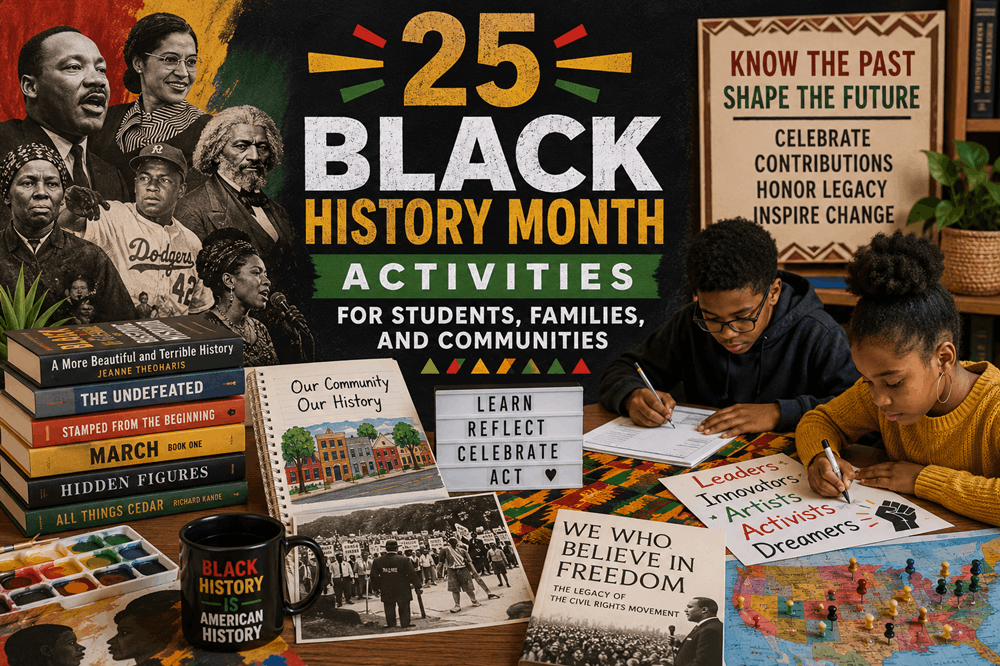
Black History Month activities should help people learn real history, ask better questions, and connect the past to everyday life. The best activities go beyond memorizing names. They use stories, primary sources, books, music, art, local history, museums, and conversation to show how Black history has shaped the United States and the wider world.
How to Choose Meaningful Black History Month Activities
Black History Month began as a way to make Black history visible in schools, public life, and national memory. It grew from the work of historian Carter G. Woodson and the organization now known as the Association for the Study of African American Life and History, often called ASALH. What began as Negro History Week in 1926 later expanded into Black History Month.
Woodson is often called the “father of Black history” because he pushed schools, publishers, and public institutions to recognize Black achievement and Black historical experience as part of American history.
For 2026, ASALH has chosen the theme “A Century of Black History Commemorations,” marking 100 years since the first national Negro History Week. That theme is a helpful reminder: Black History Month is not just about one month of activities. It is part of a long effort to teach, preserve, and honor Black history.
When choosing activities, start with one goal. Do you want students to study primary sources? Learn about local Black history? Read biographies? Explore music and art? Understand civil rights? Connect family stories to larger history? A focused activity is usually better than a random list of facts.
Good Black History Month activities should do at least one of these things:
- Teach accurate history with context.
- Highlight Black voices, leadership, creativity, and community life.
- Use real sources, stories, images, music, documents, or artifacts.
- Include more than the same few famous names.
- Connect Black history to American history, world history, and local history.
- Encourage reflection without putting unfair pressure on Black students to explain everything.
Quick Activity Ideas by Group
| Group | Good Activity Types | Helpful Focus |
|---|---|---|
| Elementary students | Picture books, music, art, timelines, simple biographies, classroom displays | Introduce real people, places, and stories in age-appropriate ways. |
| Middle school students | Primary source stations, local history maps, short research projects, group posters | Build context and help students compare different sources. |
| High school students | Document analysis, debates, oral history projects, museum-style exhibits, essay prompts | Connect Black history to law, culture, politics, economics, and social change. |
| Families | Book nights, documentaries, museum visits, family interviews, music listening sessions | Make learning part of normal conversation and shared time. |
| Community groups | Speaker events, archive projects, neighborhood history walks, public displays | Connect national history to local people, places, and memory. |
Classroom Activities for Black History Month
1. Build a Black History Timeline
Create a timeline that stretches beyond one person or one era. Include early African civilizations, the transatlantic slave trade, resistance to slavery, Reconstruction, Black education, civil rights, Black arts movements, military service, science, politics, sports, business, and modern activism.
For younger students, the timeline can use pictures and short captions. Older students can add laws, court cases, speeches, books, music, and local events. The goal is to show that Black history is not one short chapter. It is a long, complex part of history.
2. Study One Primary Source Each Week
Primary sources help students work directly with history. These can include letters, photographs, newspaper pages, speeches, oral histories, posters, maps, court records, or government documents.
The Black History Month teacher resources page brings together materials from major institutions, including the Library of Congress, National Archives, Smithsonian, National Park Service, and other cultural organizations. Teachers can choose one source each week and ask students: Who made this? When was it made? What does it show? What questions does it raise?
3. Create a Lesser-Known Figures Research Wall
Students often learn about Martin Luther King Jr., Rosa Parks, Harriet Tubman, and Frederick Douglass. These figures matter, but Black history includes many more people. Have students research lesser-known leaders, artists, scientists, soldiers, writers, inventors, athletes, educators, activists, and local community members.
Each student can create a short profile with a photo or illustration, key dates, major achievements, and one sentence explaining why the person should be remembered. The wall can grow throughout February.
4. Compare a Textbook Summary With a Primary Source
This activity works well for middle school and high school. Give students a short textbook-style paragraph about an event, then pair it with a primary source from the same period. For example, students might compare a paragraph about school desegregation with a newspaper article, photograph, court document, or student testimony.
This teaches students that history is built from evidence. It also helps them see what summaries include, what they leave out, and why firsthand records matter.
5. Map Important Places in African American History
Black history happened in neighborhoods, churches, schools, farms, courtrooms, theaters, military bases, universities, libraries, barbershops, businesses, and protest sites. Have students create a map of important places connected to African American history.
The map can be national, state-level, or local. Students can include places such as HBCUs, civil rights landmarks, Underground Railroad sites, Black-owned newspapers, historic churches, jazz clubs, museums, or local historical markers.
6. Hold a Student-Led Mini Museum Exhibit
Turn the classroom, library, hallway, or community room into a mini museum. Students can choose objects, images, documents, biographies, book covers, music, or local stories to display. Each display should include a title, short explanation, and historical context.
This activity works especially well when students have to explain their choices. It teaches curation, writing, research, and public speaking. It also helps students think about how museums decide what stories to tell.
Reading, Writing, and Research Activities
7. Read a Biography or Picture Book Together
Books are one of the easiest ways to begin. Younger students can read picture books about Black leaders, artists, scientists, athletes, and everyday families. Older students can read memoirs, essays, speeches, poems, or biographies.
After reading, ask students to answer three questions: What challenge did this person face? What choice did they make? What can we learn from their life without turning them into a perfect hero?
8. Write a One-Page Historical Profile
Have students write a short profile of one person from Black history. The profile should include where the person lived, what they did, what obstacles they faced, and why their story matters.
To avoid shallow reports, require students to use at least two sources. One should be from a trusted museum, archive, library, university, or government site if possible.
9. Create a Quote Wall With Context
Quote walls can be powerful, but only if they include context. Instead of posting a famous quote alone, students should explain who said it, when it was said, what was happening at the time, and what the speaker meant.
This keeps the activity from becoming decoration only. It turns each quote into a doorway into history.
10. Compare Two Historical Figures From Different Time Periods
Ask students to compare two people from different periods. For example, they might compare Ida B. Wells and a modern journalist, Bayard Rustin and a later organizer, or Shirley Chisholm and a current political leader.
The goal is not to say they are exactly alike. The goal is to notice patterns: activism, public speech, media, law, education, resistance, leadership, and the changing meaning of citizenship.
11. Write a Letter From the Present to the Past
Students can write a respectful letter to a historical figure, community leader, artist, soldier, writer, or activist. The letter should explain what they learned and ask thoughtful questions.
This activity works best when students first study the person’s real life. The letter should not be based on a one-sentence fact. It should show understanding of the person’s time, challenges, and work.
Art, Music, and Culture Activities
12. Explore African American Music History
Music is a powerful way to study history. Students can explore spirituals, blues, jazz, gospel, rhythm and blues, soul, funk, hip-hop, classical composition, protest music, or modern genres shaped by Black artists.
Instead of only listening, ask students to connect the music to history. What was happening when this music developed? What emotions or messages does it carry? How did Black musicians shape American and global culture?
13. Study a Black Visual Artist
Choose an artist such as Jacob Lawrence, Faith Ringgold, Augusta Savage, Alma Thomas, Romare Bearden, Gordon Parks, or Elizabeth Catlett. Students can study one artwork and answer: What do you notice? What story does it tell? What historical context helps us understand it?
The National Museum of African American History and Culture educator resources can help teachers connect objects, art, and primary sources to broader African American history and culture.
14. Create Art Inspired by a Real Historical Source
Students can create a drawing, collage, poem, poster, or digital design inspired by a real source, such as a photograph, speech, newspaper page, song, or artifact. The key is that the artwork should respond to history, not replace it.
Each student should include a short artist statement explaining the source they used and what their piece is trying to show.
15. Study Black Foodways and Family Traditions
Food can teach history when it is handled with respect and context. Students might study African American foodways, farming, migration, family recipes, Gullah Geechee culture, soul food, church meals, Black-owned restaurants, or the history of specific ingredients.
This can be a good family or community activity too. People can discuss how recipes, meals, and kitchen traditions carry memory across generations.
Local History and Community Activities
16. Research Black History in Your City or State
Black history is not only national. Every city, town, county, and state has stories worth studying. Students can research Black schools, churches, businesses, newspapers, neighborhoods, civil rights groups, military service, local leaders, artists, or athletes.
Local libraries, historical societies, public archives, museums, and university collections are good places to start. This activity helps students see that history happened near them, not only in famous places.
17. Visit a Museum, Historic Site, or Local Exhibit
A museum visit can make history feel more concrete. Visit a local Black history museum, art museum, historic home, civil rights site, cemetery, archive, or traveling exhibit. If an in-person visit is not possible, use a virtual exhibit.
Before visiting, ask students to prepare two questions. After the visit, ask them to choose one object, image, or story they want to remember and explain why.
18. Interview a Family or Community Elder
Oral history can help students understand how larger events touched real lives. Students can interview a family member, neighbor, church member, teacher, veteran, artist, business owner, or community leader.
Good questions include: What was school like when you were young? What changes have you seen in this community? Who taught you important lessons? What local history do younger people need to know?
Students should ask permission before recording or sharing any story. They should also treat personal memories with care.
19. Create a Local Black History Map
Build a map of local places connected to Black history. Include schools, churches, businesses, neighborhoods, parks, murals, protest sites, former segregation-era spaces, community centers, or historical markers.
Each location should include a short description. This can become a classroom display, digital map, walking tour, or community project.
Family Activities for Black History Month
20. Watch a Documentary and Discuss It
Families can choose an age-appropriate documentary about African American history, music, civil rights, sports, art, migration, or local history. The discussion afterward matters as much as the film.
Ask simple questions: What did we learn? What surprised us? What did this film make us want to research next? How does this history connect to today?
21. Read One Book Together During February
Choose one book and read it across the month. It can be a picture book, middle-grade biography, memoir, poetry collection, novel, or nonfiction history book. Families with children of different ages can choose one shared theme and different reading levels.
At the end of the month, each person can share one passage, image, idea, or question they want to remember.
22. Start a Family History Conversation
Black History Month can also be a time for family storytelling. Families can talk about migration, schools, work, military service, music, faith communities, food, neighborhoods, holidays, or important family objects.
These conversations do not need to be formal. They can happen at dinner, during a phone call, or while looking through old photographs. The goal is to connect personal memory with larger history.
Virtual Museum and Primary Source Activities
23. Explore the National Archives African American Heritage Resources
The National Archives African American Heritage page highlights records, programs, and online materials documenting the Black experience. Students can choose one document, photograph, or collection and explain what it reveals.
This activity works well for older students because archives teach patience. Not every source gives an easy answer. Sometimes students have to look closely, read carefully, and ask better questions.
24. Use Library of Congress Images and Primary Sources
The Library of Congress African American Heritage collection includes images showing Black experiences and achievements in the United States from the 1700s to the 2000s. Students can choose one source and write a short caption that explains what the source shows and what historical question it raises.
A useful rule: do not let students only describe what they see. Ask them to interpret it. What does this source help us understand about work, family, education, protest, creativity, military service, migration, or daily life?
25. Create a Digital Learning Board
Students, families, or community groups can create a digital board of links, images, videos, books, songs, and primary sources. Organize the board by theme: civil rights, Black artists, local history, Black scientists, sports history, literature, music, military service, or community leadership.
This can be shared with a class, homeschool group, library, church, or family. It also gives people something to return to after February ends.
Activities to Avoid or Rethink
Some activities are well meant but not very meaningful. Others can be harmful or uncomfortable. Black History Month should be engaging, but it should also be respectful.
Avoid reducing Black history to only slavery and suffering. That history must be taught honestly, but Black history also includes family life, resistance, invention, education, art, business, politics, faith, literature, military service, science, sports, and joy.
Avoid teaching only the same few famous people every year. Students should know major figures, but they should also learn about lesser-known people, local leaders, women, children, workers, artists, organizers, and communities.
Avoid crafts with no history attached. A poster, coloring page, or art activity can be useful if it connects to a real person, source, event, or cultural tradition. Without that connection, it becomes decoration instead of learning.
Avoid simulations of slavery, segregation, or racial trauma. Students do not need to act out oppression to understand it. Use age-appropriate sources, testimony, literature, discussion, and historical context instead.
Avoid asking Black students to speak for all Black people. No student should be made responsible for explaining an entire race, culture, or history to classmates.
Avoid treating Black history as separate from American history or world history. Black history is part of political history, labor history, military history, art history, education history, religious history, sports history, and local history.
Simple Black History Month Activity Plan
If you want an easy plan for February, choose one activity type for each week.
| Week | Activity Focus | Example |
|---|---|---|
| Week 1 | People and biographies | Research lesser-known figures and create short profiles. |
| Week 2 | Primary sources | Analyze photographs, letters, speeches, newspaper pages, or records. |
| Week 3 | Culture and creativity | Study music, art, literature, foodways, or performance. |
| Week 4 | Local and community history | Create a local map, interview someone, or visit a museum or exhibit. |
This plan keeps the month balanced. It includes individual lives, historical evidence, cultural expression, and local connection.
Final Takeaway
Black History Month activities should help people learn with care. The best activities are not just busywork. They help students, families, and communities study people, sources, places, and questions with respect and curiosity.
A strong activity does not need to be complicated. A good book discussion, one primary source, one local history map, one museum visit, or one thoughtful interview can teach more than a large project with little context.
Black History Month is strongest when it opens the door to deeper learning. February can begin the conversation, but Black history belongs in classrooms, homes, libraries, museums, and communities all year.